
Fitness Supplements for Beginners: What You Need and What's Hype
Written by Smart Supplements Editorial Team
Key takeaways
- Supplements account for 5-10% of results — training, nutrition, and sleep deliver the other 90%. Fix those first.
- Five supplements have strong evidence for fitness beginners: protein powder, creatine monohydrate, caffeine, magnesium, and omega-3.
- A complete evidence-based beginner stack costs €30-50/month. Anything more is optimisation, not necessity.
- Skip BCAAs, mass gainers, fat burners, and testosterone boosters — the evidence doesn't support them for beginners.
- Add one supplement every 2-4 weeks to track individual response and avoid attribution confusion.
Table of contents
Walk into any supplement store — online or physical — and you'll see 200+ products all promising to transform your body. Fat burners. Mass gainers. Testosterone boosters. Pre-workouts with ingredient lists longer than a university syllabus. The marketing is loud, the packaging is aggressive, and the implicit message is clear: you need all of this to get results.
The truth? You need about five of them. Maybe.
This guide is the one I wish existed when I started training. No hype, no affiliate-driven "top 50" lists, just an honest breakdown of what actually works, what the evidence says, and what you can safely ignore — at least until you've got a few years of consistent training under your belt.
The Honest Truth About Supplements
Let's get this out of the way first: supplements account for roughly 5-10% of your results. The other 90-95%? That comes from three things:
- Training consistently (3-5 times per week, with progressive overload)
- Eating enough protein and total calories (matched to your goal)
- Sleeping 7-9 hours per night
This isn't opinion — it's the consensus across exercise science literature. A 2018 position stand by the International Society of Sports Nutrition (ISSN) explicitly states that "supplementation should only be considered after an athlete's diet has been optimised" (Kerksick et al., 2018).
The supplement industry is worth over €40 billion globally. That's a lot of money riding on convincing you that pills and powders are essential. They're not essential. Some are helpful. A few are genuinely evidence-based. Most are marketing dressed up as science.
The food-first principle: Before spending a single euro on supplements, ask yourself: could I get this nutrient from food? In many cases, the answer is yes. Protein from eggs, chicken, legumes, and dairy. Omega-3 from fatty fish. Magnesium from nuts, seeds, and dark leafy greens. Supplements fill gaps — they don't replace meals.

That said, certain supplements have decades of research behind them, offer genuine advantages in convenience or dosing precision, and are affordable enough that the cost-benefit makes sense — even for beginners.
The 5 Supplements That Actually Have Evidence
These are the supplements where the research is strong, the safety profile is well-established, and the practical benefit for someone who trains regularly is meaningful. I've ranked them roughly by importance.
1. Protein Powder
What it does: Provides a convenient source of complete protein to help meet daily targets for muscle repair and growth.
The evidence: The research here is overwhelming. A meta-analysis of 49 studies found that protein supplementation significantly augmented resistance training-induced gains in muscle mass and strength, particularly when total daily protein intake exceeded 1.6 g/kg of body weight (Morton et al., 2018). The European Food Safety Authority (EFSA) recognises protein's role in muscle maintenance and growth.
Who needs it: Anyone struggling to hit 1.6-2.2 g/kg protein daily through food alone. If you weigh 75 kg, that's 120-165 g of protein per day. For context, a chicken breast has about 31 g. It's doable through food, but a shake or two makes it substantially easier.
What to look for:
- 20-30 g protein per serving
- Minimal added sugars (under 3 g)
- Third-party tested (look for Informed Sport or equivalent)
- Whey concentrate or isolate for fast absorption; plant-based blends (pea + rice) for equivalent quality without dairy
| Protein Type | Protein/Serving | Absorption Rate | Best For |
|---|---|---|---|
| Whey Concentrate | 20-25 g | Fast (1-2 hrs) | Post-workout, budget option |
| Whey Isolate | 25-30 g | Fast (1-2 hrs) | Lactose-sensitive, lean bulking |
| Plant Blend (Pea+Rice) | 20-25 g | Moderate (2-3 hrs) | Vegan, dairy-free, sustainability |
| Casein | 24-28 g | Slow (4-6 hrs) | Before bed, sustained release |
Dose: 1-2 scoops daily (20-50 g), timed around training or whenever convenient. Total daily protein intake matters more than timing (Schoenfeld & Aragon, 2018).
Orangefit Protein
Plant-based protein shake made from yellow split peas. Complete amino acid profile, easy to digest, no artificial sweeteners. Available in multiple flavours.
- • 100% plant-based (yellow split peas)
- • Complete amino acid profile
- • No artificial sweeteners
Disclosure: We may earn a commission if you purchase via these links.
For a between-meals option that's easy to carry in a gym bag:
Orangefit Protein Bar
Vegan protein bar with 17g protein and under 2g sugar. Free from sucralose, lactose, soy, gluten, and palm oil.
- • 17g protein per bar
- • Under 2g sugar
- • No sucralose or palm oil
Disclosure: We may earn a commission if you purchase via these links.
For a deeper comparison of protein types, see our Whey vs Plant Protein guide.
2. Creatine Monohydrate
What it does: Increases phosphocreatine stores in muscles, allowing you to produce more ATP during high-intensity exercise. Translation: more reps, more power, slightly faster recovery between sets.
The evidence: Creatine is the single most researched sports supplement in history. Over 500 studies confirm its efficacy and safety. The ISSN position stand concluded that "creatine monohydrate is the most effective ergogenic nutritional supplement currently available to athletes in terms of increasing high-intensity exercise capacity and lean body mass during training" (Kreider et al., 2017).
Who needs it: Essentially anyone doing resistance training or high-intensity exercise. It works for beginners and advanced athletes alike. It's also one of the cheapest supplements available.
What to look for:
- Creatine monohydrate specifically (not HCL, ethyl ester, or buffered — they're not superior despite higher prices)
- Creapure certification (German-manufactured, highest purity standard)
- No added fillers
Dose: 3-5 g daily, every day (including rest days). No need for a loading phase — it just takes 3-4 weeks to fully saturate muscles instead of 5-7 days. Take it whenever convenient; timing doesn't matter much (Antonio & Ciccone, 2013).
Common myths debunked: Creatine does not cause kidney damage in healthy individuals. This has been studied extensively. It does not cause hair loss (one poorly designed study from 2009 is behind this myth). It may cause 1-2 kg of water weight gain initially — this is intracellular water in muscles, not bloating.
Upfront Creatine
Straightforward creatine monohydrate at an unbeatable price. Clean formula, no nonsense.
- • Pure creatine monohydrate
- • Best price in NL (€8)
- • No fillers
Disclosure: We may earn a commission if you purchase via these links.
For runners and endurance athletes, creatine has specific benefits covered in our Creatine for Runners deep-dive.
3. Caffeine
What it does: Reduces perceived exertion, increases alertness, and modestly improves strength and endurance performance.
The evidence: A comprehensive meta-analysis demonstrated that caffeine improves muscular endurance by 6-7%, muscular strength by 2-3%, and aerobic endurance by 2-4% (Grgic et al., 2020). The EFSA has approved health claims for caffeine's contribution to increased endurance performance and reduction in perceived exertion.
Who needs it: Anyone who tolerates caffeine and wants a modest performance boost. You don't need a pre-workout supplement — coffee or caffeine tablets work identically.
Dose: 3-6 mg/kg body weight, 30-60 minutes before training. For a 70 kg person, that's 210-420 mg — roughly 2-4 cups of coffee. Start at the lower end. More is not better; above 6 mg/kg, side effects (jitteriness, anxiety, GI distress) increase without additional performance benefit.
Important caveats:
- Don't take caffeine after 2 PM if you train in the evening — it has a half-life of 5-6 hours and will impair sleep quality
- Build tolerance slowly if you're not a regular coffee drinker
- Caffeine paired with L-theanine can reduce jitteriness while maintaining the focus benefits
4. Magnesium
What it does: Supports muscle function, energy production, sleep quality, and recovery. Involved in 300+ enzymatic reactions in the body.
The evidence: Studies estimate that 60-70% of Europeans don't meet the recommended daily intake for magnesium. A 2017 systematic review found that magnesium supplementation improved both objective and subjective measures of sleep quality (Abbasi et al., 2012), and exercise actively depletes magnesium through sweat and increased metabolic demand (Nielsen & Lukaski, 2006).
Who needs it: Most people who train regularly, particularly if you sweat heavily, sleep poorly, or experience muscle cramps. Almost certainly you if you live in Northern Europe and eat a typical Western diet.
What to look for:
| Magnesium Form | Best For | Bioavailability |
|---|---|---|
| Glycinate | Sleep, anxiety, recovery | High |
| Citrate | General use, budget | Moderate-High |
| Malate | Energy, muscle soreness | Moderate-High |
| Oxide | Avoid for supplementation | Low (4%) |
| Threonate | Cognitive function | High (brain-specific) |
Dose: 200-400 mg elemental magnesium daily. Take in the evening — magnesium glycinate in particular supports relaxation and sleep onset. See our Magnesium Types Guide for detailed comparisons.
Orangefit Magnesium
Plant-based magnesium supplement supporting muscle function, energy production, and recovery.
- • Supports muscle function
- • Aids energy production
- • Plant-based formula
Disclosure: We may earn a commission if you purchase via these links.
5. Omega-3 Fatty Acids (EPA + DHA)
What it does: Reduces exercise-induced inflammation, supports joint health, and contributes to cardiovascular and brain function.
The evidence: A 2020 systematic review found that omega-3 supplementation reduces delayed-onset muscle soreness (DOMS) and may improve recovery between training sessions (Philpott et al., 2019). The EFSA recommends 250 mg combined EPA+DHA daily for cardiovascular maintenance, with research supporting higher doses (1-3 g) for anti-inflammatory benefits.
Who needs it: Anyone not eating 2-3 portions of fatty fish per week. In Europe, most people fall well short of this.
What to look for:
- Combined EPA+DHA content (not total fish oil — a 1000 mg fish oil capsule may only contain 300 mg EPA+DHA)
- Algae-based omega-3 for plant-based athletes (identical EPA/DHA, more sustainable)
- Third-party tested for heavy metals and oxidation
Dose: 1-3 g combined EPA+DHA daily, taken with a meal containing fat. Our Omega-3 Supplements Guide covers this in detail.
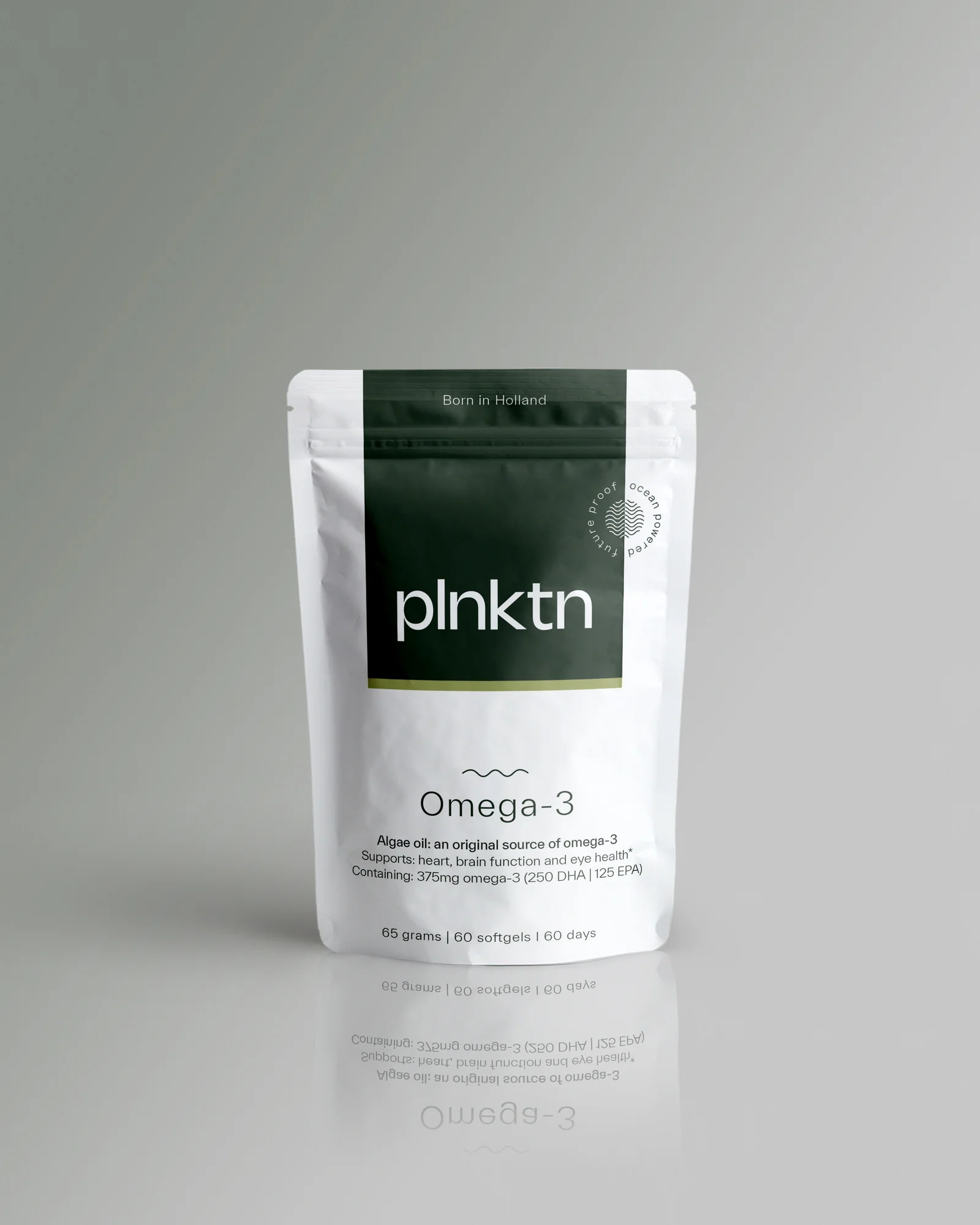

Omega-3 (algenolie)
Daily omega-3 from the original source: algae. With essential EPA and DHA for heart, brain and eyes.
- • 250 mg DHA and 125 mg EPA per capsule
- • 100% fish-free, plant-based algenolie
- • No fishy aftertaste, clean and controlled source
Disclosure: We may earn a commission if you purchase via these links.

What You Can Safely Skip (For Now)
This section will probably annoy some supplement companies. That's fine. Here's what beginners don't need:
BCAAs (Branched-Chain Amino Acids): If you're eating enough total protein (1.6+ g/kg), BCAAs provide zero additional benefit. They're literally a subset of the amino acids already in your protein shake. A 2017 review concluded that "the claim that consumption of dietary BCAAs stimulates muscle protein synthesis or produces an anabolic response in human subjects is unwarranted" (Wolfe, 2017).
Mass Gainers: These are protein powder mixed with maltodextrin (sugar) at a 300-400% markup. You can make a more nutritious high-calorie shake at home with protein powder, oats, banana, peanut butter, and milk for a fraction of the cost.
Fat Burners: The thermogenic effect of most fat burner ingredients is negligible — perhaps 50-100 extra calories burned daily. A caloric deficit from food and exercise is the only reliable path to fat loss. Some ingredients (like synephrine or yohimbine) carry cardiovascular risks.
Testosterone Boosters: The vast majority of "natural test boosters" (tribulus, fenugreek, D-aspartic acid) produce no meaningful increase in testosterone levels in healthy young men. If you genuinely suspect low testosterone, see a doctor — don't self-medicate with supplements.
Greens Powders: Not harmful, but wildly overpriced for what you get. A serving of actual vegetables provides more fibre, more phytonutrients, and better satiety than any greens powder. If you absolutely refuse to eat vegetables, they're better than nothing — but they're a band-aid, not a solution.
Collagen: Emerging evidence for joint and skin health, but not a priority for fitness beginners. Your body synthesises collagen from dietary protein and vitamin C. Focus on adequate total protein first.
How to Read a Supplement Label
This is possibly the most important section in this article. The supplement industry relies on consumer confusion. Learning to read labels puts you in control.
The Essentials
Serving Size vs Container Size: A product advertising "60 servings" at 5 g creatine per serving is very different from one with "30 servings" at 3 g. Always calculate cost per effective dose, not cost per container.
Active Ingredient Dose: The amount that matters. "500 mg turmeric extract" means nothing without knowing the curcuminoid percentage. "500 mg turmeric extract (95% curcuminoids)" tells you the actual active dose is 475 mg.
Proprietary Blends: A red flag. These list ingredients without individual doses, only a total blend weight. This lets manufacturers use tiny amounts of expensive ingredients while burying them in cheap fillers. Avoid proprietary blends.
Third-Party Testing Certifications
| Certification | What It Tests | Trusted? |
|---|---|---|
| Informed Sport | Banned substances | Yes — gold standard for athletes |
| NSF Certified for Sport | Purity, label accuracy | Yes |
| USP Verified | Purity, potency, dissolution | Yes |
| GMP Certified | Manufacturing quality | Baseline — not sufficient alone |
| "Lab Tested" (no logo) | Usually self-reported | Sceptical — verify independently |
Red Flags
- Claims that sound too good to be true ("gain 10 kg of muscle in 30 days")
- Proprietary blends hiding individual doses
- No third-party testing certification
- Ingredient lists longer than 15-20 items
- "Clinically dosed" without citing which clinical dose they're referencing
- Before/after photos (often manipulated lighting, dehydration, or different timeframes than claimed)
For a more detailed label-reading guide, see our How to Read Supplement Labels article.

Plant-Based vs Traditional Supplements
A decade ago, plant-based supplements were clearly inferior — chalky protein powders, limited options, questionable amino acid profiles. That's no longer the case.
Modern plant-based protein (pea + rice blends) delivers an amino acid profile comparable to whey when properly formulated. A 2019 study found no significant difference in muscle thickness or strength gains between pea protein and whey protein over 8 weeks of resistance training (Banaszek et al., 2019).
Creatine is synthesised chemically regardless of branding — all creatine monohydrate is vegan by default. Same goes for caffeine tablets.
Omega-3 from algae oil provides the same EPA and DHA as fish oil, without the fish. Fish get their omega-3 from algae in the first place — you're just cutting out the middleman.
European plant-based brands worth noting:
- Orangefit — Dutch brand offering protein powders, bars, and supplements with clean ingredient lists and solid dosing
- Upfront — focuses on sports performance supplements (including creatine) with full transparency on sourcing
The practical takeaway: if you prefer plant-based supplements, you're not compromising on quality or results. You may even gain advantages in digestibility and environmental sustainability.
For a detailed protein comparison, see our Whey vs Plant Protein breakdown.
How Much Should You Spend?
Here's where things get uncomfortable for the supplement industry. A complete, evidence-based beginner stack costs far less than most people think.
| Supplement | Budget Option (€/month) | Premium Option (€/month) | Notes |
|---|---|---|---|
| Protein Powder | €15-20 | €30-40 | 1 scoop/day vs 2 scoops/day |
| Creatine Monohydrate | €5-8 | €12-15 | Unflavoured vs branded/Creapure |
| Caffeine | €0-3 | €5-8 | Coffee vs caffeine tablets |
| Magnesium | €5-10 | €12-18 | Citrate vs glycinate |
| Omega-3 | €8-12 | €15-25 | Fish oil vs algae-based |
| Monthly Total | €33-53 | €74-106 |
The budget stack (€33-53/month) covers everything a beginner needs. The premium options offer marginal improvements in purity, form, or convenience — not fundamentally different results.
Where NOT to spend money:
- Pre-workout supplements (use coffee + creatine instead)
- Individual amino acid supplements (get them from protein)
- "All-in-one" formulas (usually underdose everything)
- Monthly subscription boxes (fun, but poor value per ingredient)
Money better spent elsewhere:
- Quality food (€100-150/month on increased protein intake from real food will outperform any supplement)
- A gym membership or home equipment
- A single session with a sports dietitian (€50-100, one-time, far more valuable than months of random supplementation)
Common Beginner Mistakes
I've made most of these myself. Learn from collective experience:
1. Taking Too Many Supplements at Once
Starting five new supplements simultaneously makes it impossible to identify what's helping and what's causing side effects. Add one new supplement every 2-4 weeks. Keep a simple log. This is how you build a personalised stack rather than blindly following someone else's protocol.
2. Expecting Instant Results
Creatine takes 3-4 weeks to saturate muscles. Omega-3 may take 6-8 weeks to measurably reduce inflammation markers. Protein supplementation improves body composition over months, not days. If you quit after two weeks because you didn't "feel anything," you never gave the supplement a fair trial.
3. Ignoring Diet Quality
A protein shake doesn't cancel out a diet of processed food. Supplements are additions to a solid nutritional foundation — not replacements for one. If your diet consists primarily of fast food and ready meals, fixing that will deliver 10x the results of any supplement stack.
4. Following Influencer Recommendations Blindly
Most fitness influencers are paid to promote supplements. Their "daily stack" videos are advertisements. Some are transparent about this; many aren't. Look for recommendations backed by peer-reviewed research, not testimonials. If someone claims a supplement "changed their life" but can't cite a single study, be sceptical.
5. Ignoring the Basics
No supplement compensates for sleeping 5 hours a night, training sporadically, or chronically under-eating protein. Master the fundamentals first. Then, and only then, consider supplementation as fine-tuning.
For a structured approach to building a stack, see our How to Build a Supplement Stack guide, and for optimising when you take them, our Supplement Timing Guide.

Frequently Asked Questions
What should be my very first supplement?
Protein powder, if you're struggling to hit your daily protein target (1.6-2.2 g/kg). If your protein intake is already solid from food, creatine monohydrate — it's cheap, incredibly well-researched, and beneficial for nearly everyone who trains. For a broader supplement starting point, our Smart Supplements 101 guide covers the fundamentals.
Do I need supplements if I'm eating well?
Not necessarily. A well-planned diet can cover most nutritional bases. However, certain nutrients are difficult to obtain in optimal amounts from food alone — particularly vitamin D in Northern Europe (October-March), omega-3 if you don't eat fish regularly, and creatine (you'd need 1-2 kg of raw meat daily to match a 5 g supplement dose). Supplements fill specific, evidence-based gaps.
Are fitness supplements safe?
The five recommended in this article all have strong safety profiles when taken at recommended doses. Creatine is the most studied — no adverse effects in healthy individuals across hundreds of trials. The bigger risk is unregulated supplements with hidden ingredients. Stick to reputable brands with third-party testing. The EU's regulatory framework (EFSA oversight, Novel Food regulations) provides stronger consumer protection than many other markets.
How long before I see results?
Depends on the supplement: protein's benefit to body composition is gradual over weeks to months. Creatine saturates in 3-4 weeks (or 5-7 days with a loading phase). Caffeine works within 30-60 minutes. Magnesium may improve sleep within 1-2 weeks. Omega-3's anti-inflammatory effects build over 4-8 weeks.
Can I take all five supplements together?
Yes. These five don't have meaningful interactions with each other. A practical daily routine: protein shake post-workout (or whenever convenient), creatine mixed into any drink (timing doesn't matter), caffeine before training, magnesium in the evening, omega-3 with a meal containing fat.
What about nootropics for mental focus during training?
Caffeine is technically a nootropic, and it's already on the list. Beyond that, L-theanine paired with caffeine can improve focus without jitteriness. True nootropic stacks are a separate category — beneficial for cognitive work but not essential for physical training beginners.
I'm a runner — does this advice still apply?
Mostly yes. Runners benefit from all five, with particular emphasis on omega-3 (joint protection), magnesium (cramp prevention), and caffeine (endurance performance). For runner-specific recommendations, see our Supplements for Running guide and the Runner Supplement Stack article.
The Bottom Line
Fitness supplements for beginners come down to a simple framework:
- Get your diet, training, and sleep right first. This is 90% of your results.
- Add protein powder if you can't hit your protein target through food.
- Add creatine monohydrate — it's cheap, safe, and works.
- Add caffeine before training if you tolerate it.
- Fill nutritional gaps with magnesium and omega-3.
- Ignore everything else until you've been training consistently for at least a year.
That's it. Five supplements. €30-50 per month. No proprietary blends, no miracle claims, no Instagram hype. Just evidence.
Disclaimer
This article is for informational and educational purposes only and does not constitute medical advice. Individual supplement needs vary based on diet, health status, medications, and genetic factors. Some supplements featured include affiliate relationships with partner brands — this means Smart Supplements may earn a commission at no additional cost to you. These relationships do not influence our recommendations, which are based solely on published research. Consult a qualified healthcare provider before starting any supplement regimen, particularly if you take prescription medications, are pregnant or breastfeeding, or have existing health conditions.
Written by the Smart Supplements editorial team. Last reviewed April 2026.
Related Articles
- Supplements for Running: The Evidence-Based Guide
- The Complete Protein Guide for Runners
- Creatine for Runners: What the Research Actually Says
- The Runner's Supplement Stack
- Whey vs Plant Protein: Which Is Better?
- What Are Nootropics? A Beginner's Guide
- How to Build a Supplement Stack
- Supplement Timing Guide
This article is for informational purposes only and is not intended as medical advice. Always consult a healthcare professional before starting any new supplement, especially if you take prescription medication.
Related topics
Where to buy
Affiliate linksUpfront Creatine
Straightforward creatine monohydrate at an unbeatable price. Clean formula, no nonsense.
- • Pure creatine monohydrate
- • Best price in NL (€8)
- • No fillers
Orangefit Protein
Plant-based protein shake made from yellow split peas. Complete amino acid profile, easy to digest, no artificial sweeteners. Available in multiple flavours.
- • 100% plant-based (yellow split peas)
- • Complete amino acid profile
- • No artificial sweeteners
Orangefit Protein Blend
Triple-source plant protein: yellow split peas, fava beans, and pumpkin. 24g protein + 5g BCAAs per shake, with turmeric and bioperine.
- • 24g protein per serving
- • 5g BCAAs included
- • Triple protein source
Upfront Crea PRO
Premium creatine formula with enhanced absorption. For athletes who want more from their creatine.
- • Enhanced absorption formula
- • Premium creatine
- • For serious athletes
Disclosure: We may earn a commission if you purchase via these links.
Related articles
The Daily Wellness Stack: Morning, Afternoon & Evening Supplements
A practical guide to building a daily supplement stack across three tiers (Foundation, Optimised, Premium) with morning/afternoon/evening timing protocols,
Best Wellness Supplements in Europe: A 2026 Buyer's Guide
An honest buyer's guide to the best wellness supplements available in Europe in 2026 — covering multivitamins, magnesium, omega-3, adaptogens, vitamin D, f
Supplements for Burnout Recovery: Rebuilding Energy, Sleep & Resilience
A phased supplement protocol for burnout recovery — covering the biochemistry of burnout, nutrient depletion patterns, a 12-week recovery framework (Replen