Storing Magic Truffles: What Is Known About Freshness and Shelf Life
How do you store magic truffles, how long do they stay fresh, and does drying or freezing change anything?
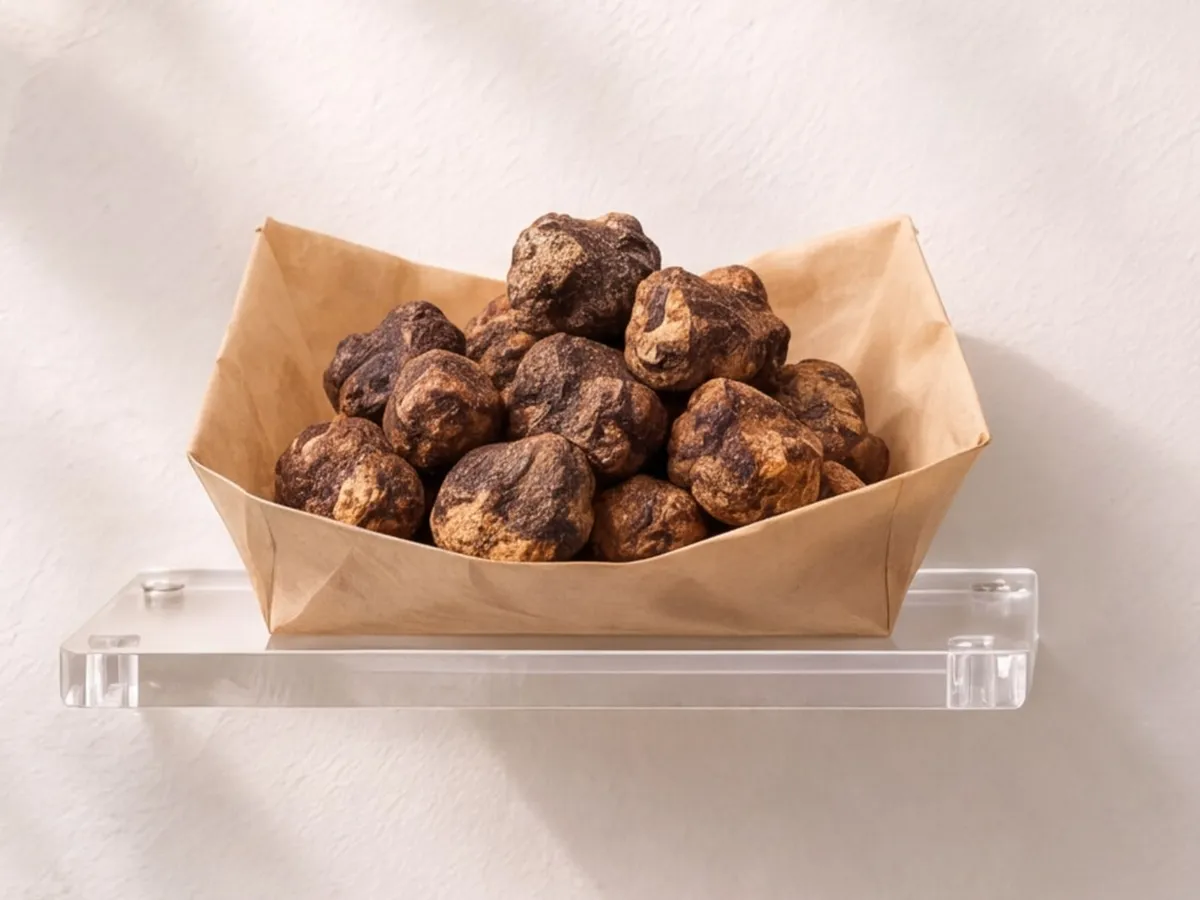
In short
- No source we could open states a shelf life or storage method for magic truffles (sclerotia); no stability study on sclerotia turned up in a Europe PMC search on 20 November 2026.
- The only storage experiments found used Psilocybe cubensis mushrooms: fresh material frozen at very low temperatures lost the most of the measured tryptamines (the family that includes psilocybin and psilocin), dried material kept dark at room temperature the least.
- Blueing is the visible sign of psilocybin being broken down by enzymes after injury. The paper does not show that colour measures how much has been lost.
- A use-by date is about safety and a best before date about quality, according to UK government food-labelling guidance on GOV.UK; any storage line on a truffle label is that seller's statement.
- Dutch sources disagree on dried truffles: Jellinek (January 2021) says they are prohibited, DRUGSinfo says truffles are not under the Opium Act and does not mention drying.
On this page 9 sections
- What you're storing
- What the one stability study measured
- Why this doesn't transfer neatly to truffles
- Does a colour change tell you something?
- The label that matters: use-by or best before
- Fresh and dried are not just storage choices in the Netherlands
- What nobody has told us
- So what do you do with that?
- Where to read next
Your magic truffles have arrived, you've used a little, and now a small tub sits on the kitchen counter looking at you. Fridge? Cupboard? Freezer? Fair question, and a trickier one than it looks: the drug information pages we read don't cover it, and the one set of measurements we found concerns a different part of the fungus.
The short version: in the sources we could open, no regulator, harm-reduction service or laboratory has published how long psychoactive truffles (the sclerotia of certain Psilocybe fungi) keep, or how best to keep them. What exists is one set of storage experiments on the fruiting bodies, the actual mushrooms, of Psilocybe cubensis. In those, fresh mushrooms stored at very low temperatures lost the most of the measured tryptamines (the family of compounds that includes psilocybin and psilocin), and dried material kept in the dark at room temperature lost the least. Truffles are a different tissue, so that is a clue about the chemistry, not a shelf life.
This page describes what is known and what isn't. It isn't a storage instruction, and it isn't legal advice: the only legal position it reports is the Dutch one, from two Dutch sources.
What you're storing
A magic truffle is a sclerotium: an underground lump the fungus makes to store nutrients. DRUGSinfo, the Dutch drug information service, puts it this way: "Soms maakt de schimmel ondergrondse opslagplaatsen aan voor voedingsstoffen. Dit worden truffels (tripknollen) genoemd" ("Sometimes the fungus makes underground storage places for nutrients. These are called truffles"). If you want the full picture of what they are and where they come from, the truffles and mushrooms guide covers it.
Two things make storage a real question. Fresh truffles are sold fresh, so the seller's date and storage line matter. And the compounds people care about, psilocybin and psilocin, are chemicals that can break down: the next section reports a study that, according to a later review, put its biggest losses down to oxidation after the material was cut while still moist.
What the one stability study measured
The main experiment comes from a Czech forensic chemistry group at the University of Chemistry and Technology in Prague (Gotvaldová and colleagues, Drug Testing and Analysis, 2021). They used "freshly cultivated fruit bodies of Psilocybe cubensis" and kept them under different storage and processing conditions, including fresh and dried material at several temperatures. We could read only the abstract of the original paper, so what follows leans on that and on how a 2025 review (Pharmaceuticals) describes the same work.
The headline from the abstract: "the highest degradation of tryptamines was seen in fresh mushrooms stored at -80°C, and the lowest decay was seen in dried biomass stored in the dark at room temperature." The same group repeated the finding in a 2025 conference abstract.
The review adds detail, with the usual caution that we are reading it second-hand:
- Freezing fresh mushrooms at −20 °C and −80 °C was "highly detrimental", with psilocybin falling by more than 80 per cent at both temperatures.
- Fresh mushrooms kept at 20 °C in the dark still held more than 1 per cent psilocybin by weight after three months.
- According to the review, the study suggested that the freezer losses were caused not by temperature or light as such, but by cutting the mushrooms into small pieces while still moist, which "promoted oxidation".
- In dried mushrooms the first months of storage showed the fastest losses, with more than half of the original amount gone in that period, and storage in the dark was "less harmful".
Those last two points sit a little awkwardly next to the abstract's "lowest decay", and it's worth holding both: dried and dark was the best of the conditions tested, and it still wasn't loss-free. The full paper would show how the conditions and time spans fit together; we haven't opened it.
One more thing from the same work. The abstract notes that "the concentration of tryptamines in individual fruiting bodies is highly variable." Two mushrooms can differ, before any storage happens at all.
Why this doesn't transfer neatly to truffles
Everything above was measured in mushrooms. We searched the research literature (through Europe PMC, on 20 November 2026) for storage or stability studies on sclerotia and found none. A sclerotium is a different tissue from a mushroom, so the mushroom results could carry over, or not. We found nothing published that says which.
So the studies tell you something about the compound, which breaks down by oxidation and is affected by how the material is handled, but not how many days a particular tub of fresh truffles stays as it was.
Strength is not a fixed number either. How strains differ is one reason truffles vary, and the mushroom work above adds that even individual fruiting bodies vary a lot. DRUGSinfo puts the practical side like this: "Het is moeilijk in te schatten hoeveel truffels nodig zijn voor een trip. Sommige soorten paddenstoelen of verse truffels zijn sterker dan andere" ("It is hard to estimate how many truffles are needed for a trip. Some kinds of mushrooms or fresh truffles are stronger than others").
Does a colour change tell you something?
Psilocybin-containing mushrooms turn blue where they are bruised or cut. The chemistry was worked out in a 2020 paper in Angewandte Chemie (Lenz and colleagues): when the tissue is injured, an enzyme called PsiP strips the phosphate group off psilocybin to give psilocin, and a second enzyme, the laccase PsiL, oxidises psilocin so that it links up into blue-coloured chains. In the authors' words, "the phosphatase PsiP and the laccase PsiL degrade psilocybin and initiate blueing." They also write that their results "imply" that the phosphate on psilocybin "serves a reversible protective function".
Two readings follow from that, and both stay within what the paper says:
- Blue is what the breakdown looks like. The colour is the oxidised product of the very compound people are after.
- The paper doesn't tell you how much has been lost when you see blue, or that a blue-free piece is intact. It is a study of enzymes in P. cubensis mushrooms, not a freshness test for truffles. Treat colour as a hint, not a measurement.
The label that matters: use-by or best before
Food sold prepacked usually carries one of two kinds of date, and they mean different things. The UK government's guidance on GOV.UK explains the general rule for food labels: "Use-by dates relate to the safety of food, whereas best before dates relate to quality." A use-by date "must be shown on foods that go off quickly, such as meat products and ready-to-eat salads", and "if you do not store food properly, it could become unsafe to eat before the use-by date." After a best before date, "the food is usually safe to eat but may not be of the same quality."
That guidance is for ordinary British food and says nothing about truffles. We could not open a Dutch or EU page on dates today, so we don't say which kind a truffle label should carry. What the rule does give you is a way to read a label: a date is either about safety or about quality, and any storage line next to it is the seller's statement about that product, not a standard that applies to every truffle.
Fresh and dried are not just storage choices in the Netherlands
If drying comes to mind as the obvious way to make truffles last, there is a legal wrinkle that has nothing to do with chemistry, and Dutch sources don't agree on it.
Jellinek, a Dutch addiction-care organisation, states on a page dated January 2021: "Verkoop van verse sclerotia (truffels) is niet verboden... Gedroogde truffels zijn wel weer verboden" ("Sale of fresh sclerotia (truffles) is not prohibited... Dried truffles, on the other hand, are prohibited"). The same page says psilocin and psilocybin are on List I of the Opium Act, and mushrooms containing them on List II.
DRUGSinfo, on its page about the law, says: "Omdat truffels geen paddenstoelen zijn, vallen deze niet onder de Opiumwet. Truffels zijn dan ook vrij te koop in smartshops" ("Because truffles are not mushrooms, they do not fall under the Opium Act. Truffles are therefore freely sold in smartshops"). It doesn't mention drying at all, and neither of the two pages is a legal text.
So one source says drying changes the legal status in the Netherlands and the other makes no distinction. We aren't a legal authority and we haven't tried to settle it here. The practical point is only that "just dry them to keep them" is a question about the law before it's a question about freshness, and this page reports only the Dutch sources; other countries have their own rules, which we haven't checked here. Our truffle safety guide is the place to start on safety.
What nobody has told us
For completeness, here is what we looked for and didn't find in the sources read:
- A stated shelf life for fresh truffles from a regulator, harm-reduction service or study.
- A study of how long psilocybin lasts in sclerotia, fresh, chilled, dried or frozen.
- Official advice on spotting spoiled truffles. We didn't find a page we could open that covers mould or spoilage in fresh fungal products, so we say nothing about it here.
- Whether blueing in a truffle tracks loss of strength.
Shop pages do carry their own storage statements for the products they sell, and they are context, not evidence. As of 20 November 2026 you can read them on the page about microdosing truffles.
So what do you do with that?
The studies say that in mushrooms, handling and conditions affect how much of the active compounds survive, that dried, dark, room-temperature storage did best of the conditions tested, and that freezing fresh material did worst. We found no study that tests whether any of that holds for truffles. The sources we read are silent on shelf life, and the Dutch sources disagree about drying.
That leaves two honest positions: read what the seller says about their own product, and be wary of anyone who gives you a confident number of days, because nothing we could find supports one. If you want to go on from here, what to expect from magic truffles covers the experience itself, microdosing products explains the product types, and the buying guide to microdosing truffles lists what specific shops sell.
Where to read next
This article is for informational purposes only and is not intended as medical advice. Always consult a healthcare professional before starting any new supplement, especially if you take prescription medication.
Where to buy
How do the named microdosing packs, portion sizes and shops compare?
Buying guideMicrodosing truffles: products, packs and where to buy
Read the buying guide All buying guides and brandsMore on truffles & microdosing
- Magic mushrooms and truffles: same conversation, different productsHow do they relate, and what did clinical trials test?
- Magic truffle varieties: what changes between the names?Which truffle names are species, which are trade names, and what is known about strength?
- Microdosing: the idea, the research and the realityWhat did placebo-controlled studies measure, and how does the reality compare with the idea?
- Magic truffles and mushrooms legal status in Europe by countryAre magic mushrooms and magic truffles legal in my European country?