What to expect from magic truffles: effects, variability and cautions
What happens after eating them, and why does the same pack differ between people?
In short
- DRUGSinfo describes effects beginning 20 to 60 minutes after taking mushrooms or truffles and lasting about 3 to 4 hours, with people still impaired afterwards; Talk to FRANK says up to five hours for mushrooms.
- Experiences vary: psilocybin content ranged roughly threefold in one 2013 sample set of truffles, and research found mindset and setting matter alongside dose.
- Difficult experiences are a documented possibility; DRUGSinfo says a bad trip cannot be stopped early and suggests a calm place and a sober trip sitter.
- People with a psychosis history or other severe psychiatric conditions, and people on medicines, should take medical advice first; do not drive afterwards.
- As read on 8 October 2026, fresh truffles are described as sold legally in Dutch smartshops; sources disagree on dried truffles, so the question is left open.
On this page 9 sections
- Five things worth knowing first
- What are you actually taking?
- A rough timeline
- Same pack, different evening: why experiences vary
- Challenging experiences: what they can look like
- After-effects: the afterglow and the less cheerful bits
- Who should avoid magic truffles
- Is being alone a problem?
- Where this leaves you
You've bought a pouch of magic truffles, or you're thinking about it, and the question that keeps coming back is: what actually happens once you eat them? Search results tend to offer two extremes, a glossy promise and a horror story. The truthful picture sits in between, and it starts with a slightly inconvenient fact. The same pack can produce quite different experiences in different people, or in the same person on a different evening.
This guide pulls together what Dutch harm-reduction services and published research describe: roughly how long things take, what people report, why experiences vary so much, what a difficult experience can look like, and who should skip truffles altogether. It isn't a dosing plan, and it can't predict how your evening will go. Nobody can.
Five things worth knowing first
- Timing: Trimbos-run DRUGSinfo says effects begin 20 to 60 minutes after taking mushrooms or truffles and last about 3 to 4 hours, with people still impaired afterwards (DRUGSinfo, checked 8 October 2026). UK service Talk to FRANK says mushrooms can take more than 30 minutes to work and effects can last up to five hours (Talk to FRANK).
- Variability is the rule. Dose matters most, but a pooled analysis of controlled studies found mood, personality and setting also shaped how pleasant or anxious the response was (Studerus et al., 2012).
- Difficult moments are part of the picture, not a rare glitch. They are usually temporary, but they can be frightening.
- Some people should avoid truffles: anyone with a personal or family history of psychosis, and people on certain medicines, among others (details below).
- Don't drive. Jellinek calls taking part in traffic afterwards "a bad plan and prohibited" (our translation), and DRUGSinfo says you can't yet drive safely once the main effects fade.
What are you actually taking?
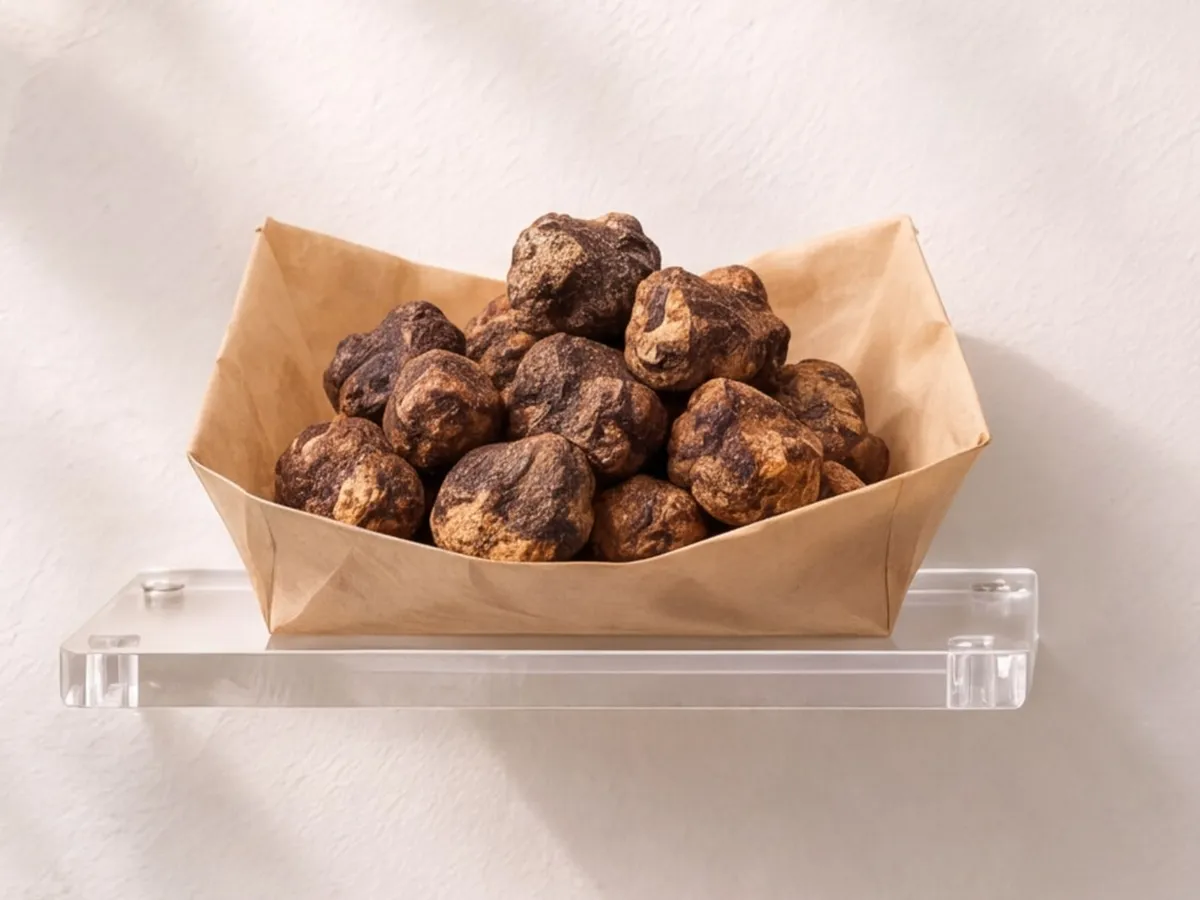
Magic truffles are the underground storage structures (sclerotia) of certain Psilocybe fungi. They contain psilocybin, which the body converts to psilocin, the compound that acts on serotonin receptors. A 2025 systematic review of human pharmacokinetic data describes psilocybin as a pro-drug that is rapidly absorbed and converted to psilocin after oral dosing, with a terminal half-life for psilocin of roughly 1.2 to 4.7 hours across studies (Otto et al., 2025, Clinical Pharmacokinetics). That's the chemistry behind the "a few hours" timeline. It describes an average pattern, not a stopwatch for your evening.
On the law, as read on 8 October 2026: Jellinek describes fresh truffles as sold legally in Dutch smartshops, DRUGSinfo says truffles are legal because they are not mushrooms, and mushrooms are banned. Sources differ on dried truffles, with Jellinek placing them under List I of the Opium Act and DRUGSinfo and Drugs en Uitgaan making no such distinction, so we leave that open. Dutch rules don't apply elsewhere in the EU; our mushrooms and truffles guide has the detail.
A rough timeline
Services describe the following pattern. Treat it as a sketch, because individual experiences differ.
| Phase | What services and studies describe | Worth knowing |
|---|---|---|
| Before effects | Nothing much, or mild nausea, yawning, restlessness | Onset is quoted at 20 to 60 minutes (DRUGSinfo); Talk to FRANK says more than 30 minutes. Waiting is part of the experience, and the delay is one reason people misjudge how much they've taken. |
| Come-up and peak | Colours, sounds and shapes feel more intense; thoughts speed up; time feels distorted; emotions can swing between positive and negative | DRUGSinfo describes effects arriving in waves. Strength and character differ between people. |
| Coming down | Effects fade; people may feel tired, reflective or still a little "off" | Information services say you can stay blurry and unfocused for some time after the main effects. |
| Next day and after | Jellinek advises taking the day after off and planning nothing; some people report feeling well afterwards | See "After-effects" below; good feelings are reported in surveys, not guaranteed. |
Physical effects DRUGSinfo lists include muscle relaxation, chills, headache, nausea or stomach discomfort, dilated pupils, sweating, dizziness, and a slight rise in heart rate and blood pressure (DRUGSinfo effects). Its risk page calls a "body load" (restlessness, nausea, dizziness, chills) something almost everyone experiences (DRUGSinfo risks).
Same pack, different evening: why experiences vary
This is the part packaging can't promise away, and it comes from two directions: the truffles and the person.
The truffles aren't uniform. A 2013 analysis of Psilocybe sclerotia sold as "magic truffles" found psilocybin content ranging from 59.3 to 167.8 micrograms per 100 mg of fresh sclerotia (Pellegrini et al., 2013, Drug Testing and Analysis). That is close to a threefold spread between the samples tested. It doesn't tell us how any particular pack behaves today, and a supplier's printed amount is an average claim, not a guarantee. DRUGSinfo says the same in plainer words: there can be a big difference in how strong these products are.
You aren't uniform either. A pooled analysis covered 23 controlled studies, 409 psilocybin administrations and 261 healthy volunteers. Dose was the most important predictor of the response, but personality, mental state beforehand and setting also made a measurable difference. High absorption (a tendency to be deeply drawn into experiences), being emotionally excitable and active beforehand, and having had few recent psychological problems were linked with more pleasant and mystical-type experiences. High emotional excitability and younger age were linked with unpleasant or anxious reactions (Studerus et al., 2012, PLoS ONE). These were laboratory volunteers, so the results only partly map onto a truffle evening at home.
Set and setting is more than a slogan. "Set" is your mindset and "setting" is the environment. A prospective survey of people who planned to take a psychedelic on their own initiative (654 at the first time point, fewer later) found that a positive set, and recreational intentions, were associated with a lower chance of a challenging experience (Haijen et al., 2018, Frontiers in Pharmacology). It is an observational survey, so it shows associations, not that any preparation will prevent a hard time. DRUGSinfo's practical version: a calm, safe place, and a sober trip sitter, meaning someone who hasn't used.
So even with identical truffles in the same room, two people, or the same person on a different day, can end up in different places. That's the real limit of any timeline, including the one above.
Challenging experiences: what they can look like
This is the part a pouch label won't cover, and the research handles it more calmly than most online stories do.
A study that built the Challenging Experience Questionnaire from internet survey responses about difficult psilocybin experiences identified seven themes: grief, fear, death, insanity, isolation, physical distress and paranoia (Barrett et al., 2016, Journal of Psychopharmacology). So "challenging" can mean anything from physical discomfort to feeling afraid you're losing your mind. The authors note that such reactions are usually benign with proper screening, preparation and support in controlled settings, but remain a safety concern in uncontrolled settings.
DRUGSinfo says a bad trip can't be stopped early. The approach is to change the environment and have trusted, sober support, and it ends as the effects wear off (DRUGSinfo risks). That's one reason to be wary of any product that claims to switch a trip off.
If something feels wrong, or if distress or unusual perceptions continue after the effects should have ended, the Drugs Infolijn (0900-1995, listed by DRUGSinfo, phone, chat and email) offers anonymous advice. If someone is in danger or has a medical emergency, call 112.
After-effects: the afterglow and the less cheerful bits
Some people report feeling well in the days afterwards. In the Haijen survey, psychological well-being was higher two and four weeks after a psychedelic experience than before, and stronger mystical-type experiences predicted bigger increases. The participants chose to take part, were not randomised, and didn't take any particular product, so it isn't a result you can plan around.
The less cheerful side, per DRUGSinfo's risk page: psychological complications can include worsening of existing depression, anxiety or panic; psychosis in people predisposed to it; and, for some, lingering visual disturbances (often called flashbacks, clinically hallucinogen persisting perception disorder). It says persistent symptoms deserve professional advice. A 2008 safety review of human hallucinogen research notes that persisting adverse reactions are rare when research follows careful screening and support, with overwhelming distress during the experience the most likely risk and prolonged psychosis less common (Johnson, Richards and Griffiths, 2008). Research conditions are far more controlled than a living room, so that reassurance travels only so far.
Who should avoid magic truffles
According to the sources above, these are the situations to take seriously:
- A personal or family history of psychosis or other severe psychiatric disorders. Johnson and colleagues list excluding these volunteers as a core safeguard in research, and DRUGSinfo says people with mental-health conditions such as depression, anxiety or psychosis face a much greater chance of the risks.
- Anyone using psychiatric or other medicines. DRUGSinfo's risk page says the physical risks are small for healthy people "who don't use medication", and warns that ceremonies are dangerous for people on medicines. It doesn't list specific interactions, so ask a doctor or pharmacist. One published analysis of online experience reports (Nayak et al., 2021, Pharmacopsychiatry) associated combining lithium with classic psychedelics with seizures; that's a report-based association, not a full risk estimate. For the general logic of checking supplements and medicines together, see our guide to supplement and drug interactions.
- Mixing with alcohol or other drugs. DRUGSinfo's risk page frames physical risks as minimal only for healthy people not taking medication or combining substances.
- Anyone who needs to drive, work with machinery or look after others. Jellinek and DRUGSinfo warn that you stay unfocused for some time after, and Jellinek says taking part in traffic is prohibited.
- Anyone who feels pushed. If you're nervous, in a rough patch or in a chaotic place, that matters, because set and setting do.
Is being alone a problem?
DRUGSinfo's guidance is to arrange a trip sitter, "someone who hasn't used". That fits what the research describes: overwhelming distress is the most likely problem, and calm company in a safe place is the usual safeguard. It's a harm-reduction suggestion, not a law, and no one can promise it prevents a hard time.
Where this leaves you
The pharmacology above is averages and ranges across studies, mostly of pure psilocybin in clinics rather than truffles at home, and research on truffles themselves is limited to one lab analysis of sclerotia content plus harm-reduction guidance. That's why no page can tell you how strong your truffles are or how you'll react. What you can do is plan around the things you do control: a calm place, sober company, a clear day either side, no other substances and no driving.
From here, the truffle safety guide covers difficult experiences and where to get support in more depth, magic truffle varieties explains what the names on a pack mean, and microdosing looks at the small-amount question. If you're at the browsing stage, microdosing truffles: products, packs and where to buy shows how small-portion packs differ from full-size ones and which shops list them.
This article is for informational purposes only and is not intended as medical advice. Always consult a healthcare professional before starting any new supplement, especially if you take prescription medication.
Sources
The 10 outside pages this article links to, in the order it first cites them.
- DRUGSinfo, checked 8 October 2026 drugsinfo.nl
- Talk to FRANK talktofrank.com
- Studerus et al., 2012 pmc.ncbi.nlm.nih.gov
- Otto et al., 2025, Clinical Pharmacokinetics pmc.ncbi.nlm.nih.gov
- Jellinek jellinek.nl
- DRUGSinfo risks drugsinfo.nl
- Pellegrini et al., 2013, Drug Testing and Analysis pubmed.ncbi.nlm.nih.gov
- Haijen et al., 2018, Frontiers in Pharmacology pmc.ncbi.nlm.nih.gov
- Barrett et al., 2016, Journal of Psychopharmacology pmc.ncbi.nlm.nih.gov
- Johnson, Richards and Griffiths, 2008 pmc.ncbi.nlm.nih.gov
Where to buy
How do the named microdosing packs, portion sizes and shops compare?
Buying guideMicrodosing truffles: products, packs and where to buy
Read the buying guide All buying guides and brandsMore on truffles & microdosing
- Magic mushrooms and truffles: same conversation, different productsHow do they relate, and what did clinical trials test?
- Magic truffle varieties: what changes between the names?Which truffle names are species, which are trade names, and what is known about strength?
- Microdosing: the idea, the research and the realityWhat did placebo-controlled studies measure, and how does the reality compare with the idea?
- Magic truffles and mushrooms legal status in Europe by countryAre magic mushrooms and magic truffles legal in my European country?