Magic truffle varieties: what changes between the names?
Which truffle names are species, which are trade names, and what is known about strength?
In short
- Truffle names are a mix of species names, trade or cultivar names and each shop's own strength words; only the first kind has a scientific meaning, and even species labels differ between sources.
- Strength words belong to the shop that wrote them: on 8 October 2026 Mush Magic and Azarius placed Mexicana at the mild end and Hollandia, Utopia and Valhalla at the strong end, with different words for Mokum, Atlantis and Tampanensis in the middle.
- We found one peer-reviewed measurement of commercial-type sclerotia (psilocybin 59.3-167.8 ug per 100 mg fresh, species and sample count not stated in the abstract) and no study comparing named varieties side by side.
- A pack's weight is not its psilocybin content, and fresh-weight and dry-weight figures cannot be compared directly.
- Fresh psilocybin truffles are sold legally in the Netherlands and mushrooms are prohibited; sources disagree on dried truffles (read on 8 October 2026). This is not an EU-wide position.
On this page 11 sections
- Before you pick a name off the shelf
- What's a "magic truffle", anyway?
- Three kinds of names on one shelf
- The species names: what's behind the Latin
- Strength words: each shop has its own scale
- What published analyses show (and don't)
- Reading a truffle listing: what to look for
- The Netherlands in brief
- Safety and support
- So what actually changes between the names?
- Where to read next
A truffle shelf can read like the server list of a fantasy game: Mexicana, Mokum, Pandora, Utopia, Hollandia, Valhalla. It's tempting to treat the names like a ladder, with a friendly bottom rung and something mythic at the top. So what do the names actually mean, and how much does the ladder tell you?
Strain names turn out to be a mix of three things. Some are species names a mycologist gave a fungus. Some are trade names a grower or shop chose. And the strength words that go with them ("mild", "strong", "our strongest") are each shop's own scale. Only the first kind has a scientific meaning, and the published measurements of psilocybin in truffles are too sparse to back up a ranking of the rest.
Before you pick a name off the shelf
- Names come in three kinds. Species names (Psilocybe mexicana, P. tampanensis, P. atlantis), trade or cultivar names (Pandora, Hollandia, Valhalla and others) and shop-defined strength labels. They look alike on a pack and mean very different things.
- Strength words belong to each shop. On 8 October 2026 Mush Magic and Azarius both placed Mexicana at the mild end and Hollandia, Utopia and Valhalla at the strong end; in the middle their words differ, so a ladder works inside the shop that wrote it.
- Species labels aren't always settled. Some names carry different species labels in different places, and reference works disagree about the species name "galindoi".
- Published potency data for truffles is thin. Only one peer-reviewed measurement of commercially sold sclerotia turned up, and no study compares named varieties side by side (details below).
- A pack's weight isn't its psilocybin content. Different packs of the same named variety may differ.
- The legal picture, in one line. Fresh truffles are sold legally in the Netherlands, mushrooms are prohibited and dried truffles are disputed between sources (read on 8 October 2026; see the Netherlands section). That's a Dutch position, not an EU-wide one.
What's a "magic truffle", anyway?
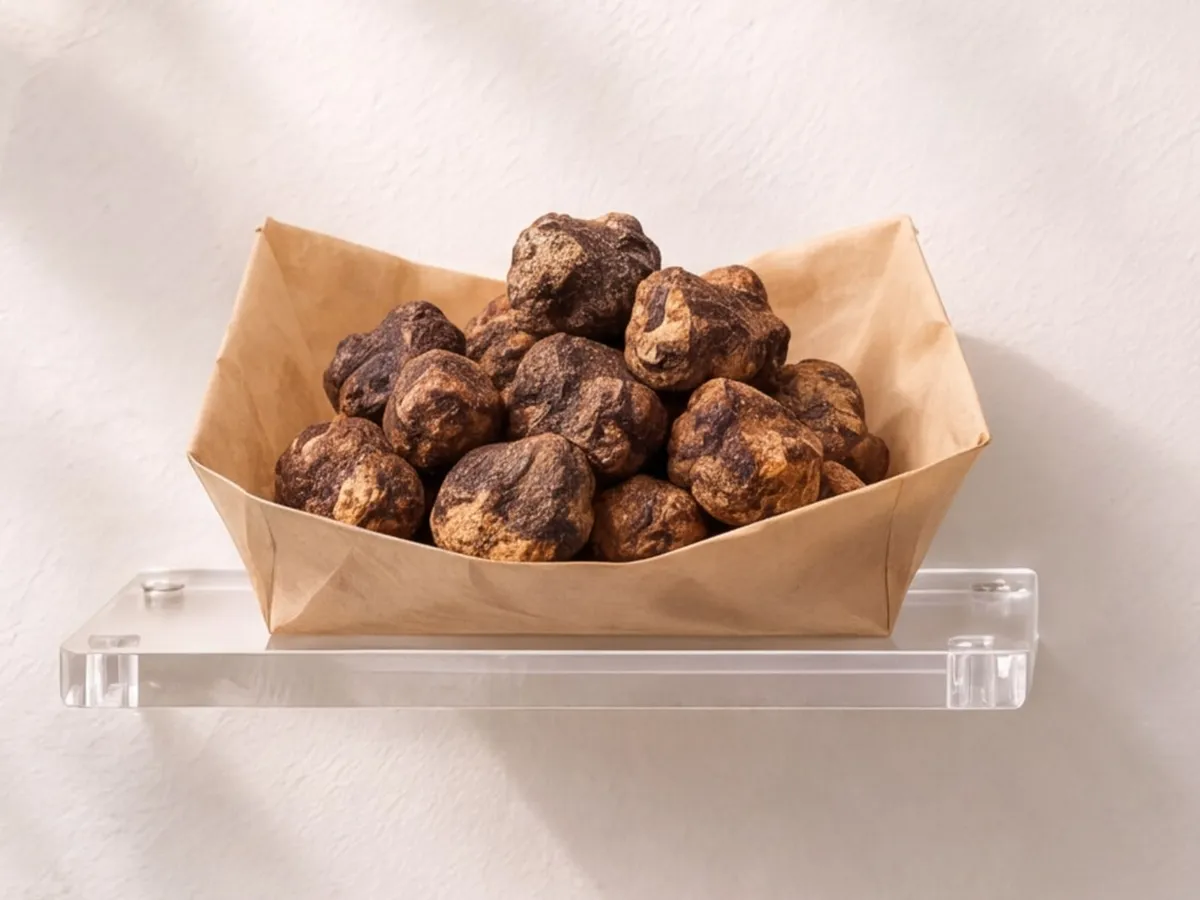
Not a culinary truffle. Magic truffles are sclerotia: dense, underground masses of fungal tissue that certain Psilocybe species form, commonly called "magic truffles" in a 2013 analysis of them. They contain psilocybin, the same compound found in psilocybin mushrooms, which are the fruiting bodies of related fungi. The legal difference between the two in the Netherlands is covered below.
Three kinds of names on one shelf
Here are the names listed by Mush Magic, Azarius and Zamnesia on their public pages on 8 October 2026, and what those pages say about them. These are supplier descriptions, reported as claims; we haven't tested the products.
| Name | What kind of name it looks like | What the shop pages say |
|---|---|---|
| Mexicana | A species name used as a variety name | Mush Magic: "Psilocybe Mexicana", "of mild strength". Azarius: P. mexicana |
| Tampanensis | A species name used as a variety name | Azarius: P. tampanensis. Mush Magic: "AKA 'philosopher's stones'" |
| Atlantis | A species name used as a variety name | Azarius lists P. atlantis among its truffle species. Mush Magic's page says it's "cultivated from a rare species of Psilocybe cubensis" |
| Mokum | Trade name | Azarius: a P. mexicana variety. Mush Magic's navigation lists it as "Psilocybe mokum", with no species statement in the description |
| Pajaritos | Trade name | Neither Mush Magic's description nor Azarius's shop page states a species |
| Fantasia | Trade name | Mush Magic: "Psilocybe cubensis sclerotia" |
| Pandora | Trade name | Mush Magic: "developed by MushMagic" as a "slightly weaker (but still very strong) version of the Hollandia truffle" |
| Hollandia, Utopia, Valhalla | Trade names | Mush Magic's navigation lists each as "Psilocybe" plus the name. Azarius gives no species. An Azarius wiki page says such names are "partly commercial branding rather than strict mycological classification" |
Zamnesia's truffle page says it offers fresh varieties "from the gentle Mexicana to the potent Valhalla".
Grower-named products work this way everywhere: "Psilocybe Hollandia" looks like a species name, but it isn't listed as one in the species entries below. The formal fungal name registers weren't searched, so read that as "no sign of it", not proof.
The species names: what's behind the Latin
Four species names come up most. The descriptions that follow come from Wikipedia's species entries, which cite the original taxonomic papers; treat them as orientation rather than a taxonomy ruling.
- Psilocybe mexicana was described by the French mycologist Roger Heim in the 1950s, according to Wikipedia's summary, and can form sclerotia.
- Psilocybe tampanensis was described by Gastón Guzmán and Steven Pollock in 1978 from a collection near Tampa, Florida, per Wikipedia. It's the source of the "philosopher's stones" nickname.
- Psilocybe atlantis was described by Guzmán and colleagues from a collection in Georgia, USA, per Wikipedia.
- Psilocybe galindoi is the odd one. Most of the taxonomic datasets that GBIF aggregates list the name as a synonym of P. mexicana, though one dataset still treats it as accepted. Wikipedia's entry adds that material sold under this name in Western cultivation is really P. tampanensis, but that sentence has no citation and carries a "disputed" tag.
The synonymy is the better supported half; the misidentification rests on that one disputed entry, so treat it as unsettled rather than established. Either way it shows the problem: when a name on a pack can be argued over by the people who study the fungus, the name alone isn't a precise description of what's in the pack. Researchers have used the name too: the Marschall 2022 trial describes its dried truffles as Galindoi truffles. A name in a paper is still a label, not a verified identification.
Strength words: each shop has its own scale
Both shops describe their truffles on a ladder. Here are the words each one used on 8 October 2026. The Azarius column is the tier from its truffle category page; the Mush Magic column quotes its product descriptions.
| Name | Azarius tier | Mush Magic description |
|---|---|---|
| Mexicana | Mild | "Of mild strength" |
| Pajaritos | Mild | "a thoughtful strain", with no strength word |
| Mokum | Mild | "despite the unique effects, these are strong truffles" |
| Tampanensis | Medium | "strong visual effects and deep, philosophical thoughts" (no tier word) |
| Fantasia | Medium | "Friendly and of moderate strength" |
| Atlantis | Medium | "one of the strongest strains of magic truffles available" |
| Pandora | Medium | "a slightly weaker (but still very strong) version" of Hollandia |
| Hollandia | Strong | "among the strongest available" |
| Utopia | Strong | "take second place, alongside Hollandia, as our strongest" |
| Valhalla | Strong | "our absolute strongest" |
At the ends the two scales line up. In the middle the words differ: Azarius calls Mokum mild and Mush Magic calls it strong, and Atlantis is medium at one shop and one of the strongest at the other. That's what independently written scales look like. Each ranks products within one shop's own range, and "strong" isn't a unit, so use a ladder to compare products inside one shop rather than across shops.
Azarius's shop page also attaches psilocybin ranges to its tiers: roughly 0.4 to 0.7% of dry weight for mild, 0.7 to 1.0% for medium and 1.0 to 1.5% for strong. A percentage of dry weight is a different basis from the fresh weight a pack is sold at, so it can't be multiplied by the pack weight without knowing the water content.
What published analyses show (and don't)
Here's the published evidence as of 8 October 2026, from a search of Europe PMC and the web.
- Pellegrini et al. (2013) developed a method for measuring psilocybin and psilocin in sclerotia and applied it to Psilocybe sclerotia. It found only psilocybin, at 59.3 to 167.8 µg per 100 mg of fresh sclerotia. That's roughly 0.06 to 0.17% of fresh weight, or about 0.6 to 1.7 mg per gram. The abstract doesn't say which varieties were tested or how many samples.
- The Marschall 2022 trial analysed the dried truffles it gave participants and reported an alkaloid concentration of about 2,129 µg/g, or around 1.5 mg in a 0.7 g dried dose. It was one batch, measured for a trial.
- Fresh and dried figures use different bases, which is why the two results above can't be compared directly. Many shop ranges use "% dry weight" while packs are sold fresh, so a percentage on a page isn't a number you can multiply by a pack's weight without knowing the water content.
- Variation can be large even under controlled conditions. In a 2026 analysis of 14 Psilocybe cubensis mushroom strains grown identically, total tryptamines varied more than 7.8-fold between strains, and psilocybin varied between individual fruiting bodies of the same strain. These were mushrooms, not truffles, so it shows what's possible. It doesn't describe commercial truffles.
What the search didn't turn up: a published, peer-reviewed analysis comparing named commercial truffle varieties side by side, or one that tests whether a variety's name predicts its psilocybin content or its effects. Azarius's wiki says the same, that controlled comparisons holding dose constant and varying only the variety are still awaited, which matches our reading of the literature.
Reading a truffle listing: what to look for
Here's how to read a listing, using the pages above as the example. The answers are what those pages state.
| Question | What the shop pages gave |
|---|---|
| Which variety is it? | A name, on every product |
| Which species is it? | Sometimes stated (Azarius for Mexicana, Tampanensis, Atlantis, Mokum), sometimes not, and sometimes described differently in other references (see above) |
| How much is in the pack? | Mush Magic: 15 g, vacuum-packed. Azarius describes a standard pack as 12-15 g (its examples use 15 g) |
| How much psilocybin per gram? | Azarius gives tier ranges; Mush Magic's pages give none |
| How long does it keep? | Azarius says 2 to 3 months refrigerated at 2 to 4°C. Whichever shop you use, the date on your pack is the one that counts |
| Is a lab report linked? | Not on the pages we read on 8 October 2026, so potency figures are the shop's own description |
Three habits follow from that:
- Read the name as a label, not a measurement. If a page claims a species, check whether it also tells you where that identification came from.
- Treat percentages and "strong" as the shop's claims. They become information when there's a named method, sample and batch.
- Compare like with like. Fresh weight, dried weight and percentage of dry weight are different things.
Want to try those habits on real listings? Microdosing truffles: products, packs and where to buy puts the small-portion packs and the shops that list them side by side.
The Netherlands in brief
As of 8 October 2026, fresh psilocybin truffles (sclerotia) are sold legally in Dutch smartshops, according to Jellinek (page version January 2021), Trimbos's DRUGSinfo and Drugs en Uitgaan. The Opium Act text puts psilocine and psilocybine on List I and mushrooms on List II. The mushroom list names species such as Psilocybe mexicana, P. tampanensis and P. galindoi but no truffles or sclerotia, and Jellinek dates the ban on selling fresh mushrooms to December 2008. Dried truffles are where the sources part ways: Jellinek says they fall under List I, while Trimbos says truffles aren't covered and Drugs en Uitgaan says they aren't on the Opium lists, though their active ingredients are on List I; neither mentions drying, so this page doesn't call dried truffles either legal or banned. The ban on certain designer-drug groups from 1 July 2025 (government page) doesn't mention truffles.
Dutch rules don't apply across the EU, and a shop shipping "where permitted" is the shop's statement, not a legal clearance. Jellinek also says driving after use is prohibited. Our mushrooms and truffles guide sets out the legal picture in more detail.
Safety and support
The NCCIH says the experience depends on how much psilocybin someone takes and on their personality, mood, expectations and surroundings, and lists the type of mushroom and prior experience among the factors, together with combined use with other drugs. It lists possible adverse effects including raised blood pressure and heart rate, nausea, anxiety, paranoia and hallucinations, and says psilocybin isn't safe for people with psychotic conditions such as schizophrenia or severe forms of bipolar disorder. It also notes research is under way on interactions with conventional medicines, including SSRIs.
The practical takeaway here is narrower: a variety's name or a shop's strength word isn't a reliable guide to how strong a given pack will be, and it's no substitute for advice from a doctor, pharmacist or Dutch harm-reduction service. Jellinek and Trimbos publish information in Dutch, and if you or someone else is in distress after using, contact a doctor or emergency services.
So what actually changes between the names?
- Species, where it's stated and correct, is a real difference, though researchers disagree about some names, and the differences in published potency data between species aren't well established.
- Trade names tell you which grower or shop sold it, which is useful for finding the same product again.
- Strength words tell you where the shop thinks it sits in its own range. They don't transfer between shops.
- Psilocybin content is the number that matters and the one a pack rarely states. Without a lab report, a ladder is an estimate.
Where to read next
A name on the pack is only the start. These guides pick up the questions that come next.
- What to expect from magic truffles, for the timing, why the same pack differs between people, difficult moments and who should skip them.
- Truffle safety, difficult experiences and getting support, for who should avoid psilocybin, what difficult experiences look like and the Dutch help options.
- Microdosing products and protocols explained, for what truffle microdosing packs contain, where the Fadiman and Stamets schedules came from and what controlled trials have tested.
- Microdosing: the idea, the research and the reality, for what placebo-controlled psilocybin microdosing studies measured and why expectation muddies the results.
This article is for informational purposes only and is not intended as medical advice. Always consult a healthcare professional before starting any new supplement, especially if you take prescription medication.
Sources
The 18 outside pages this article links to, in the order it first cites them.
- 2013 analysis of them pubmed.ncbi.nlm.nih.gov
- Mush Magic mushmagic.com
- Azarius azarius.com
- Zamnesia zamnesia.com
- Wikipedia's summary en.wikipedia.org
- Wikipedia en.wikipedia.org
- Wikipedia en.wikipedia.org
- GBIF gbif.org
- Wikipedia's entry en.wikipedia.org
- Marschall 2022 trial pmc.ncbi.nlm.nih.gov
- total tryptamines varied more than 7.8-fold between strains pubmed.ncbi.nlm.nih.gov
- Jellinek jellinek.nl
- Trimbos's DRUGSinfo drugsinfo.nl
- Drugs en Uitgaan drugsenuitgaan.nl
- Opium Act text wetten.overheid.nl
- Jellinek jellinek.nl
- government page rijksoverheid.nl
- NCCIH nccih.nih.gov
Where to buy
How do the named microdosing packs, portion sizes and shops compare?
Buying guideMicrodosing truffles: products, packs and where to buy
Read the buying guide All buying guides and brandsMore on truffles & microdosing
- Magic mushrooms and truffles: same conversation, different productsHow do they relate, and what did clinical trials test?
- Microdosing: the idea, the research and the realityWhat did placebo-controlled studies measure, and how does the reality compare with the idea?
- Magic truffles and mushrooms legal status in Europe by countryAre magic mushrooms and magic truffles legal in my European country?
- What to expect from magic truffles: effects, variability and cautionsWhat happens after eating them, and why does the same pack differ between people?