Microdosing products and protocols explained
What is in a microdosing pack, and where did the popular schedules come from?
In short
- A microdosing pack is a pre-weighed portion (the shop pages describe six 1 g doses of fresh truffles); the label weight is not a psilocybin dose.
- The Fadiman and Stamets schedules are descriptions published by their authors, based on self-reports and a patent application that reported no human data; no trial has compared them.
- In placebo-controlled trials, psilocybin microdosing mostly did not outperform placebo; observational studies that found improvements involved participants who knew what they took.
- Lion's mane and niacin each need their own evidence: lion's mane has small trials, mostly in older adults with mild cognitive impairment, and we found no human test of niacin as a 'delivery' aid.
- Fresh truffles are sold legally in the Netherlands, mushrooms are prohibited and dried truffles are disputed between sources (read on 8 October 2026); that is a Dutch position, not an EU-wide one.
On this page 12 sections
- Six things to know before you read a pack label
- What's actually in a microdosing pack
- The Fadiman protocol: a schedule from self-reports
- The Stamets stack: from patent application to shop shelf
- What controlled research has tested
- What a schedule can and can't tell you
- Lion's mane: what its own studies tested
- Niacin: the "delivery" idea and the flush
- Reading a pack page: the box and the contents
- The Netherlands in brief (as of 8 October 2026)
- Safety, briefly
- Where this leaves packs, protocols and add-ons
Pick up a truffle microdosing pack and you're handed two things: six small portions and a vocabulary test. Fadiman. Stamets. "One on, two off." A "stack". Some packs even arrive named after how you'd like your Tuesday to feel. Let's sort out what the products are, where the named schedules came from and what has actually been tested.
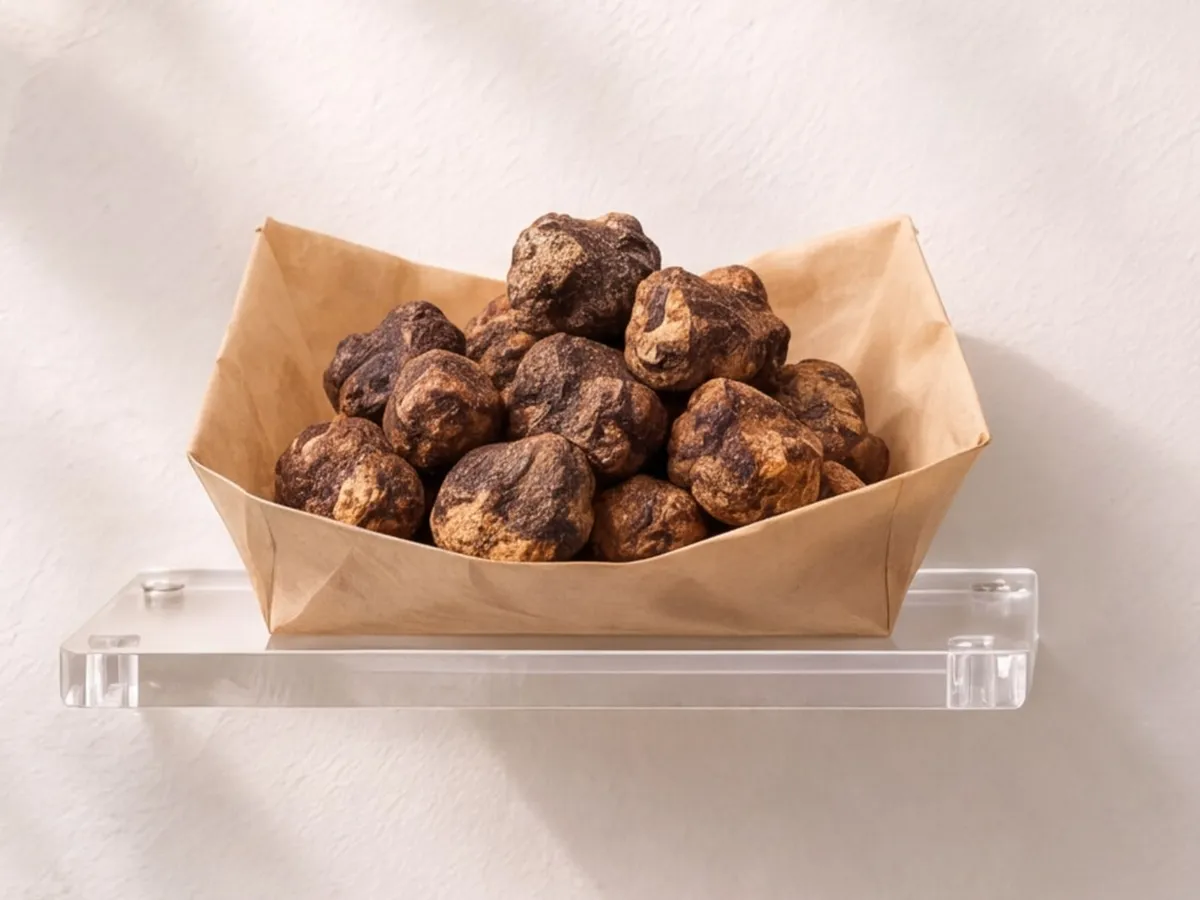
In plain terms, the packs are small, pre-weighed portions of fresh truffles. The schedules are published by their authors and come from personal reports and, in Stamets's case, a patent application. When controlled trials tested psilocybin microdosing against placebo, they mostly found no reliable benefit beyond placebo. Lion's mane and niacin, the two add-ons in the Stamets stack, are separate ingredients with their own, separate evidence.
Six things to know before you read a pack label
- A pack is a portion size, not a protocol. The shop pages describe six 1 g doses of fresh truffles, and the pack names describe the mood they're aimed at rather than different formulas.
- A named schedule is a description, not a result. Fadiman's one-day-on, two-days-off pattern came from self-reports he gathered. The Stamets stack began as a patent application that reported no human data.
- Controlled trials of psilocybin microdosing mostly didn't beat placebo. Larger observational studies found improvements, but those participants knew what they were taking.
- Lion's mane and niacin can't borrow psilocybin's evidence. Each has its own research, and for the idea that niacin "delivers" the other two we found no human study.
- A "1 g" label is a weight, not a psilocybin dose. Published measurements of truffle content vary.
- Fresh truffles are sold legally in the Netherlands; mushrooms are prohibited; dried truffles are disputed between sources. That's a Dutch position (read on 8 October 2026), not an EU-wide one.
What's actually in a microdosing pack
Microdosing means taking amounts of a psychedelic too small to cause the usual psychedelic experience, repeatedly, on a schedule. What counts as "too small" isn't settled. A 2026 phase 1 study gave 56 healthy adults single doses of psilocybin between 0.5 and 4.0 mg specifically to identify a subperceptual dose. That the question is still being asked tells you "microdose" isn't a measured category.
On the shop side, here's what two retailers' public pages said on 8 October 2026. These are supplier descriptions, quoted as claims; they haven't been tested or endorsed by us.
Mush Magic lists five microdosing packs: Original, Productivity, Clarity, Creativity and Energy. Each page describes six 1 g doses of truffles (two of the five say fresh); the pages describe the portions rather than naming a truffle variety or a psilocybin content.
Azarius has a microdosing category that includes three Cibdol-branded products. Everything in this paragraph is Azarius's own page copy; Cibdol's labels haven't been seen. Each is described as six 1 g doses of fresh sclerotia, with the species named: according to Azarius's product pages, the Truffle Microdoses FP pack is Psilocybe mexicana, the SP pack is Psilocybe galindoi and the OP pack is Psilocybe tampanensis. (Treat the galindoi label with care: Wikipedia's species entry says material sold in the West under that name is misidentified, and that true P. galindoi is considered a synonym of P. mexicana. It floats P. tampanensis as the real identity but marks that as disputed. The identity of the name is unsettled.) Azarius's pages tie FP, SP and OP to a Fadiman schedule, a Stamets schedule and a one-day-on, one-day-off schedule. The same category also lists stacked packs from another brand that pair truffles with other ingredients (per the page: lion's mane and ginkgo in one, cordyceps and MCT in another, cacao in a third).
Three things worth noticing:
- The pack is truffles; the stack is separate. Azarius's SP page lists the contents as six 1 g portions of sclerotia and says you can add lion's mane and niacin yourself if you want the "full stack".
- The schedule is sometimes printed next to the product. A pack of six doses is six doses. The schedule is a suggestion that travels with it.
- Schedules are written loosely. Published versions of the Stamets schedule have moved between five days on and two off, and four on and three off (see the Stamets section below), so check which version a page means.
Those shop pages don't list truffle microdosing gummies or chocolates. Chocolate and capsules do appear in research: a 2026 systematic review of psilocybin mushroom and truffle microdosing notes studies using preparations including dried, ground, encapsulated, chocolate and fresh material, with "extreme heterogeneity" across preparations and schedules. The legal side of fresh versus dried is covered further down.
The Fadiman protocol: a schedule from self-reports
James Fadiman, a psychologist, described a microdosing schedule in his book The Psychedelic Explorer's Guide (2011). His own microdosing website describes it as one day of microdosing followed by two days off, continued for at least a month, and says he has been collecting anecdotal reports from people who track their experience in a daily journal.
That's the origin. A 2024 Aeon essay describes the protocol as informed by anecdotal reports, and says these schedules are popular but haven't been tested in any systematic way against others. The two off days rest on people's reports that effects seem to last around two days. That's an observation worth testing, not a measured property of the schedule.
It is, however, the schedule researchers borrowed. The Marschall 2022 trial cites Fadiman's book for the "every third day" pattern its participants followed. So it's a schedule that has been studied. It hasn't been shown to be better than any other.
The Stamets stack: from patent application to shop shelf
Paul Stamets is a mycologist. His patent application, published in 2018, proposes combining psilocybin or psilocin with erinacines or hericenones (compounds associated with lion's mane) and niacin, which the application defines as nicotinic acid, also known as vitamin B3. According to its description, niacin is a vasodilator that helps these compounds cross the blood-brain barrier. Google Patents lists the application's status as abandoned (as of our check on 8 October 2026). The document reports no human clinical data: it proposes example formulas rather than results.
So the stack begins as a hypothesis: psilocybin for neuroplasticity, lion's mane for nerve growth factor, niacin for delivery. That's a reasonable thing for an inventor to propose. It isn't a finding.
The schedule has moved too. A Double Blind magazine explainer reports that Stamets described five days on and two off around 2017, and four on, three off by 2019, and that his hypothesis hadn't been tested in a rigorous clinical trial. That's a secondary source, but it fits the loose way the schedule appears on shop pages.
What controlled research has tested
Observational studies ask people who already microdose how they feel. Controlled trials give some people a placebo without telling them which they got. They answer different questions, and for "does this work?" the second kind matters more.
| Study | Design | What it found |
|---|---|---|
| Szigeti et al., eLife, 2021 | Self-blinding citizen science: participants made their own placebo capsules; 191 completed. Mostly LSD, about a quarter psilocybin mushrooms | Microdosers improved, but so did the placebo group, with no significant difference between groups on the psychological measures. Acute effects faded after accounting for participants' guesses about their capsule |
| Cavanna et al., Translational Psychiatry, 2022 | Double-blind, placebo-controlled; 34 people starting to microdose with Psilocybe cubensis mushrooms | No evidence for enhanced well-being, creativity or cognition, and a few small changes towards cognitive impairment. The authors conclude expectation underlies at least some anecdotal benefits |
| Marschall et al., J Psychopharmacol, 2022 | Double-blind, placebo-controlled crossover with psilocybin truffles, dosed every third day | No effect on emotion processing or on anxiety and depression symptoms compared with placebo. Participants broke the blind in the second block |
| Prochazkova et al., 2026 | Two randomised, double-blind, placebo-controlled trials of psilocybin truffles | No significant effect on behavioural or subjective measures; small early effects didn't survive correction for multiple comparisons. Participants stayed blinded |
Reviews paint the same picture. A 2026 systematic review and meta-analysis of 24 studies (3,681 participants) found that randomised trials showed subjective and neurophysiological effects but minimal impact on cognition, creativity or sustained mood, while observational studies showed mood and personality improvements "likely influenced by expectancy or lifestyle factors". A 2026 review of mushroom and truffle microdosing rated the certainty of the evidence as low and said a causal effect can't be inferred. A 2024 critique looked at 15 papers published up to March 2022 and concluded it was premature to draw conclusions about efficacy or safety, so it's an older verdict than the 2026 reviews above.
The NCCIH says, on a page last updated in May 2024, that it isn't clear whether microdosing is safe or effective.
None of these trials compared protocols with each other. So there's no controlled evidence that Fadiman's pattern beats Stamets's, or any other.
What a schedule can and can't tell you
A schedule can be tidy, popular and well-meant without showing a benefit. Two reasons:
- It's built from reports. Self-reports from people who chose to microdose capture how they felt, which includes hope, routine and the novelty of a new habit.
- Expectation is strong here. In several trials above, participants worked out whether they'd had the real dose. Szigeti's team found that some effects shrank once those guesses were taken into account.
The one large observational study that looked at stacking shows why this matters. Rootman et al. (Scientific Reports, 2022) followed 953 people who microdosed psilocybin and 180 who didn't, for about a month. There was no randomisation, and both groups knew their status. The microdosers reported improvements in mood and mental health. They fell into three groups: psilocybin alone (40.4%), psilocybin plus lion's mane (31.9%) and psilocybin plus lion's mane and niacin (27.7%). The mood results didn't differ across those groups. A finger-tapping measure of psychomotor speed improved in people aged 55 and over in the combination group (100 of the 953 microdosers were 55 or older). The authors say they lacked the power to separate the combination's effect from niacin alone, can't rule out expectancy effects, and describe it as the first study to distinguish between stacked combinations. Stamets is among the authors, and the paper's competing-interests statement lists commercial and patent interests connected to the combination.
So: a small, interesting signal in one subgroup of an unblinded study. Not a test of the stack.
Lion's mane: what its own studies tested
Lion's mane (Hericium erinaceus) is an edible mushroom sold as a supplement. What it does or doesn't do doesn't depend on psilocybin, so look at it on its own:
- Mori et al., 2009: 30 Japanese adults aged 50 to 80 with mild cognitive impairment, randomised to lion's mane tablets or placebo for 16 weeks. The lion's mane group scored higher on a cognitive scale at weeks 8, 12 and 16. Scores dropped significantly four weeks after stopping.
- Docherty et al., 2023: a pilot study of 41 healthy adults aged 18 to 45. After a single dose, participants were faster on a Stroop task an hour later, and 28 days of supplementation showed a trend (p = 0.051) towards lower subjective stress. The authors note null and limited negative findings too, and call for larger studies.
- Surendran et al., 2025: 18 healthy adults aged 18 to 35 given a single dose of an extract. No significant overall effect on cognition or mood, with one task (a pegboard test) improving.
- A 2025 systematic review found five randomised trials and a few pilot studies, assessing cognitive outcomes in people with and without dementia.
Reading across them: there are small trials with some positive signals, mostly in older adults with mild cognitive impairment. The evidence in healthy younger adults is mixed and small. The nerve-growth-factor idea rests largely on laboratory and animal research. And apart from the observational comparison above, we found no study testing lion's mane combined with psilocybin against a control.
Supplement form matters, too. Fruiting-body extracts, mycelium products and tablets aren't interchangeable, and the studies above used different preparations and amounts. For the general approach to checking what a supplement label tells you, see our guide to reading supplement labels.
Niacin: the "delivery" idea and the flush
In the patent application, niacin is the carrier, and the application defines niacin as nicotinic acid, the form associated with flushing. The EU's Scientific Committee on Food explained why that matters in its 2002 opinion on niacin:
- It set an upper level of 10 mg a day for free nicotinic acid, based on occasional flushing reported at 30 mg a day in an old study. Flushing comes from blood vessels widening, and the committee flagged a worry about brief drops in blood pressure, especially in older people.
- It set a separate upper level of about 900 mg a day for nicotinamide, which doesn't cause flushing.
- It noted that more serious effects, such as liver toxicity, occurred at doses roughly ten times higher than those linked to flushing.
An upper level is a long-term intake guide for the general population. It isn't a diagnosis of harm and it isn't advice for any individual. But set it beside the patent application, whose first example formula lists 200 mg of niacin a day. Since the application defines niacin as nicotinic acid, that's 20 times the 10 mg figure for nicotinic acid, though a fraction of the 900 mg figure for nicotinamide. The number matters less than the awareness that the flush people talk about is a known, dose-related effect of this form of the vitamin.
As for whether niacin helps psilocybin or lion's mane reach the brain, a search of Europe PMC on 8 October 2026 found no human study testing it. The idea is a mechanism stated in the patent application, so it remains a hypothesis.
Reading a pack page: the box and the contents
A label can tell you a lot about the box. It can tell you much less about what's in it.
What a good label or product page can show: the truffle variety name, whether a species is stated, the weight per portion, a packing or best-before date, storage instructions and any batch information. For fresh truffles, the date and storage instructions on your own pack are the ones that count.
What it generally can't show:
- How much psilocybin is in a "1 g" portion. The one peer-reviewed measurement of sclerotia content cited here, Pellegrini et al. (2013), found only psilocybin (no psilocin) in the sclerotia it examined, at 59.3 to 167.8 µg per 100 mg of fresh sclerotia. Per gram of fresh sclerotia, that works out at about 0.6 to 1.7 mg. The paper's abstract doesn't say which varieties were tested or how many samples. A trial team that analysed the dried truffle batch it used (Marschall 2022) reported an alkaloid concentration of about 2,129 µg/g, or around 1.5 mg in its 0.7 g dried dose. Those figures use different bases (fresh versus dried), so they can't be lined up directly. The point is that a portion's weight and its psilocybin content are two different numbers.
- Whether potency is consistent from pack to pack. Suppliers describe truffles as consistent because they're grown under controlled conditions, and that may well be true, but we found no published comparison of commercial batches. For a sense of what can happen, one analysis of 14 Psilocybe cubensis mushroom strains grown under uniform conditions found total tryptamines varied more than 7.8-fold between strains, and psilocybin varied between individual fruiting bodies of the same strain. That's mushrooms, not truffles, so it shows what's possible rather than what happens in a pack.
- That the product matches its description. A "lab-tested" statement becomes information when you can read the report: what was measured, in which batch, by whom.
A truffle pack isn't a regulated supplement, so label-reading here is a way of asking good questions rather than a promise of what you'll find.
The Netherlands in brief (as of 8 October 2026)
The Opium Act text (read on 8 October 2026) puts psilocine and psilocybine on List I and mushrooms on List II. The mushroom list names species such as Psilocybe mexicana, P. tampanensis and P. galindoi, but it names no truffles or sclerotia. Fresh psilocybin truffles are sold legally in Dutch smartshops: Jellinek (page version January 2021) says selling fresh sclerotia isn't prohibited, Trimbos's DRUGSinfo and Drugs en Uitgaan say truffles aren't on the Opium Act lists (Drugs en Uitgaan adds that their active ingredients are on List I), and another Jellinek page adds that fresh truffles fall under the Warenwet (Commodities Act). Mushrooms are on List II, and since December 2008 that has included selling them fresh. Dried truffles are disputed: Jellinek says they fall under List I, the other two make no distinction for drying, and we treat it as unresolved. A ban on certain designer-drug groups took effect on 1 July 2025; the government's page on it doesn't mention truffles.
Don't assume another country treats truffles the same way (other EU countries weren't checked for this page). A shop shipping "where permitted" is the shop's statement, not a legal clearance, and Jellinek says driving after use is prohibited, which matters because "sub-perceptual" is a description, not a driving test. Our mushrooms and truffles guide covers the legal picture in more depth.
Safety, briefly
The NCCIH lists psilocybin's adverse effects as including anxiety, paranoia, poor sleep and fatigue, and says microdosing specifically can cause insomnia, increased anxiety, low mood and low energy. It states psilocybin isn't safe for people with psychotic conditions such as schizophrenia or severe forms of bipolar disorder, and notes ongoing research on interactions with conventional medicines including SSRIs. Mush Magic's own pack pages list possible side effects (reduced appetite, insomnia, gastrointestinal symptoms, increased anxiety, reduced energy, mood or focus, and cognitive problems) and advise consulting a doctor with concerns. If you take any medicine, a pharmacist or doctor is the person to ask; our guide to supplement and drug interactions explains why interactions are worth checking, though psilocybin isn't a supplement and that guide doesn't cover it. For Dutch harm-reduction information, Jellinek and Trimbos publish guidance in Dutch.
Where this leaves packs, protocols and add-ons
- Packs are a convenience: pre-weighed portions solve a weighing problem, and they're easy to read once you know a "1 g" label is a weight rather than a psilocybin dose.
- Fadiman's and Stamets's schedules are useful reference points when people mention them. They're authors' descriptions, and no trial has compared one with another.
- The best-controlled psilocybin microdosing studies so far haven't found a reliable benefit beyond placebo. That doesn't prove nobody benefits; it's the current state of the evidence.
- Lion's mane has its own small research base, mostly in older adults with mild cognitive impairment, and niacin's "delivery" role is a stated hypothesis.
To go deeper on the trials, microdosing: the idea, the research and the reality goes through them and the reviews. For what a truffle experience can be like, see what to expect from magic truffles, and for what the names on a pack mean, magic truffle varieties.
Microdosing packs and shops compared: Explore the named packs, portion sizes and dated shop listings in the buying guide.
This article is for informational purposes only and is not intended as medical advice. Always consult a healthcare professional before starting any new supplement, especially if you take prescription medication.
Sources
The 31 outside pages this article links to, in the order it first cites them.
- identify a subperceptual dose pubmed.ncbi.nlm.nih.gov
- five microdosing packs mushmagic.com
- microdosing category azarius.com
- systematic review pmc.ncbi.nlm.nih.gov
- microdosing website microdosingpsychedelics.com
- 2024 Aeon essay aeon.co
- Marschall 2022 trial pubmed.ncbi.nlm.nih.gov
- patent application patents.google.com
- explainer doubleblindmag.com
- Szigeti et al., eLife, 2021 doi.org
- Cavanna et al., Translational Psychiatry, 2022 pubmed.ncbi.nlm.nih.gov
- Prochazkova et al., 2026 pubmed.ncbi.nlm.nih.gov
- systematic review and meta-analysis pubmed.ncbi.nlm.nih.gov
- review of mushroom and truffle microdosing pubmed.ncbi.nlm.nih.gov
- 2024 critique pubmed.ncbi.nlm.nih.gov
- says nccih.nih.gov
- Rootman et al. (Scientific Reports, 2022) pubmed.ncbi.nlm.nih.gov
- Mori et al., 2009 pubmed.ncbi.nlm.nih.gov
- Docherty et al., 2023 pubmed.ncbi.nlm.nih.gov
- Surendran et al., 2025 pubmed.ncbi.nlm.nih.gov
- 2025 systematic review pubmed.ncbi.nlm.nih.gov
- 2002 opinion on niacin ec.europa.eu
- Pellegrini et al. (2013) pubmed.ncbi.nlm.nih.gov
- Marschall 2022 pmc.ncbi.nlm.nih.gov
- total tryptamines varied more than 7.8-fold between strains pubmed.ncbi.nlm.nih.gov
- Opium Act text wetten.overheid.nl
- Jellinek jellinek.nl
- Trimbos's DRUGSinfo drugsinfo.nl
- Drugs en Uitgaan drugsenuitgaan.nl
- Jellinek page jellinek.nl
- government's page on it rijksoverheid.nl
Where to buy
How do the named microdosing packs, portion sizes and shops compare?
Buying guideMicrodosing truffles: products, packs and where to buy
Read the buying guide All buying guides and brandsMore on truffles & microdosing
- Magic mushrooms and truffles: same conversation, different productsHow do they relate, and what did clinical trials test?
- Magic truffle varieties: what changes between the names?Which truffle names are species, which are trade names, and what is known about strength?
- Microdosing: the idea, the research and the realityWhat did placebo-controlled studies measure, and how does the reality compare with the idea?
- Magic truffles and mushrooms legal status in Europe by countryAre magic mushrooms and magic truffles legal in my European country?