Microdosing Myths Debunked: 10 Things People Get Wrong
Written by Smart Supplements Editorial Team
Key takeaways
- Many popular microdosing claims are oversimplified or unsupported by controlled research
- The placebo effect plays a significant and documented role in reported benefits
- A correctly calibrated microdose is sub-perceptual — you should not feel high
- Microdosing has real side effects and is not safe for everyone
- Psilocybin truffles and mushrooms contain the same active compounds at varying concentrations
- The best approach is treating microdosing as a personal experiment with honest expectations
Table of contents
- Myth 1: Microdosing Is a Proven Treatment for Depression
- Myth 2: You Should Feel Something on a Microdose
- Myth 3: Microdosing Makes You More Creative
- Myth 4: Everyone Should Follow the Fadiman Protocol
- Myth 5: Microdosing Has No Side Effects
- Myth 6: Psilocybin Truffles Are Weaker Than Mushrooms
- Myth 7: Microdosing Is Completely Legal Everywhere
- Myth 8: You Can Microdose While Taking Antidepressants
- Myth 9: Microdosing Is Just a Silicon Valley Fad
- Myth 10: All Truffles/Mushrooms Are the Same for Microdosing
- The Meta-Myth: Microdosing Either Works or It Doesn't
- Frequently Asked Questions
- Further Reading
Microdosing has crossed over from psychedelic subculture to mainstream wellness conversation — and in that crossing, a thick layer of myth has settled over the practice. Some myths overstate the benefits. Others overstate the dangers. A few are so deeply embedded that even experienced microdosers repeat them without question. Here are ten that deserve correction.
Myth 1: Microdosing Is a Proven Treatment for Depression
This is perhaps the most harmful myth, because it conflates two different things.
The reality: Full-dose psilocybin therapy — where patients take 25mg of synthetic psilocybin under clinical supervision — has shown remarkable results for treatment-resistant depression in Phase 2b trials by COMPASS Pathways and at Johns Hopkins. These are supervised sessions with trained therapists, preparation, and integration work.
Microdosing is a completely different intervention. The doses are 5–10% of a clinical dose, taken without supervision, and the research is far less conclusive. The Imperial College self-blinding study (Szigeti et al., 2021) found that microdosing and placebo produced equivalent improvements in wellbeing — suggesting that expectation and ritual may drive much of the benefit.
Does this mean microdosing is useless for mood? No. Many people report genuine subjective improvements. But calling it a "proven treatment" is irresponsible and could lead people to delay seeking evidence-based care.
What to do instead: If you are dealing with clinical depression, speak to a healthcare professional first. Microdosing may complement therapy, but it should not replace it. Read our full analysis in Microdosing for Anxiety and Depression.
Myth 2: You Should Feel Something on a Microdose
This myth traps more beginners than any other. They take a microdose, feel nothing obvious, and assume it is not working — so they increase the dose until they do feel something.
The reality: A correctly calibrated microdose is, by definition, sub-perceptual. You should not feel high, see visual changes, or experience any impairment. The effects — if they exist — are subtle enough that you might only notice them when reviewing your journal entries at the end of the week.
If you feel something acutely after dosing, your dose is too high. This is not microdosing; it is a light trip, which carries different risks and is not suitable for work, driving, or normal daily activities.
The threshold test: Take your microdose on a normal workday. If a colleague could tell, it is too much. If you can go about your entire day and only notice in retrospect that you were slightly more present or slightly less reactive — that is the target zone.
Myth 3: Microdosing Makes You More Creative
This one is seductive because it has a kernel of truth — but the kernel has been inflated into an entire cob.
The reality: The creativity claim largely traces back to a 2018 Leiden University study (Prochazkova et al.) where participants at a microdosing event scored higher on convergent and divergent thinking tests after microdosing. The problem? There was no control group, no blinding, and participants were at an event specifically about microdosing — their expectations could not have been higher.
When controlled studies have tested creativity more rigorously, the results are mixed at best. The 2021 Imperial College self-blinding study found no significant difference between microdose and placebo groups on creative thinking measures.
What might actually happen: Microdosing may reduce inhibition and self-criticism, which can feel like enhanced creativity. If you normally second-guess every idea, taking away that filter might help you generate more — but the raw creative capacity is yours, not the psilocybin's. Our full exploration is in Microdosing and Creativity.
Myth 4: Everyone Should Follow the Fadiman Protocol
The Fadiman Protocol — one day on, two days off — has become so synonymous with microdosing that many people treat it as the only valid approach.
The reality: James Fadiman himself has said the protocol was a starting point for data collection, not a universal prescription. Different bodies, goals, and lifestyles may benefit from different schedules:
- The Stamets Protocol (4 on, 3 off) may suit people seeking more sustained neuroplasticity effects via the Stamets Stack
- The Every Other Day protocol works well for people who want more consistent effects
- Intuitive dosing (1–3 times per week, when it feels right) is preferred by many experienced microdosers
- Some people find they respond best to once weekly doses with longer integration periods
The best protocol is the one that fits your life and that you will actually follow consistently for 4–8 weeks. Read about how long to microdose for guidance on cycling.
Myth 5: Microdosing Has No Side Effects
This myth is dangerous because it lowers people's guard.
The reality: Microdosing can produce side effects, and some people are more susceptible than others. Commonly reported issues include:
- Increased anxiety — especially at higher microdoses or in anxious individuals
- Insomnia — if dosed too late in the day
- Digestive discomfort — nausea, bloating, or mild stomach upset (truffles contain chitin, which is hard to digest)
- Emotional amplification — both positive and negative emotions may intensify
- Headaches — reported by a minority, often in the first week
- Jaw tension — related to serotonergic activation
These are generally mild and manageable, but they are real. More seriously, microdosing carries meaningful risks for people with a history of psychosis, bipolar disorder, or those taking SSRIs. Our complete guide covers this in detail: Microdosing Side Effects.

Microdosing XP Truffles
Pre-portioned psilocybin truffle strips designed specifically for microdosing — consistent dosing without a scale.
- • Pre-portioned for accurate microdosing
- • No scale needed — ready to use
- • Consistent psilocybin content per portion
Disclosure: We may earn a commission if you purchase via these links.
Myth 6: Psilocybin Truffles Are Weaker Than Mushrooms
This myth is widespread and completely understandable — truffles look less dramatic than mushrooms, so they must be less potent, right?
The reality: Fresh truffles and fresh mushrooms contain the same active compounds (psilocybin, psilocin, baeocystin). The concentration varies by species, not by whether it is a truffle or a mushroom. Some truffle varieties (Hollandia, Valhalla) are significantly stronger gram-for-gram than mild mushroom strains.
The confusion arises because dried mushrooms are compared to fresh truffles. Drying removes ~90% of water weight, concentrating the psilocybin. So 1g of dried mushrooms ≈ 10g of fresh — and 10g of fresh truffles is a solid dose.
For microdosing specifically, the distinction is nearly irrelevant. What matters is finding and calibrating your dose regardless of the source material. See our full comparison: Microdosing Truffles vs Mushrooms.
Myth 7: Microdosing Is Completely Legal Everywhere
The reality: Psilocybin is a Schedule I or equivalent substance in most countries worldwide. The Netherlands is a notable exception, where psilocybin truffles (sclerotia) are legal to buy and possess. Portugal has decriminalised personal possession. Czechia legalised medical psilocybin in January 2026. But in most of Europe, the UK, and Australia, possession carries criminal penalties.
Even in the Netherlands, there are rules: psilocybin mushrooms (the fruiting body) are illegal. Only truffles enjoy legal status.
The legal landscape is changing rapidly, but assuming legality based on trending social media posts is risky. Always check the specific laws in your jurisdiction: Microdosing Legal Guide.
Myth 8: You Can Microdose While Taking Antidepressants
This myth circulates constantly in online communities, often framed as "I microdosed alongside my SSRI and it was fine."
The reality: SSRIs (selective serotonin reuptake inhibitors) and psilocybin both act on the serotonin system. Combining them creates two significant risks:
- Blunted effects — SSRIs can reduce or eliminate psilocybin's effects entirely, leading people to increase their dose dangerously
- Serotonin syndrome — a rare but potentially life-threatening condition caused by excessive serotonergic activity, with symptoms including agitation, rapid heart rate, high blood pressure, and in severe cases, seizures
The fact that some people combine the two without obvious problems does not make it safe. Individual variation in serotonin metabolism is enormous, and the interaction is unpredictable.
Critical rule: Never stop SSRIs abruptly to start microdosing. SSRI withdrawal must be medically supervised and typically takes weeks to months. Consult your prescribing doctor about any changes to your medication.
Myth 9: Microdosing Is Just a Silicon Valley Fad
This dismissal frames microdosing as a tech-bro productivity hack that will fade like every other optimisation trend.
The reality: While Silicon Valley brought microdosing into mainstream media attention around 2015, the practice has far deeper roots and a much broader demographic. James Fadiman began collecting microdosing reports in 2010, but indigenous use of psilocybin extends thousands of years.
Today's microdosing community is remarkably diverse:
- Professionals seeking cognitive enhancement (the Silicon Valley stereotype)
- People with depression and anxiety looking for alternatives to pharmaceutical approaches
- Artists and musicians exploring creative processes
- Athletes integrating microdosing with exercise and movement
- Meditators deepening their mindfulness practice
- Older adults interested in neuroplasticity and cognitive preservation
- Parents (yes, really) looking for patience and presence
More importantly, serious research institutions — Imperial College London, Johns Hopkins, Maastricht University, the Beckley Foundation — are investing millions in understanding psychedelics. This is not a fad; it is an emerging field of neuroscience.
Myth 10: All Truffles/Mushrooms Are the Same for Microdosing
The reality: Psilocybin content varies dramatically between species and even between batches of the same species. A microdose of Hollandia truffles (very potent) is a very different experience from the same weight of Mexicana truffles (mild).
For microdosing, milder strains are preferred because their lower psilocybin concentration makes precise dosing easier and reduces the risk of accidentally crossing into perceptual territory. Recommended beginner strains include:
- Mexicana — consistently mild, the gold standard for microdosing
- Tampanensis — mild to medium, widely available
- Pajaritos — mild, gentle onset
Strains to avoid for microdosing beginners: Hollandia, Valhalla, and Utopia — their potency makes accurate microdosing difficult without extensive experience.
A precision scale (0.01g accuracy) is non-negotiable regardless of which strain you use. Read our full guide: Best Microdosing Truffles.
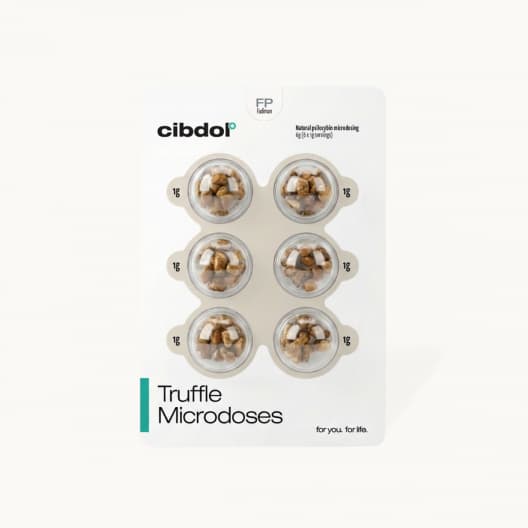

Truffle Microdoses (FP)
Cibdol Truffle Microdoses (FP), carefully prepared microdosing truffles designed for the Fadiman Protocol. Made with mild Psilocybe mexicana truffles, each pack contains 6 × 1g portions for subtle, non-psychoactive support. Ideal for those seeking inner calm through a gentle, structured microdosing approach.
- • For inner calm and emotional balance
- • Up to 1.0 mg psilocybin per dose (6×)
- • Up to 1.8 mg active tryptamines per dose
Disclosure: We may earn a commission if you purchase via these links.
The Meta-Myth: Microdosing Either Works or It Doesn't
Perhaps the biggest misconception of all is the binary framing: microdosing is either a miracle or a scam.
The reality: The truth is messier and more interesting. Microdosing exists in a grey zone where pharmacology, psychology, ritual, and expectation all interact. The placebo effect is not "fake" — it represents the genuine power of belief and intentional practice to change your neurobiology.
Some benefits may come directly from psilocybin's action on serotonin receptors. Others may come from the ritual of taking your dose, the self-awareness of tracking in a journal, or the simple fact that you decided to pay more attention to your inner life. All of these are real. None of them are separable with our current research tools.
The most useful approach is to treat microdosing as a personal experiment with honest expectations:
- Track everything
- Maintain your scepticism
- Take breaks
- Be willing to conclude it does not work for you
- Be equally willing to accept benefit if your data shows it
That is not myth. That is science.
Frequently Asked Questions
Is microdosing just the placebo effect?
The honest answer is: partially, probably. The Imperial College self-blinding study found equivalent improvements between microdose and placebo groups. But "just placebo" is misleading — the placebo effect represents real neurobiological changes triggered by expectation and ritual. Some effects may also be pharmacological. The most likely reality is that microdosing benefits are a combination of both.
Can microdosing cause a bad trip?
At a properly calibrated sub-perceptual dose, no. A true microdose should produce no perceptual changes. However, if the dose is too high (which happens easily without a precision scale), you could experience anxiety, confusion, or mild psychedelic effects that feel unpleasant in a work or social context. This is why starting low and weighing precisely are essential.
Is microdosing addictive?
Psilocybin is not physically addictive and does not produce withdrawal symptoms. Tolerance builds rapidly, which actually discourages frequent use. However, some people develop a psychological attachment to the practice — feeling they "need" their microdose to function. This is a signal to take a break. The goal is to build patterns that persist without the substance.
Can microdosing replace therapy?
No. Microdosing and therapy address different things. Therapy provides tools, frameworks, and professional support for understanding and changing patterns. Microdosing may increase openness and neuroplasticity that make therapy more effective — but it cannot replicate the therapeutic relationship or evidence-based interventions like CBT or EMDR.
Is it true that microdosing makes you smarter?
There is no evidence that microdosing increases IQ, memory capacity, or raw cognitive ability. What some people experience is reduced mental friction — less procrastination, less self-doubt, more willingness to engage with challenging tasks. This can feel like being "smarter" but is more accurately described as having fewer barriers to using the intelligence you already have.
Are natural truffles better than synthetic psilocybin?
There is no evidence that natural psilocybin is superior to synthetic. The active compound is identical. However, truffles contain trace amounts of other tryptamines (baeocystin, norbaeocystin) that may contribute to a slightly different experience — a concept sometimes called the "entourage effect." This has not been rigorously tested.
Further Reading
- Microdosing Psilocybin: The Complete Beginner's Guide — the best starting point
- How to Start Microdosing — practical first steps
- Microdosing Side Effects — the full safety picture
- Microdosing and Creativity: Myth or Real Cognitive Boost? — deeper dive into the creativity question
- The Fadiman Protocol vs Stamets Protocol — choosing your schedule
This article is for informational purposes only and does not constitute medical advice. Psilocybin is a controlled substance in many jurisdictions. Always check local laws and consult a healthcare professional before beginning any microdosing protocol.
Last updated: March 2026
Related topics
Where to buy
Affiliate linksMicrodosing Truffles
Cibdol microdosing truffle kits: FP (Fadiman), SP (Stamets), and OP (One-day-on/off). Lab-tested, 6×1g servings per pack. Choose by protocol and goal — inner calm, mental flexibility, or daily sharpness.
Microdosing XP Truffles
Pre-portioned psilocybin truffle strips designed specifically for microdosing — consistent dosing without a scale.
- • Pre-portioned for accurate microdosing
- • No scale needed — ready to use
- • Consistent psilocybin content per portion
Magic Truffles
Legal psilocybin truffles (sclerotia) available over the counter in the Netherlands. Multiple strains from mild to strong.
Mushroom Grow Kits
All-in-one psilocybin mushroom grow kits — just add water. Multiple strains available for home cultivation in the Netherlands.
Disclosure: We may earn a commission if you purchase via these links.
Related articles
Microdosing Magic Truffles vs Dried Mushrooms: What's the Difference?
Microdosing truffles vs dried mushrooms: psilocybin content, potency variability, legal status, and practical differences. Which is better for microdosing
How to Start Microdosing: Setting, Dose, and What to Expect
How to start microdosing step by step: choose your substance, set your dose, pick a protocol, and know what to expect in your first month. Practical beginn
Is Microdosing Legal? A Country-by-Country Guide for Europe
Is microdosing legal? Country-by-country guide to psilocybin and LSD microdosing laws in Europe — Netherlands, Czechia, Germany, UK, and more. Updated for 2026.