Microdosing Magic Truffles vs Dried Mushrooms: What's the Difference?
Written by Smart Supplements Editorial Team
Key takeaways
- Truffles and mushrooms contain the same active compounds: psilocybin and psilocin
- Truffles are legal in the Netherlands; mushrooms are illegal throughout the EU
- Commercial truffles are far more consistent in potency than home-grown mushrooms
- A 1g fresh truffle microdose delivers roughly the same psilocybin as 0.1g dried mushroom
- Pre-dosed truffle products eliminate the most common dosing errors
- For beginners, truffles are the safer, more practical, and legal choice
Table of contents
Truffles and mushrooms both contain psilocybin — but they're not the same thing, and the difference matters more than most guides admit. If you're choosing between them for microdosing, here's what you actually need to know.
What Are Magic Truffles?
Magic truffles are not actually truffles in the culinary sense (those are Tuber species). They're sclerotia — dense, underground food reserves produced by certain Psilocybe mushroom species. Think of them as the mushroom's survival bunker: a compact mass of mycelium and nutrients that the organism produces to survive unfavourable conditions.
The key species that produce sclerotia include:
- Psilocybe mexicana — the mildest, most studied, and most commonly used for microdosing
- Psilocybe tampanensis — the "Philosopher's Stone," medium potency, clear-headed
- Psilocybe galindoi — earthy, grounding, used in Cibdol's Stamets protocol product
- Psilocybe atlantis — medium-strong, visual and introspective
These sclerotia contain the same psychoactive compounds as the mushroom fruiting bodies: psilocybin (a prodrug) and psilocin (the active metabolite). The chemical pathway in your body is identical regardless of whether the psilocybin came from a truffle or a mushroom cap.
The crucial legal distinction: when the Netherlands banned magic mushrooms in 2008, the legislation specifically named paddenstoelen (mushrooms, i.e. fruiting bodies). Sclerotia were not included in the ban. This legislative gap is why truffles are fully legal in the Netherlands while mushrooms are not.
For a complete guide to truffle biology, strains, and effects, see Magic Truffles Explained.
What Are Dried Mushrooms?
Dried mushrooms are the fruiting bodies of Psilocybe species — the familiar cap-and-stem structures that grow above ground. The most common species worldwide for recreational and therapeutic use include:
- Psilocybe cubensis — the most widely cultivated species globally (Golden Teacher, B+, McKennaii, etc.)
- Psilocybe semilanceata — the European "liberty cap," found wild in temperate grasslands
- Psilocybe azurescens — extremely potent, found in the Pacific Northwest (US)
Mushrooms are dried after harvest to preserve them — fresh mushrooms are ~90% water, so drying concentrates the psilocybin content dramatically. This is why the dosing numbers are so different between fresh truffles and dried mushrooms.
Legal status: Dried mushrooms are illegal throughout the EU, including the Netherlands. The 2008 Dutch ban specifically covers the fruiting bodies. Growing mushrooms from spore kits occupies a grey area in some jurisdictions (spores contain no psilocybin), but harvesting the fruiting bodies is illegal.
Psilocybin Content: The Numbers
This is where most guides create confusion by mixing up fresh and dry weights.
| Product | Typical Psilocybin Content | Standard Microdose |
|---|---|---|
| Fresh truffles (sclerotia) | 0.5–1.8 mg/g | 0.5–1.5g fresh |
| Dried mushrooms (cubensis) | 3–15 mg/g | 0.05–0.3g dry |
| Fresh mushrooms (cubensis) | 0.3–1.5 mg/g | 0.5–2g fresh |
Why the numbers look so different
Fresh truffles contain about 50–70% water. Dried mushrooms have had most water removed. When you compare the psilocybin content on a dry-weight basis, truffles and mushrooms are much closer than the raw numbers suggest.
The practical implication: a 1g fresh truffle microdose delivers roughly the same amount of psilocybin as a 0.1g dried mushroom microdose. The target is the same — a sub-perceptual amount, typically 1–3mg of psilocybin.
Why precision matters more for mushrooms
With dried mushrooms, the margin for error is much smaller. A 0.1g dosing error with dried mushrooms could double your psilocybin intake. With fresh truffles, a 0.5g error produces a proportionally smaller change. This is one reason truffles are better suited to microdosing beginners — the dosing is more forgiving.
Potency Variability
This is arguably the most important practical difference for microdosers.
Commercial Dutch truffles
Truffles sold by established Dutch retailers (Azarius, Cibdol, Dutch Headshop) are:
- Grown under controlled indoor conditions
- Harvested from consistent genetic stock
- Tested for potency batch-to-batch
- Sold by species with expected potency ranges
The result: batch-to-batch variation is relatively low. A 1g portion of Psilocybe mexicana from Azarius today will deliver a very similar psilocybin dose to a 1g portion from the same supplier next month.
Home-grown or wild-sourced mushrooms
Dried mushrooms — whether home-grown from a kit or foraged in the wild — have dramatically higher variability:
- Different parts of the same mushroom (cap vs stem) contain different psilocybin concentrations
- Growing conditions (temperature, humidity, substrate) affect potency
- Different flushes from the same grow kit can vary significantly
- Wild mushrooms (P. semilanceata) vary by location, season, and soil conditions
- No standardised testing for personal-use mushrooms
For someone following a structured microdosing protocol, this variability is a real problem. Monday's 0.15g mushroom dose might deliver 1mg of psilocybin; Thursday's 0.15g from a different part of the same batch might deliver 3mg. That kind of inconsistency makes it impossible to properly assess what the substance is doing.
| Factor | Commercial Truffles | Home-grown Mushrooms | Wild Mushrooms |
|---|---|---|---|
| Potency consistency | High | Low-medium | Very low |
| Species certainty | Guaranteed | Guaranteed | Requires expertise |
| Dosing precision | High (pre-dosed available) | Low (scale required) | Very low |
| Legal status (EU) | Legal (NL) | Illegal (most EU) | Illegal (all EU) |
| Cost per microdose | €2–3 | €1–2 | Free (if foraging) |
The Legal Reality for European Users
This is the deciding factor for many people.
Truffles: Buy legally in the Netherlands from licensed smartshops or online retailers. Ship within the EU (legal risk varies by destination country — see our legal guide). No prescription required. Age 18+. Quality-controlled, labelled, and consistent.
Mushrooms: Illegal to sell, buy, or possess in every EU country, including the Netherlands. Available only through grey-market sources or home cultivation (which itself is legally complicated). No quality standards, no consumer protection, no recourse if something goes wrong.
Grow kits: Magic mushroom grow kits are sold legally in the Netherlands (the mycelium contains psilocybin, but enforcement focuses on the fruiting bodies). This creates a peculiar situation where you can legally buy and maintain a grow kit but technically break the law when you harvest. Enforcement for personal-use cultivation is minimal in the Netherlands, but the legal risk exists.
For a full country-by-country breakdown, see Is Microdosing Legal?.
Which Is Better for Microdosing?
For the vast majority of people — especially beginners — truffles are the better choice for microdosing. Here's why:
Truffles win on:
✅ Legal access — the only legal psilocybin product in Europe ✅ Consistency — commercial cultivation under controlled conditions ✅ Pre-dosed options — Azarius, Cibdol, and Dutch Headshop all offer 1g pre-portioned servings ✅ Lower risk — forgiving dosing curve (0.5g error is less consequential than with dried mushrooms) ✅ Convenience — order online, delivered to your door ✅ Quality assurance — reputable brands, established market, consumer protections
Mushrooms may be preferred by:
- Experienced psychonauts with established dosing knowledge
- People with access to consistent, tested material
- Home cultivators with precision scales and grow experience
- People in jurisdictions where truffles are not accessible
The bottom line
If you're starting a microdosing protocol, use pre-dosed commercial truffles. They eliminate the two biggest sources of error — inconsistent potency and inaccurate weighing — and they're legal. Once you have months of experience and understand your individual response, you can explore other options with more informed risk assessment.
Microdosing XP Truffles
Pre-portioned psilocybin truffle strips designed specifically for microdosing — consistent dosing without a scale.
- • Pre-portioned for accurate microdosing
- • No scale needed — ready to use
- • Consistent psilocybin content per portion
Disclosure: We may earn a commission if you purchase via these links.

Truffle Microdoses (FP)
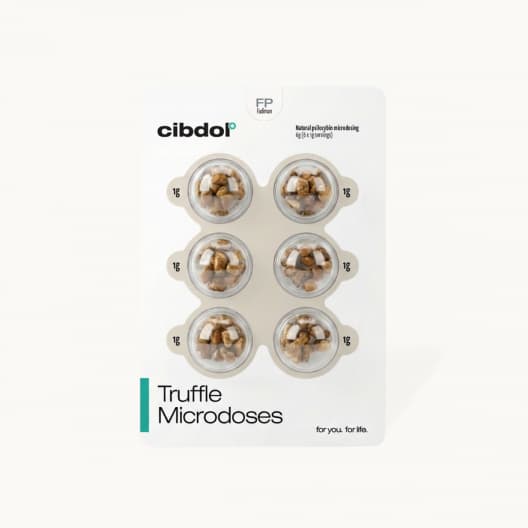
Cibdol Truffle Microdoses (FP), carefully prepared microdosing truffles designed for the Fadiman Protocol. Made with mild Psilocybe mexicana truffles, each pack contains 6 × 1g portions for subtle, non-psychoactive support. Ideal for those seeking inner calm through a gentle, structured microdosing approach.
- • For inner calm and emotional balance
- • Up to 1.0 mg psilocybin per dose (6×)
- • Up to 1.8 mg active tryptamines per dose
Disclosure: We may earn a commission if you purchase via these links.
Pre-Dosed Products: The Best of Both Worlds
The pre-dosed microdosing truffle market has matured significantly. Current options include:
Azarius Microdosing Truffles — four intent-based variants (Mental, Emotional, Physical, Spiritual) at €14.99 each, plus the classic XP strips at €15–25. All are 6×1g pre-portioned.
Cibdol Truffle Microdoses — three protocol-matched variants (FP for Fadiman, SP for Stamets, OP for one-day-on/off) at €14.95–€19.95. Different truffle species per protocol.
Dutch Headshop Microdosing Truffles — private-label 6×1g packs from €15 with QR-code guidance included.
For a detailed comparison of all products, see our Best Microdosing Truffles buyer's guide.
Frequently Asked Questions
Are truffles the same as mushrooms for microdosing?
Chemically, yes — both contain psilocybin and psilocin. Practically, no. Truffles are legal (in NL), more consistent in potency, and available in pre-dosed formats. Mushrooms are more potent per gram but more variable and illegal throughout the EU.
How much truffle for a microdose?
0.5–1.5g of fresh psilocybin truffle. Start at 0.5–0.7g and increase by 0.1–0.2g per dose day until you find your sub-perceptual threshold. Pre-dosed products typically come in 1g portions — the sweet spot for most people.
Are magic truffles legal?
In the Netherlands, yes — fully legal to buy, possess, and consume. Elsewhere in the EU, the legal status varies. See our Is Microdosing Legal? guide for country-specific details.
Can I grow mushrooms for microdosing instead?
Grow kits are sold legally in the Netherlands, but harvesting the fruiting bodies is technically illegal. The potency of home-grown mushrooms varies significantly between flushes and between individual mushrooms, making precise microdosing much more difficult than with commercial truffles.
Do truffles taste different from mushrooms?
Both have a distinctive earthy, slightly sour taste. Truffles tend to be denser and more intensely flavoured per gram. At microdose quantities (0.5–1.5g), the taste is minimal and easily masked with food or drink.
Why are truffles less potent than dried mushrooms?
Mainly water content. Fresh truffles are 50–70% water. When you account for this and compare on a dry-weight basis, the psilocybin concentrations are much closer. The apparent potency gap is largely a measurement artefact.
Further Reading
- Magic Truffles Explained — full guide to strains, effects, and dosage
- Best Microdosing Truffles — product comparison
- How to Start Microdosing — beginner setup guide
- Microdosing Psilocybin: The Complete Guide — pillar overview
- Is Microdosing Legal? — country-by-country breakdown
- Microdosing Side Effects — what to watch out for
This article is for informational purposes only. Psilocybin truffles are legal in the Netherlands; mushrooms are controlled substances in all EU countries. Always check local laws before purchasing.
Last updated: March 2026
Written by the Smart Supplements editorial team
Related topics
Where to buy
Affiliate linksMicrodosing Truffles
Cibdol microdosing truffle kits: FP (Fadiman), SP (Stamets), and OP (One-day-on/off). Lab-tested, 6×1g servings per pack. Choose by protocol and goal — inner calm, mental flexibility, or daily sharpness.
Microdosing XP Truffles
Pre-portioned psilocybin truffle strips designed specifically for microdosing — consistent dosing without a scale.
- • Pre-portioned for accurate microdosing
- • No scale needed — ready to use
- • Consistent psilocybin content per portion
Magic Truffles
Legal psilocybin truffles (sclerotia) available over the counter in the Netherlands. Multiple strains from mild to strong.
Mushroom Grow Kits
All-in-one psilocybin mushroom grow kits — just add water. Multiple strains available for home cultivation in the Netherlands.
Disclosure: We may earn a commission if you purchase via these links.
Related articles
Is Microdosing Legal? A Country-by-Country Guide for Europe
Is microdosing legal? Country-by-country guide to psilocybin and LSD microdosing laws in Europe — Netherlands, Czechia, Germany, UK, and more. Updated for 2026.
Microdosing Psilocybin: The Complete Beginner's Guide
The complete beginner's guide to microdosing psilocybin. Learn protocols, dosages, what science says, safety tips, and legal status in Europe. Evidence-based.
Psilocybin Retreats in the Netherlands: What to Know Before You Go
A comprehensive guide to legal psilocybin truffle retreats in the Netherlands — covering types, costs, quality indicators, what to expect, and how to choos