Lion's mane: the mushroom behind the focus claims
Where does the focus reputation come from, and which part of the mushroom does a trial actually apply to?
In short
- The 'grows new brain cells' idea comes from cell and animal work; the human trials are few and small, and the two recent trials in healthy young adults found a result on one or two tests.
- Which part of the mushroom a product contains (fruiting body, mycelium, extract) decides which trial it resembles, so it is the first thing to check on a label.
- Funding for each trial is listed in the study table, so you can see who supported the research.
- In a 2019 consultation record hosted by the European Commission, dehydrated mycelium powder was assessed as a novel food, and the fruiting body was noted to have a consumption history (read 8 October 2026; current catalogue entry not opened).
On this page 7 sections
- Lion's mane in four points
- From log to supplement: what lion's mane is and why "focus" follows it around
- What people have actually taken in trials
- Fruiting body, mycelium on grain, extract: what the label is telling you
- Safety, interactions and the EU's view of mycelium
- What the evidence adds up to
- Where to read next
It looks like a white pom-pom someone left on a log, it has a name from a fantasy novel, and the tub says "focus". Lion's mane (Hericium erinaceus) is one of the most talked-about mushrooms on any smartshop shelf. So what is the focus reputation built on? It starts with compounds studied in cells and animals. The human studies are much smaller. And the preparation in your capsule matters, because each trial tested a specific version of the mushroom: which part of it was actually in the capsule?
Lion's mane in four points
- Lion's mane is a real, edible mushroom with a long culinary history in East Asia. The "grows new brain cells" story comes from cell and animal experiments.
- Human trials exist but are small: an older-adult study in mild cognitive impairment, and two recent trials in healthy young adults that found a result on one or two tests among many.
- "Lion's mane" on a label can mean fruiting body, mycelium grown on grain, or an extract of either, and each trial tested one specific version. That is the most useful thing to check on a pack.
- Mycelium and fruiting-body products are treated differently under EU novel-food rules (details below, read on 8 October 2026).
From log to supplement: what lion's mane is and why "focus" follows it around
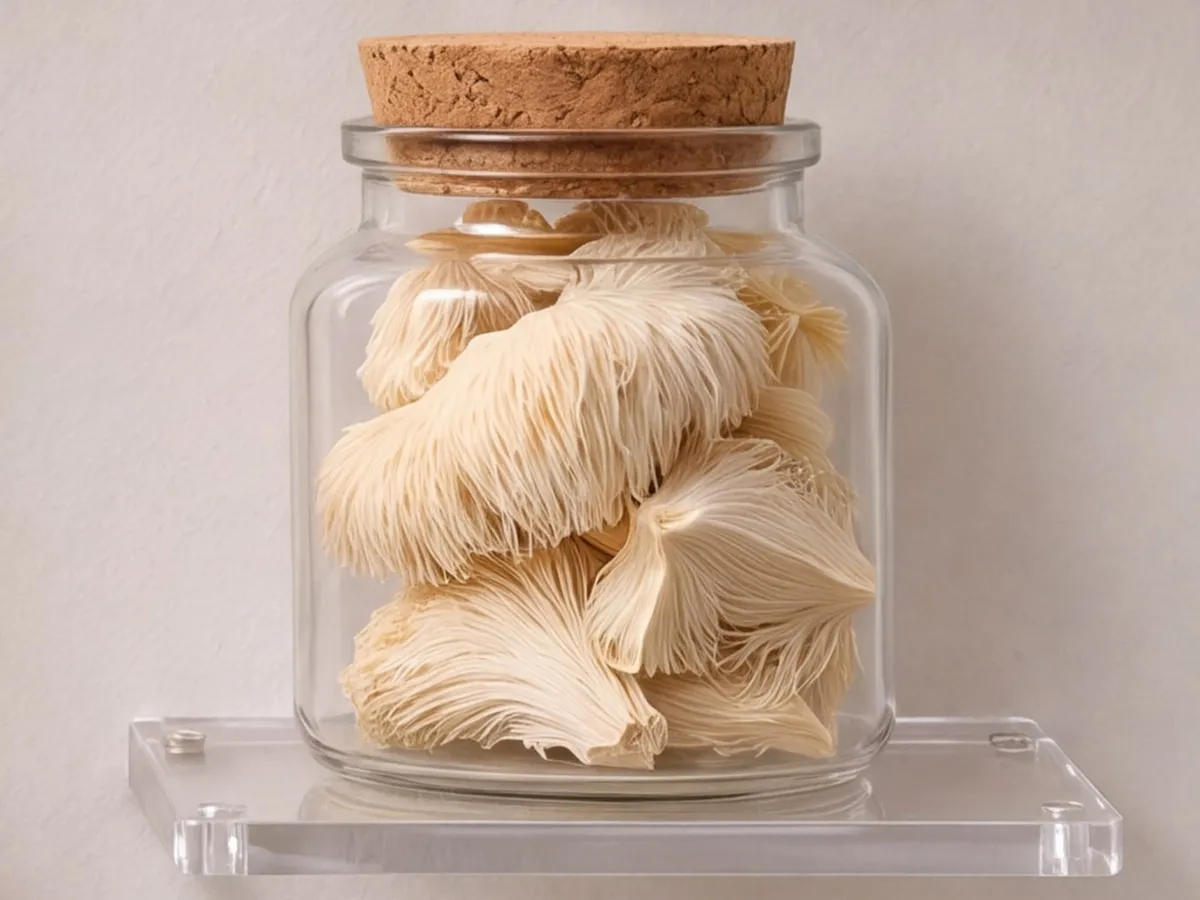
Hericium erinaceus is a toothed fungus that grows on hardwood. Its cascade of soft white spines gives it the "lion's mane" and "pom-pom" nicknames; in Japan it is called yamabushitake. People eat the fresh fruiting body, and supplement makers use powders and extracts made from the fruiting body, from the mycelium (the thread-like vegetative body of the fungus), or from both.
The brain-health reputation comes from two families of compounds that researchers have isolated from it. The introduction to one recent trial puts it simply: the fruiting body is rich in hericenones, while the mycelium contains more erinacines (Surendran et al., 2025, Frontiers in Nutrition). In cell and animal experiments, both groups have been reported to promote nerve growth factor synthesis and to have neuroprotective effects (Docherty et al., 2023, Nutrients). That is a good reason to run human trials. It isn't the result of one, and "does something in a dish or a mouse" is a long way from "does something you'd notice at your desk".
What people have actually taken in trials
Here are the human studies, laid out so you can see what each one used and who took part.
| Study | Who | What they took | Result in brief | Who supported it |
|---|---|---|---|---|
| Mori et al., 2009, Phytotherapy Research | 30 Japanese adults aged 50–80 with mild cognitive impairment | Four 250 mg tablets (96% dried yamabushitake powder) three times a day for 16 weeks | Cognitive scores were higher than placebo at weeks 8, 12 and 16, then fell back four weeks after stopping | No funder stated in the abstract, but the authors work at a mushroom company (Hokuto Corporation) |
| Li et al., 2020, Frontiers in Aging Neuroscience | People with mild Alzheimer's disease, pilot trial | Three 350 mg capsules a day of erinacine A-enriched mycelium (5 mg/g erinacine A) for 49 weeks | Daily-living scores were better than placebo; MMSE rose within the mycelium group and CASI fell within the placebo group; four people left over side effects (three on the mycelium, one on placebo): abdominal discomfort, nausea or a skin rash | Grape King Bio Inc. provided research materials and paid the salaries of five authors |
| Docherty et al., 2023, Nutrients | 41 healthy adults aged 18–45 | 1.8 g a day of a commercial lion's mane product, one dose and then 28 days | Faster on one Stroop task an hour after a single dose; a possible reduction in stress after 28 days that just missed the usual significance threshold (p = 0.051) | The product was provided by Sempera Organics, which the paper says had no role in design, analysis or publication |
| Grozier et al., 2022, International Journal of Exercise Science | 24 college-age adults | 10 g a day of lion's mane in muffins for four weeks (single-blind) | No effect on the cognitive or metabolic measures tested | No external funding; the lion's mane was donated by Nammex, which also advised on dose and duration |
| Surendran et al., 2025, Frontiers in Nutrition | 18 healthy adults aged 18–35, crossover design | One 3 g dose of a 10:1 fruiting-body extract, tested 90 minutes later | No significant effect on the combined cognition or mood scores; one motor-skill test (the grooved pegboard) was better, while two other tests, a Flanker task and a Trail Making Test, did worse | Two authors work for Three Spirit Drinks, a company that uses lion's mane plants in its products; it contributed to the publication fee |
Reading the table, study by study
Mori 2009 is the foundation, and it is small. It is the study behind most "lion's mane helps memory" claims: thirty people, with mild cognitive impairment rather than healthy brains. The effect faded after people stopped, which is interesting, but one pilot trial can't tell you how big or lasting a benefit is. The summary also doesn't say which part of the mushroom the powder came from.
The erinacine A trial used a mycelium preparation you probably can't buy as an ordinary supplement. Li and colleagues tested mycelium enriched in one specific compound, in people with early Alzheimer's disease. That says little directly about a healthy 25-year-old taking a fruiting-body capsule, and the EU rules on mycelium (below) make that exact preparation an awkward fit for the shop shelf.
The two recent healthy-adult trials are modest. Docherty's team described their own results as tentative: one quicker task, a stress trend that didn't cross the line, and some null findings. Surendran's team, testing a single large dose of fruiting-body extract, found nothing on the overall cognition and mood measures and one better motor-skill result. Both are pilot-sized, and neither tested gaming, deep work or long study sessions, so neither supports a claim like "improves focus".
Longer use in young, healthy people is still thinly tested. Grozier's four-week muffin trial found nothing, and Docherty's 28-day phase, the closest thing to a longer test, was inconclusive. When a product page says "studies show", the useful follow-up is which of these it means.
A 2025 systematic review in Frontiers in Nutrition collected the clinical literature. Combining the scores from one randomised trial and one pilot trial gave a weighted mean MMSE increase of 1.17 points in the lion's mane groups (Menon et al., 2025). That is a small number from a small pool of trials.
Fruiting body, mycelium on grain, extract: what the label is telling you
This is where "lion's mane" stops being one thing. The trials above used at least four different materials, so a label needs to answer the question the study already asked.
| Label wording | What it usually means | Question to ask |
|---|---|---|
| Fruiting body (powder) | Dried, ground mushroom; the part people eat | Is the part named on the pack? Mori's tablets used a dried powder; the trial summary doesn't say which part of the mushroom it came from. |
| Fruiting body extract (e.g. "10:1") | Water and/or ethanol extraction of the fruiting body, concentrated | Is the extraction ratio the only detail given? Surendran's extract is described by its ratio and process; a ratio alone doesn't say how much of any compound you get. |
| Mycelium (powder or extract) | The fungus's vegetative body, often grown on grain | Is it separated from the grain? A product described as "mycelium on grain" or "myceliated oats" contains both fungus and substrate. |
| Mycelium plus fruiting body | A blend | Which proportion? A published safety study on one such powder describes it as mycelial biomass and fruiting body cultured on oats (Mahadevan et al., 2025; this was a rat study, not a human trial). |
| "Standardised to erinacine A" or "hericenones" | A target compound measured by the maker | Does the pack say how it was measured and how much per serving? Even then, a compound level describes what's in the product, not whether it works. |
A few rules of thumb fall out of that:
- Trial results transfer best to a product that matches the studied one on part of the mushroom, extraction and dose. A "lion's mane" label alone doesn't tell you that.
- Beta-glucan, hericenone or erinacine numbers describe composition. None of the trials above were designed to link a compound level to an outcome.
- Third-party testing documents what is in a batch; it doesn't turn a food supplement into a treatment. Our guide to reading supplement labels walks through what these lines usually mean.
Safety, interactions and the EU's view of mycelium
Side effects. The trials report little, but they were small and short. The systematic review above lists stomach discomfort, headache and allergic reactions as possible effects that are often not reported (Menon et al., 2025). In the erinacine A pilot, four people left over side effects (abdominal discomfort, nausea or a skin rash): three on the mycelium and one on placebo, so it isn't a clean mycelium-only signal. If you react to other mushrooms, or you are pregnant, breastfeeding, giving it to a child, or take prescription medication, there isn't enough human data to say it's fine; our note on supplements and medicines explains why a pharmacist is a good first call. Memory problems that affect everyday life deserve a proper assessment rather than a mushroom: the NHS page on memory loss explains when to see a GP.
Mycelium and the EU. In a 2019 consultation on a lion's mane product, the Commission-hosted record of the Spanish food authority's assessment concluded that Hericium erinaceus dehydrated mycelium powder is a novel food in the EU, because no history of significant consumption of the mycelium before 15 May 1997 could be shown. The same document says the fruiting body does have a history of consumption before that date and that equivalence between the two parts could not be established (AESAN consultation record on Hericium erinaceus mycelium powder, 29 October 2019). That is a 2019 record for one product, read on 8 October 2026, not today's catalogue entry. The same Commission consultation page also lists two later records that treat an extract powder from the fruiting body as not novel (28 February 2025, Finland, and 10 September 2026). Those cover fruiting-body extract powders for specific products, not mycelium. Check the Commission's Novel Food Status Catalogue and, for a specific product, the Dutch food authority (NVWA), because rules and entries change.
Not psilocybin. Lion's mane is a culinary and supplement mushroom. It is unrelated to psilocybin mushrooms and truffles, which are a separate legal matter.
What the evidence adds up to
In people, the picture so far is this: a small pilot in older adults with mild cognitive impairment showed higher scores while they took the powder; an erinacine A mycelium pilot in early Alzheimer's did similarly; and the two recent trials in healthy young adults found mixed or null results, with a result on one or two tests at best. The preparations differed from study to study, several trials had company involvement, and none tested gaming or sustained work performance.
So lion's mane is an interesting mushroom with a promising lab story, and its human story is still being written. If you enjoy it as food, that's easy. If you're curious about it as a supplement, a label that names the part of the mushroom, the extraction and the amount per serving is the best starting point for comparing products, and the study table shows which versions have actually been tested and who supported each trial. Fancy exploring the rest of the shelf? Reishi and cordyceps each have their own guide below.
Related reading: how to read supplement labels, how supplements and medicines can interact, and our beginner's guide to supplements.
Where to read next
For the wider picture:
- Functional mushrooms and adaptogens: guide hub, for the six popular ingredients, each with its own guide, and a place to start.
- Reishi and sleep: what the research shows, for the calming-mushroom reputation and what has been tested.
- Cordyceps: fungus, formulations and performance claims, for which species the endurance trials used.
- Gaming, focus and energy: guide hub, for how nootropics, caffeine pairings and plant extracts compare with gaming supplements and energy drinks.
This article is for informational purposes only and is not intended as medical advice. Always consult a healthcare professional before starting any new supplement, especially if you take prescription medication.
Sources
The 9 outside pages this article links to, in the order it first cites them.
- Surendran et al., 2025, Frontiers in Nutrition pmc.ncbi.nlm.nih.gov
- Docherty et al., 2023, Nutrients pmc.ncbi.nlm.nih.gov
- Mori et al., 2009, Phytotherapy Research pubmed.ncbi.nlm.nih.gov
- Li et al., 2020, Frontiers in Aging Neuroscience pmc.ncbi.nlm.nih.gov
- Grozier et al., 2022, International Journal of Exercise Science pmc.ncbi.nlm.nih.gov
- Menon et al., 2025 pmc.ncbi.nlm.nih.gov
- Mahadevan et al., 2025 pmc.ncbi.nlm.nih.gov
- NHS page on memory loss nhs.uk
- AESAN consultation record on Hericium erinaceus mycelium powder, 29 October 2019 food.ec.europa.eu
More on mushrooms & adaptogens
- Ashwagandha: the plant behind the stress and sleep claimsWhat did trials of branded root extracts test, and what is an adaptogen?
- Lion's mane, reishi, cordyceps, chaga: functional mushrooms comparedHow do lion's mane, reishi, cordyceps, chaga, ashwagandha and shilajit compare, and how do I read a label across them?
- Functional mushrooms and adaptogens: what the terms meanWhat do 'functional mushroom' and 'adaptogen' mean, and are they real categories?
- Reishi and sleep: what the research showsHow does reishi's calming reputation compare with what has been measured in people?