Sleep routines: the useful basics
Which everyday habits are a sensible foundation, and where do they stop?
In short
- Regular bed and wake times, a quiet last hour and a dark, cool, quiet bedroom are sensible groundwork, and cost little.
- The AASM suggests sleep hygiene should not be the only treatment for chronic insomnia; CBT-I is the recommended treatment, and the European guideline also puts CBT-I first.
- A systematic review in healthy people found evening exercise generally did not harm sleep, though vigorous exercise ending within an hour of bedtime might.
- If sleep problems persist or affect your days, talk to your GP before adding products.
On this page 10 sections
- What the guidelines put first
- Sleep hygiene: the everyday habits, and what they aren't
- A rhythm you can actually keep
- Light, noise, comfort and the glowing rectangle
- Caffeine, alcohol and the late workout
- When it is more than a routine problem
- What the European guideline adds
- And if the supplement aisle is still calling
- Quick questions
- Where to go next
Most of us have lain awake at some point, running tomorrow's meeting on a loop. When it happens a few nights in a row, the shopping instinct kicks in. Before that, it's worth knowing what a few free changes can do: a steadier rhythm, a darker room, a smarter evening. This guide covers those basics, where they stop, and what the guidelines put first when sleep stays difficult.
What the guidelines put first
Regular sleep habits are a sensible foundation, and most of them cost nothing. They are not, however, the recommended treatment for chronic insomnia. The American Academy of Sleep Medicine recommends multicomponent cognitive behavioural therapy for insomnia (CBT-I) for chronic insomnia in adults, and suggests that clinicians do not use sleep hygiene on its own as the treatment (Edinger et al., 2021, Journal of Clinical Sleep Medicine, clinical practice guideline). If sleep trouble keeps going, or it is leaking into your days, that points to a conversation with your GP rather than a longer checklist or a bigger supplement shelf.
Sleep hygiene: the everyday habits, and what they aren't
Sleep hygiene is the name for everyday habits and surroundings that support sleep: when you go to bed, what you do in the last hour, what the room is like, what you drink. CBT-I is something different. It is a structured treatment, and sleep education is only one of its parts. The US National Heart, Lung, and Blood Institute (NHLBI) lists its five components as cognitive therapy, relaxation, sleep education, sleep restriction therapy and stimulus control (NHLBI, Insomnia treatment).
So think of the habits below as good groundwork, not a therapy. They can help through a rough patch and make a treatment plan easier to follow. They are not a test you can fail.
A rhythm you can actually keep
NHLBI's healthy-sleep guidance starts with consistency: going to bed and getting up at about the same time, with weekends staying within roughly an hour of weeknights, and keeping the hour before bed for quiet time (NHLBI, Healthy sleep habits, page last updated 24 March 2022).
A rhythm only works if you can keep it. A perfect schedule that makes you anxious about missing it is a worse deal than a looser one you follow most nights. If you are not sure where you stand, a sleep diary shows more than a guess does. NHLBI suggests keeping one for a week or two before seeing a doctor, noting sleep and wake times, naps, daytime alertness, caffeine and alcohol, and exercise timing (NHLBI, Insomnia diagnosis).
Light, noise, comfort and the glowing rectangle
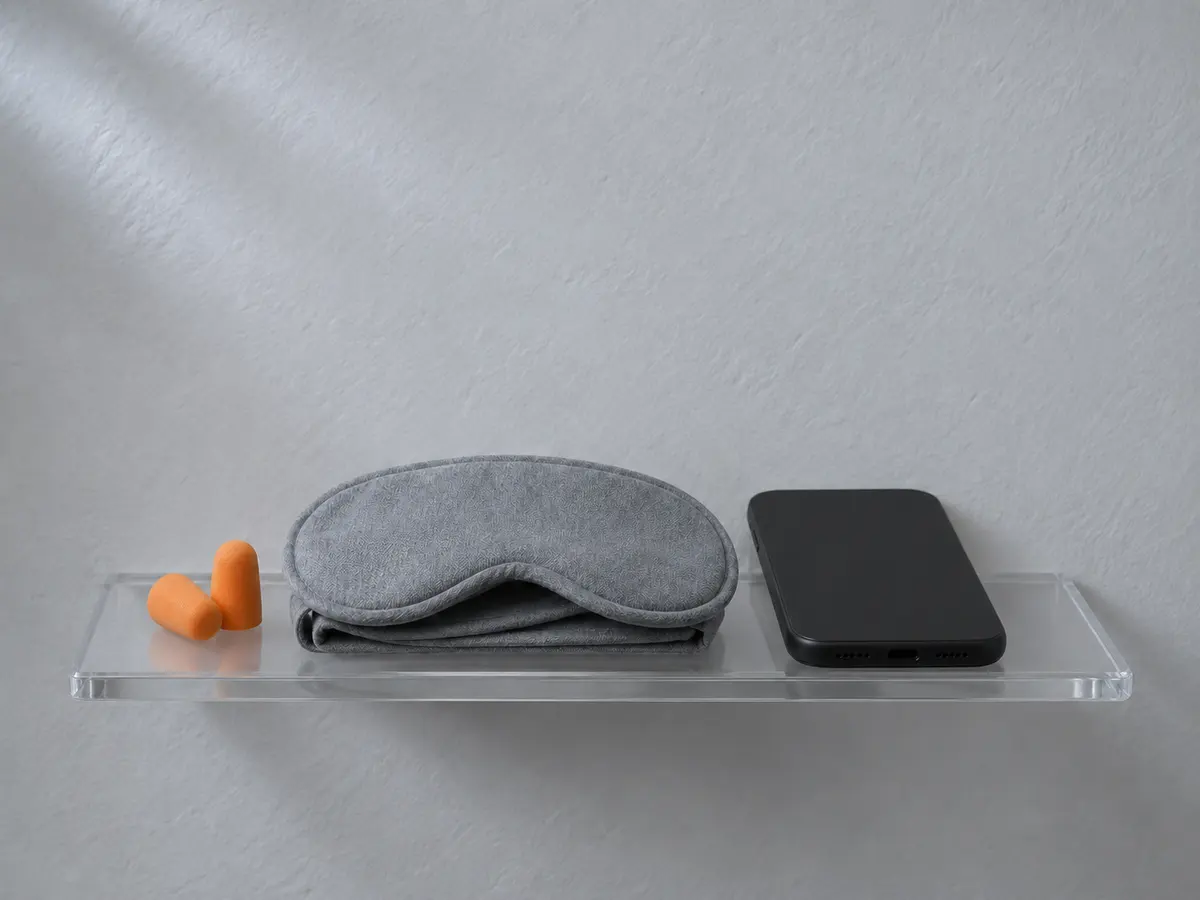
NHLBI's advice for the bedroom is short: keep it quiet, cool and dark, and avoid bright artificial light, such as from a TV or computer screen, in the hour before bed. There is no single perfect temperature, so treat the table as questions about your own room, not a score.
| What to look at | A question worth asking |
|---|---|
| Light | Is the room dark enough, and is the last hour before bed bright and screen-heavy? |
| Noise | Is it the same sound waking you each night, and can that one be reduced? |
| Comfort | Is it the bed, the room temperature or the bedding that's bothering you? |
| Activity | Are you still working or scrolling when you'd like to be winding down? |
Caffeine, alcohol and the late workout
NHLBI advises avoiding caffeine and alcohol before bed, noting that the effects of caffeine can last up to eight hours. The page gives no personal cut-off time, and neither do we: people vary, so the sleep diary above is the better tool for spotting your own pattern.
Exercise gets a more nuanced answer than the old "never train in the evening" rule. A systematic review and meta-analysis of 23 studies in healthy participants found that evening exercise generally did not harm sleep. It did find that sleep onset, total sleep time and sleep efficiency might be impaired after vigorous exercise ending within an hour of bedtime (Stutz et al., 2019, Sports Medicine, systematic review). The participants were healthy, so the review cannot say what is best for someone with insomnia. In practice, an evening session is not automatically a problem, and a hard one that finishes just before bed is the case to watch.
When it is more than a routine problem
| Situation | What to bring up |
|---|---|
| Sleep stays difficult despite sensible changes | A proper assessment, rather than stricter rules |
| Loud snoring, breathing pauses or heavy daytime sleepiness | Whether another sleep disorder needs checking |
| A new medicine started around the time sleep changed | A review with your prescriber or pharmacist |
| Worrying about sleep has become the problem itself | Support with that worry, which is a recognised part of CBT-I |
What the European guideline adds
The European Insomnia Guideline recommends CBT-I as the first-line treatment for chronic insomnia in adults of any age, including people with other health conditions, delivered in person or digitally (Riemann et al., 2023, Journal of Sleep Research, European Insomnia Guideline). It's worth asking what CBT-I options exist where you live, including digital ones, before treating a supplement as the logical next step after a checklist.
And if the supplement aisle is still calling
One reasonable order of play (an editorial view, not a medical finding): start with a real obstacle (a noisy room, a late-night routine, an irregular schedule) and deal with that first. A supplement is an optional extra rather than the automatic next step, and it's more interesting when it answers a specific question.
If you do consider one, two checks come first. Read what the label actually contains, which our guide to reading supplement labels walks through, and check whether any medicine you take changes the decision, which is the subject of our note on supplements and medicines.
The European Insomnia Guideline is direct about the supplement aisle: it lists fast-release melatonin and phytotherapeutics (plant-based remedies) among the options not recommended for insomnia treatment (Riemann et al., 2023, same guideline). That is a statement about treating insomnia, not a safety verdict on any one product.
Melatonin is the one sleep ingredient the Netherlands treats differently from most supplements. A Dutch government reply (read on 8 October 2026) says melatonin below 0.3 mg per dose may be marketed as a food supplement if the pack carries no health claim at all. From 0.3 mg upward, the reply says a product can be a medicine if it also meets other criteria set by the courts, and it notes that melatonin has long been sold as a supplement at higher doses too (Kamervragen 2019-2020, no. 297). So 0.3 mg is a line that can tip a product into medicine territory, depending on those other criteria. Our melatonin guide has the fuller picture, including EU differences.
Quick questions
Can habits replace insomnia treatment?
For chronic insomnia, the AASM guideline suggests not relying on sleep hygiene as the only treatment. Habits help as support; CBT-I is the recommended treatment.
Do I need to get every habit right?
No. A routine you can keep beats a long list of rules you dread.
How long before I notice a difference?
There is no universal timeline. Sleep that stays difficult, or spills into your days, is the cue for the GP conversation described above.
Where to go next
If the free basics are covered and you're curious about the shelf, sleep supplements in Europe is a friendly tour of the ingredients, and the melatonin guide explains why timing matters as much as the number on the label. When you'd like to see actual products, sleep products compared puts six of them side by side by ingredient, format and price.
This article is for informational purposes only and is not intended as medical advice. Always consult a healthcare professional before starting any new supplement, especially if you take prescription medication.
Sources
The 7 outside pages this article links to, in the order it first cites them.
- clinical practice guideline pmc.ncbi.nlm.nih.gov
- NHLBI, Insomnia treatment nhlbi.nih.gov
- NHLBI, Healthy sleep habits nhlbi.nih.gov
- NHLBI, Insomnia diagnosis nhlbi.nih.gov
- systematic review pubmed.ncbi.nlm.nih.gov
- European Insomnia Guideline pubmed.ncbi.nlm.nih.gov
- Kamervragen 2019-2020, no. 297 zoek.officielebekendmakingen.nl
Where to buy
Which sleep products differ in ingredients, format and price?
Buying guideSleep products compared: Cibdol and non-CBD alternatives
Read the buying guide All buying guides and brandsMore on sleep
- Sleep supplements in Europe: a guide to what's on the shelfHow do you read a sleep product by its ingredients, and what do Dutch and EU rules allow?
- Melatonin: timing, labels and the questions to askWhat is melatonin, and what does a label tell you about timing?
- Melatonin rules in Europe: supplement or medicine, by countryIs melatonin a supplement or a medicine in my country?
- Magnesium and sleep: what is the connection?What does the small amount of research on magnesium and sleep show, and what are the intake limits?