Kratom Formats: What Powder, Capsules, Extracts and Gummies Labels Really Tell You
How do the formats differ, and what do units, 7-OH and certificates tell you?
In short
- A format changes how a product is measured and processed, not which plant it comes from; 'kratom' on a label doesn't distinguish leaf, extract or 7-OH-enriched products.
- The milligram figure on a pack can mean mitragynine, extract or leaf-equivalent, so compare the unit before comparing products.
- 'Equivalent to X g of leaf' depends on an assumed leaf concentration; published leaf figures differ by a factor of two or more.
- A 'tested' claim isn't a certificate; a batch-specific COA naming the compounds and method is the checkable document.
- Strain colours and 'full spectrum' or 'premium' labels are sales descriptions, not specifications, and no label or format makes a product safe.
On this page 9 sections
- The label cheat sheet, in six lines
- Same plant, different packaging
- Format by format: what the label gives you, and what it leaves out
- Worked example: what does "equivalent to 8 g of leaf" really say?
- COA, batch and "lab tested": what's worth checking
- Real differences, and the ones that are mostly packaging
- The legal footing (read on 8 October 2026)
- Choosing between formats: mostly a question of information
- Where to read next
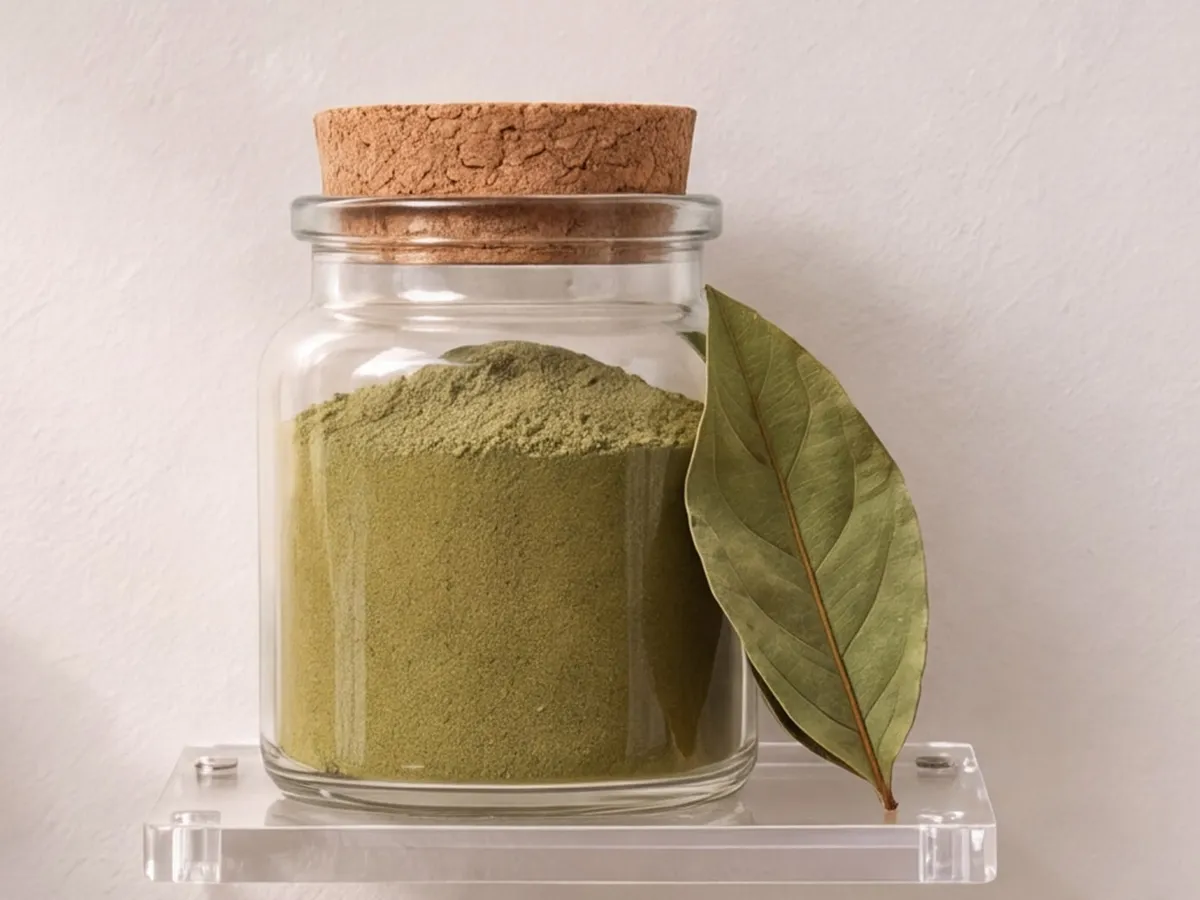
Powder, capsules, tablets, gummies, a little shot bottle. The same word, "kratom", sits on all of them, and each one comes with a number that looks as if it ought to be comparable to the others. Often it isn't. Let's work out what each format actually tells you, and where the label runs out of answers.
A kratom "format" is a way of packaging and processing the same plant, and it changes three practical things: how the product is measured, how concentrated it might be, and what the label can reasonably say about its contents. On its own, a format doesn't make a product stronger, safer or better. The numbers on packs also aren't always in the same unit: one shop's headline figure can mean milligrams of mitragynine, another's milligrams of extract, and those aren't interchangeable.
So the questions that matter are about what's declared and what can be checked. What does the number refer to (leaf, extract or a named alkaloid)? Is 7-hydroxymitragynine stated? Is there a batch-specific lab report? How many portions are in the pack? If the label can't answer those, the format name won't either. For the plant itself, its risks and the dated Dutch legal position, see the legal section below.
The label cheat sheet, in six lines
- Same plant, different products: powder is ground leaf; extracts are concentrated preparations; some products have added or enriched 7-hydroxymitragynine. "Kratom" doesn't distinguish between them.
- Read the unit: "80 mg" can mean 80 mg of mitragynine, 80 mg of extract or something else. Check what the number refers to before comparing products.
- "Equivalent to X grams of leaf" is an estimate, not a measurement: it depends on an assumed leaf concentration, and published figures for leaf vary by a factor of two or more.
- Testing claims aren't certificates: "lab tested" is a statement. A batch-specific certificate of analysis (COA) is a document you can check.
- Gummies, shots and tablets are convenient forms, not a different substance: the useful question is still what's inside and how it's declared.
- Format doesn't signal legality or safety.
Same plant, different packaging
Kratom leaf contains a mix of alkaloids. The EU Drugs Agency's (EUDA) profile gives the typical picture for dried leaf: total alkaloids around 0.5 to 1.5%, with mitragynine the most abundant (up to about two-thirds of the alkaloids in Thai varieties) and 7-hydroxymitragynine a minor part (up to about 2%). It also says the chemical composition of commercial products is usually unspecified and depends on variety, plant age, environment and harvest time (EUDA kratom drug profile, archived copy dated 1 January 2026). The profile also describes the range of forms sold: crushed or powdered dried leaf, powders fortified with extracts, pastes and resins from boiling down leaf suspensions, tinctures and capsules.
So the format changes the packaging and sometimes the processing, but the reader's questions stay the same. How much active alkaloid is in one portion? Is that figure declared or implied? Is it consistent from batch to batch? And is 7-hydroxymitragynine something the plant produced in small amounts, or something added or concentrated?
That last question has regulatory weight. The US FDA's July 2025 consumer warning is about products with added or enhanced 7-hydroxymitragynine, which it says are sold as tablets, gummies, drink mixes and shots, and it distinguishes them from the trace amounts naturally present in leaf (FDA, 29 July 2025). That's a statement about the US market and doesn't mean a gummy or shot sold in the Netherlands contains added 7-hydroxymitragynine. It does make "is 7-hydroxymitragynine declared, and at what level?" a fair question for those formats.
Format by format: what the label gives you, and what it leaves out
| Format | What the label typically gives you | What it often can't tell you |
|---|---|---|
| Leaf powder | Weight of the pack, variety or "vein colour" name, origin | Alkaloid content per gram, batch consistency, which part of the plant was used |
| Leaf capsules | Number of capsules, grams of powder per capsule | The same as powder; also, capsule counts and grams per capsule are easy to confuse |
| Extract capsules | Number of capsules and a milligram figure per capsule | Whether that milligram figure is mitragynine, extract or leaf-equivalent; what else is in the extract |
| Tablets | A milligram figure per tablet | The same unit question; how the tablet was made |
| Gummies | Pieces per pack and a milligram figure per piece | Whether the figure is extract or an alkaloid; how evenly it's spread across pieces |
| Liquid extracts and shots | Volume and a milligram figure per ml or per bottle | The same unit question; what the carrier liquid contains |
| Resin and "10x" or "15x" extracts | A multiple such as 10x or 15x | What the multiple is measured against: no source we found defines it, and the shop pages don't say |
Those are descriptions of what labels commonly include, not a judgement of any one product. To see the unit question in real life, here's how two shops' pages read on 8 October 2026. This is supplier information, not independent verification, and we haven't bought or tested any product.
Zamnesia. Its kratom category page lists mitragynine amounts per unit for several formats: capsules at 45 to 95 mg of mitragynine each, tablets with 12 mg of mitragynine each, gummies with 30 mg of mitragynine each, and a ready-to-drink shot with 80 mg of mitragynine in 15 ml. It also lists liquid extracts, tinctures, tea and resin. For one liquid extract, the page says "each batch is fully tested to ensure every milliliter contains exactly 80mg of mitragynine". The 45 mg capsule page lists ingredients (kratom extract with 45 mg of mitragynine, an anti-caking agent and a plant-based capsule) and pack sizes of 2 or 10 (Zamnesia kratom category; Zamnesia 45 mg capsules).
Azarius. Its kratom category lists powder, capsules, gummies, tablets, shredded leaf and tinctures or liquid extracts, with extracts named with multiples such as "15x Extract" and "10x Thai Resin". The gummy buying guide on that page says gummy strength is "measured in milligrams of standardised extract, not milligrams of leaf powder" and tells readers not to compare the two numbers directly. It also says a standardised extract gummy fixes the mitragynine and 7-hydroxymitragynine content to "a specific number per piece"; the category text doesn't give that number. The capsule product page states 80 mg of mitragynine per capsule, with pack sizes of 2 or 25 (Azarius kratom category; Azarius 80 mg extract capsules).
Putting the two side by side is the useful part. Both shops sell gummies, and both explain the number on them, but one headline figure is a named alkaloid and the other is described as extract. A reader skimming two pages could easily compare 30 against another figure and learn nothing about either.
Product details change, so check the live page before relying on anything above. Prices are left out on purpose: they vary by pack, variant and discount, and aren't what this comparison is about.
Worked example: what does "equivalent to 8 g of leaf" really say?
Extract products often say how much leaf they're "equal to", a bit like a map app saying "about a ten-minute walk": handy, as long as you know who's walking. One supplier's 80 mg capsule page (the Azarius page above) describes the capsule as the equivalent of roughly 8 g of powdered kratom leaf in one dose, and elsewhere as somewhere around 5-8 g depending on the batch. The same page says raw leaf contains roughly 1 to 1.5% mitragynine by dry weight, so reaching 80 mg would take "around 5 to 8 g depending on the batch".
That's a transparent claim, so we can check the arithmetic against published leaf figures. The answer is simply 80 mg divided by the concentration of mitragynine in the leaf:
| Assumed mitragynine in leaf | Leaf needed to contain 80 mg |
|---|---|
| 21 mg per gram (2.1%), top of the range EUDA reports for products in Japan | about 3.8 g |
| 18.4 mg per gram | about 4.3 g |
| 15 mg per gram (1.5%), the supplier's upper figure | about 5.3 g |
| 14.2 mg per gram | about 5.6 g |
| 12 mg per gram (1.2%), bottom of the same EUDA range | about 6.7 g |
| 10 mg per gram (1%), the supplier's lower figure | 8 g |
The 14.2 and 18.4 mg per gram rows come from a 2025 test purchase study of kratom powders bought from eight online sellers serving Hungary, which found mean mitragynine concentrations between 14.16 and 18.41 mg per gram across powders (Harm Reduction Journal, 2025). The study also found highly variable mitragynine content between products.
So "equivalent to 8 g" is the high end of a range that could reasonably run from under 4 g to 8 g, depending on which leaf you assume. Leaf figures are a spread, not a constant.
Published leaf figures span a wide range. EUDA's typical picture caps mitragynine at roughly 1% of dry leaf, while the Japanese-market figures in the same profile (12 to 21 mg per gram) and the Hungarian test purchases (about 14 to 18 mg per gram) sit higher. So an "equivalent to" line rests on an assumption about the leaf, and "which leaf does this assume?" is the useful question to ask.
This is arithmetic, not a dosing guide: it only converts one number into another. It doesn't mean that 80 mg of mitragynine in an extract produces the same effect as the same mitragynine in leaf, because leaf also carries other alkaloids and the extract's own composition isn't set out on the supplier page. The practical habit is to treat "equivalent to" lines as shorthand and look for the declared mitragynine figure.
COA, batch and "lab tested": what's worth checking
A certificate of analysis (COA) is a lab report for a specific batch. Whether it's useful depends on what it shows. This is our editorial checklist, not a regulatory standard:
- Batch or lot number that matches the one on your pack. A generic report for "kratom powder" doesn't describe your batch.
- Date and laboratory name, so the report can be verified.
- Named analytes, with results given in mg per gram or per unit: mitragynine, and 7-hydroxymitragynine reported separately rather than lumped together.
- Method. This matters more than it sounds. A 2026 study of 38 commercial kratom products found that common mass-spectrometry shortcuts can misidentify 7-hydroxymitragynine because several isomers overlap, and recommended multi-criteria confirmation (Sheehan et al., 2026, Journal of the American Society for Mass Spectrometry).
- Contaminant and safety tests (such as heavy metals and microbes) if the report claims to cover them. Absence of those lines means they weren't tested, not that they passed.
- Whether the result matches the label. In the 2026 AOAC study, products labelled as "kratom extracts" contained 22 to 75 mg of 7-hydroxymitragynine per gram, 5 to 28% above their own label claims, and had alkaloid profiles that didn't resemble leaf (Brown et al., 2026, Journal of AOAC International). Those authors work to distinguish traditional leaf from enriched products and argue the enriched products are not kratom extracts. It's a study of US products, but it shows why comparing label with lab report matters.
A COA tells you what a lab found in a sample. It's quality information, not health evidence: it doesn't show that a product is safe or suitable for you, or that an effect is real.
Real differences, and the ones that are mostly packaging
Real, and worth knowing:
- Leaf powder is a variable natural material, while extract products are processed and, if declared, may come with a stated figure. That can make portions clearer. A clearer portion isn't the same as a safer one.
- Declared units differ between shops and products (see the table above).
- Some products may carry added or enriched 7-hydroxymitragynine. FDA treats those as a separate category in the US, and lab studies have found them under "kratom" labels.
- Pack size and portion count differ a lot: 2 capsules, 10 capsules or 25 capsules aren't the same purchase, even at the same strength.
- Product composition varies between sellers. In the 2025 Hungarian test purchase, mean mitragynine content in powders ranged across sellers, and the authors flagged this variability as a harm-reduction concern.
Mostly marketing, or at least unproven:
- Vein colour and strain names (red, green, white, "Maeng Da", Bali) as predictors of effect. No controlled or blinded human study has tested whether they do. In a survey of 644 users, people reported different effects for red, green and white, but lab tests of six products from one vendor found no significant difference in mitragynine or total alkaloids between the colours (Huisman et al., 2023, IJERPH). Zamnesia's category page says alkaloid balance "shifts with the harvest and the drying method", and that half is supported: alkaloid levels in leaf vary with season and place, and with wilting and drying temperature after harvest (Sengnon et al., 2023, Plants; Zhang et al., 2025, Frontiers in Plant Science). The page goes on to say the vein colour on the label tells you more than the brand name; that's a supplier claim, and we found no study to back it up. In those two studies, vein colour on the living tree didn't change alkaloid production, and the colour of the dried powder followed the drying temperature rather than the alkaloid content.
- "Standardised" without a stated standard. It can describe a real specification, but only if the page says what is standardised (for example, mitragynine per unit) and to what range.
- "Full spectrum", "premium", "pure" and similar. None of these is a defined term on the supplier pages.
- "Beginner" or "experienced" format labels. Those are sales categories; there's no evidence base behind assigning a format to a person's experience.
- "10x" and "15x" multiples. Often meant as some kind of concentration factor, but what they're measured against isn't defined in any source we found.
- "Tested" or "lab tested" without a certificate for your batch.
The legal footing (read on 8 October 2026)
Dutch sources we found don't treat formats differently, so what follows applies to kratom generally. In the Netherlands, as read on 8 October 2026, kratom isn't on the Opium Act lists. On the food side, on 24 June 2025 the College van Beroep voor het bedrijfsleven (the trade and industry appeals tribunal) held, in a case about a 1,100 kg import of kratom leaf powder, that kratom is not excluded from food law as a narcotic, so it counts as a food; the ruling concerned whether kratom counts as a food at all, and we haven't read it as deciding any other question (ECLI:NL:CBB:2025:340). That ruling concerned a commercial import of leaf powder. We found no ruling on retail smartshop sales, capsules, extracts or gummies, so it isn't a verdict on any one format; the NVWA, the Dutch food and consumer product safety authority, is the place to ask about a specific product. Several European countries control kratom or its alkaloids, so rules differ if you order from, or travel to, another country. Laws change; check the current rules before you buy or travel. Our kratom guide has the fuller legal section. This is not legal advice.
On safety, the points that apply to every format are the same. The 2022 report from EFSA's fellowship programme concluded that kratom use may lead to addiction and withdrawal and may affect organs including the liver and kidneys, while saying that variability in composition and a lack of dose-response data prevent a health-based guidance value (Papadi et al., 2022, EFSA Journal). A laboratory-based model also predicted that mitragynine could change how some medicines are metabolised (Tanna et al., 2021), and a small clinical study has since measured it: in 12 healthy adults, a 2 g dose of kratom tea raised exposure to the sedative midazolam about 1.4-fold, a modest effect from one low dose of one product (Tanna et al., 2023, Clinical Pharmacology & Therapeutics). That's why a pharmacist should see the product label if you take regular medication. A concentrated or "fixed" portion doesn't remove either consideration.
Choosing between formats: mostly a question of information
Choosing between powder, capsules, extracts and gummies is mainly a choice about convenience and about how much information you get; format is a weak signal of quality. The product pages worth the most are the ones that name the unit, state the alkaloids, link a batch-specific certificate and say how many portions are in the pack. Where a page leans on a colour name and a word like "premium", fall back on the questions above.
Before buying anything, the most useful habit is the one that applies to every supplement: read what the label actually says and ask what it can't tell you. Our guide to how to read supplement labels covers the general version, and our guide to supplement and drug interactions explains what to bring to a pharmacist.
Where to read next
- What is kratom?, for the plant, the evidence, dependence and interaction risks and the fuller legal section.
- Kratom colours and strain names: what the label can and can't tell you, for what red, green, white and Maeng Da labels refer to, what studies measured, and what to check on a product page instead.
Update note, 14 October 2026: we corrected the medicine-interaction sentence, which described the effect only as a model prediction (a 2023 clinical study has since measured it), and the vein-colour passage, which said there was no human research and treated the whole Zamnesia sentence as unsupported (the harvest and drying half is supported; the claim that colour tells you more than the brand is not).
Kratom products compared: See how these formats appear on actual product labels and shop listings.
This article is for informational purposes only and is not intended as medical advice. Always consult a healthcare professional before starting any new supplement, especially if you take prescription medication.
Sources
The 16 outside pages this article links to, in the order it first cites them.
- EUDA kratom drug profile, archived copy dated 1 January 2026 euda.europa.eu
- FDA, 29 July 2025 fda.gov
- Zamnesia kratom category zamnesia.com
- Zamnesia 45 mg capsules zamnesia.com
- Azarius kratom category azarius.com
- Azarius 80 mg extract capsules azarius.com
- Harm Reduction Journal, 2025 pmc.ncbi.nlm.nih.gov
- Sheehan et al., 2026, Journal of the American Society for Mass Spectrometry pmc.ncbi.nlm.nih.gov
- Brown et al., 2026, Journal of AOAC International pubmed.ncbi.nlm.nih.gov
- Huisman et al., 2023, IJERPH pubmed.ncbi.nlm.nih.gov
- Sengnon et al., 2023, Plants pubmed.ncbi.nlm.nih.gov
- Zhang et al., 2025, Frontiers in Plant Science pubmed.ncbi.nlm.nih.gov
- ECLI:NL:CBB:2025:340 uitspraken.rechtspraak.nl
- Papadi et al., 2022, EFSA Journal pmc.ncbi.nlm.nih.gov
- Tanna et al., 2021 pubmed.ncbi.nlm.nih.gov
- Tanna et al., 2023, Clinical Pharmacology & Therapeutics pubmed.ncbi.nlm.nih.gov
Where to buy
Which kratom products and formats can you explore at specialist shops?
Buying guideKratom in Europe: products, formats and where to buy
Read the buying guide All buying guides and brandsMore on kratom
- What Is Kratom? The Plant, the Evidence and the Dutch and EU Legal PositionWhat is the plant, what does human research show, and what are the risks and rules around it?
- Kratom Legal Status in Europe by Country (Checked 20 November 2026)Is kratom legal in my country in Europe?
- Kratom Tolerance, Withdrawal and Medicine Interactions: What the Research ShowsWhy does kratom stop working as well with regular use, what happens when you stop or take a break, and what does it interact with?
- Kratom colours and strain names: what the label can and can't tell youWhat do colour and strain names tell you about a kratom product?