
What Is a Trip Stopper and When Should You Use One?
Written by Smart Supplements Editorial Team
Key takeaways
- A trip stopper is a harm reduction product — typically containing maltodextrin and valerian — designed to ease an overwhelming psychedelic experience, not to instantly end one.
- Trip stoppers work by raising blood sugar (which psilocybin can lower) and activating GABA receptors to promote calm, helping you regain a sense of control.
- Preparation is everything: buy a trip stopper before your session and keep it within arm's reach — it is not something you want to be searching for mid-crisis.
- The most effective safety measure is not a product but a person: a sober, trusted trip sitter who can guide you through difficult moments.
- Set and setting — your mindset and physical environment — remain the single biggest factors in whether a psychedelic experience goes smoothly.
- If someone is in genuine physical danger or experiencing a medical emergency, skip the supplements and call emergency services immediately.
Table of contents
- What Is a Trip Stopper?
- How Trip Stoppers Work
- When to Use a Trip Stopper
- When NOT to Use a Trip Stopper
- The Clinical Perspective: How Professionals Handle Psychedelic Crises
- Prevention Is Better Than Cure: Set and Setting
- Dosing: Start Low, Go Slow
- The Trip Sitter: Your Most Important Safety Measure
- What Else Helps During a Difficult Trip
- What to Avoid During a Psychedelic Crisis
- The Day After: Integration and Recovery
- Frequently Asked Questions
- Disclaimer
- Related Articles
What Is a Trip Stopper?
A trip stopper is a small, inexpensive harm reduction kit designed to take the edge off an overwhelming psychedelic experience. If you have ever wondered what you would do if a magic truffle or mushroom session becomes too intense, a trip stopper is the answer that fits in your pocket.
Let us be clear from the start: a trip stopper does not work like an off-switch. You cannot swallow a capsule and expect to be sober in fifteen minutes. What a trip stopper does is help your body and mind shift gears — lowering anxiety, stabilising blood sugar, and nudging your nervous system towards calm. Think of it less as an emergency brake and more as landing gear: it helps you come down more gently.
The most widely available trip stopper in the Netherlands is the Trip Stopper by Azarius, which retails for just €2.95. At that price, there is genuinely no reason not to have one on hand whenever you work with psilocybin truffles or mushrooms. It contains two active components:
- Maltodextrin capsules — a fast-absorbing carbohydrate that rapidly raises blood sugar
- Valerian capsules — a herbal sedative with well-documented calming properties
Some trip stopper kits on the market also include vitamin C, which acts as an antioxidant and may support the body during the metabolic demands of a psychedelic experience. However, the core mechanism relies on the maltodextrin-valerian combination.

Trip Stopper
The Azarius Trip Stopper — an essential harm reduction product for any psychedelic experience. Contains maltodextrin and valerian to help calm an overwhelming trip. Keep one accessible any time you use psychedelics.
- • Essential harm reduction product for psychedelic use
- • Contains maltodextrin and valerian to calm overwhelming trips
- • Affordable — always keep one on hand
Disclosure: We may earn a commission if you purchase via these links.
The idea is simple but grounded in real physiology: give your body what it needs to feel safe, and your mind will often follow. At under three euros, a trip stopper is the cheapest insurance policy in the psychedelic world.
How Trip Stoppers Work
Understanding why a trip stopper helps requires a quick look at what psilocybin does to your body beyond the visual and emotional effects.
Maltodextrin and Blood Sugar
Psilocybin and its active metabolite psilocin can suppress appetite and, in some individuals, contribute to a drop in blood sugar (hypoglycaemia). When your blood sugar dips, you may experience shakiness, anxiety, confusion, and a general sense of unease — symptoms that can be indistinguishable from a "bad trip" and may amplify genuine psychedelic distress.
Maltodextrin is a polysaccharide — essentially a fast-acting sugar — that your body absorbs rapidly. By taking a maltodextrin capsule, you give your bloodstream a quick glucose boost. This alone can reduce physical symptoms like trembling, lightheadedness, and that hollow, anxious feeling in your stomach. Many experienced psychonauts recommend drinking orange juice during a difficult trip for exactly this reason; maltodextrin capsules are simply a more convenient, pre-measured way to achieve the same effect.
Valerian and the GABA System
Valerian (Valeriana officinalis) has been used as a herbal remedy for anxiety and insomnia for centuries, and modern research supports its mechanism of action. Valerian compounds interact with GABA receptors in the brain — the same neurotransmitter system targeted by benzodiazepines and alcohol, though in a far gentler and non-addictive manner.
GABA is your brain's primary inhibitory neurotransmitter. When GABA activity increases, neural firing slows down, muscles relax, and the subjective experience is one of calm. During a psychedelic experience, your brain is in a state of heightened connectivity and excitability — serotonin 2A receptors are being stimulated, the default mode network is disrupted, and sensory input is amplified. Valerian essentially applies a gentle brake to this neurological acceleration.
It is worth noting that valerian does not produce the same strength of effect as a pharmaceutical benzodiazepine. It will not knock you out or completely override the psilocybin. What it will do is soften the edges — reducing panic, loosening muscle tension, and helping you feel less like you are hurtling through space without a seatbelt.
The "Landing Gear" Metaphor
The best way to think about a trip stopper is as landing gear for your psychedelic flight. You are still in the air, still moving, still experiencing the journey. But the landing gear changes the quality of the descent. Instead of a white-knuckle nosedive, you get a controlled, gradual touchdown.
This metaphor matters because it sets realistic expectations. If you take a trip stopper expecting to be stone-cold sober in ten minutes, you will be disappointed, and that disappointment itself can worsen anxiety. But if you understand that you are giving your body and brain the tools to soften the experience, you can take the capsules and then let them work — and the combination of pharmacological support and psychological reassurance is often enough to turn a crisis into a manageable challenge.
When to Use a Trip Stopper
Not every moment of discomfort during a psychedelic experience warrants reaching for a trip stopper. Psilocybin sessions can be emotionally intense by nature — that is part of how they work. The question is whether you are experiencing productive intensity or genuine distress.
Consider using a trip stopper if you or someone you are sitting for experiences:
- Escalating panic or anxiety that is not responding to reassurance, breathing exercises, or changes in environment
- Persistent thought loops — getting trapped in the same anxious thought pattern without being able to break free
- Overwhelming physical discomfort such as nausea, shaking, or a racing heart that feels genuinely frightening
- Severe paranoia — a fixed belief that something terrible is happening or about to happen, disconnected from reality
- Loss of grounding — complete inability to recognise where you are, who you are with, or that you have taken a substance
- Explicit distress — the person is crying, asking for help, or saying they want the experience to stop
The key distinction is between challenging and crisis. A challenging moment might involve confronting a difficult emotion, feeling waves of sadness, or experiencing ego dissolution that is frightening but manageable with support. These are often the moments that people later describe as the most meaningful and transformative parts of their experience.
A crisis, by contrast, involves a loss of the ability to cope. The person cannot be reassured, cannot engage with grounding techniques, and is in clear, escalating distress. That is when a trip stopper earns its place.
When NOT to Use a Trip Stopper
This section might seem counterintuitive in a harm reduction article, but it matters. Using a trip stopper at the first sign of any discomfort can actually work against you.
Psychedelic experiences are not supposed to be comfortable all the way through. Many people who work with psilocybin — whether recreationally in Amsterdam or in clinical settings at Johns Hopkins or Imperial College London — report that the most difficult moments of their sessions were also the most valuable. Confronting buried emotions, processing grief, facing fears about mortality — none of this is pleasant, but it can be profoundly healing.
If you reach for a trip stopper every time the experience becomes emotionally challenging, you may be cutting short the very process that makes psilocybin meaningful.
Do not use a trip stopper simply because:
- The visuals are more intense than you expected (intensity is not the same as danger)
- You are feeling strong emotions — sadness, awe, fear — that you can still observe and process
- The experience is different from what you anticipated (surrender is often more helpful than resistance)
- You feel uncomfortable but safe (discomfort and danger are not synonyms)
- Your trip sitter is present, you know where you are, and you can still communicate
The general rule: if you can still engage with the question "am I okay?", you probably are. A trip stopper is for when that question stops making sense.
The Clinical Perspective: How Professionals Handle Psychedelic Crises
Understanding how medical professionals manage psychedelic emergencies provides useful context for why trip stoppers exist and where they sit in the spectrum of interventions.
Reassurance as First-Line Treatment
In clinical psilocybin trials — such as those conducted by MAPS (Multidisciplinary Association for Psychedelic Studies) or the Centre for Psychedelic Research at Imperial College London — the first intervention for a participant in distress is always verbal reassurance. Trained therapists use a technique often called "talk-down":
- Speak in a calm, steady voice
- Remind the person that they have taken a substance and the effects are temporary
- Validate their experience without dismissing it ("I can see this is very intense for you")
- Encourage slow breathing
- Maintain gentle physical contact if the person consents (a hand on the shoulder)
- Avoid arguing with the content of their experience
This approach works remarkably well. In the vast majority of clinical psilocybin sessions — even at high doses — verbal reassurance and a calm presence are sufficient to guide someone through difficult moments.
Benzodiazepines: The Clinical Standard
When reassurance is not enough, the clinical standard for terminating a psychedelic crisis is a benzodiazepine — typically diazepam (Valium) or lorazepam (Ativan). These drugs powerfully activate GABA receptors, effectively dampening brain activity and significantly reducing the intensity of the psychedelic experience.
Benzodiazepines are prescription-only medications with real risks, including respiratory depression, dependence, and dangerous interactions with other substances. They are not available over the counter, and using them without medical supervision carries its own hazards.
This is precisely where trip stoppers fill a gap. They offer a legal, over-the-counter, low-risk intervention that works on similar principles (GABA activation via valerian, blood sugar stabilisation via maltodextrin) without the dangers of pharmaceutical sedatives. A trip stopper will not be as powerful as 10mg of diazepam, but for the vast majority of difficult psychedelic moments, it does not need to be.
When to Call for Help
No trip stopper — and no amount of reassurance — replaces emergency medical care when it is genuinely needed. Call emergency services (112 in Europe, 999 in the UK, 911 in the US) if:
- The person is unconscious or unresponsive
- They are having a seizure
- They have severe chest pain or difficulty breathing
- They have harmed themselves or are at immediate risk of doing so
- They have consumed an unknown substance or a dangerous combination
- They have a known heart condition or psychiatric condition that may be exacerbated
Be honest with paramedics about what substances have been consumed. Medical professionals are there to help, not to judge, and accurate information can be life-saving.
Prevention Is Better Than Cure: Set and Setting
The most powerful harm reduction tool is not something you take during a trip — it is the preparation you do before one. The concept of set and setting, first articulated by psychedelic researcher Timothy Leary and later refined by countless clinicians and experienced guides, remains the single most important framework for psychedelic safety.
Set: Your Mindset
"Set" refers to your internal state — your mood, expectations, fears, and mental health status going into the experience.
- Check in with yourself honestly. Are you in a stable emotional place? If you are going through a breakup, grieving a loss, or dealing with acute anxiety, this may not be the right time.
- Clarify your intention. You do not need a grand spiritual purpose, but having some sense of why you are doing this — curiosity, self-exploration, relaxation — provides an anchor if things get intense.
- Manage expectations. Psychedelic experiences are unpredictable. Expecting bliss sets you up for disappointment; expecting terror sets you up for a self-fulfilling prophecy. Approach with openness.
- Be honest about your mental health history. Individuals with a personal or family history of psychosis, schizophrenia, or bipolar disorder face elevated risks with psilocybin. This is not a moral judgement — it is neurochemistry.
Setting: Your Physical Environment
"Setting" is everything around you — the physical space, the people present, the sounds, the lighting, the temperature.
- Choose a familiar, comfortable space. Your own home or a trusted friend's home is ideal. Avoid public spaces, festivals, or unfamiliar locations for anything beyond microdoses.
- Control the sensory environment. Have soft lighting, comfortable seating or lying-down space, blankets, and a curated playlist ready. Avoid harsh overhead lighting and chaotic noise.
- Remove hazards. Lock away car keys, ensure windows are secured, remove sharp objects from the immediate area. This is not paranoia — it is responsible preparation.
- Prepare supplies. Water, light snacks (fruit is ideal), a trip stopper kit, comfortable clothing, and a phone with emergency numbers saved.
- Plan your timing. Allow at least 6-8 hours for the full experience, plus time for rest afterward. Do not schedule commitments for the following morning.
What NOT to Mix
Substance interactions with psilocybin can range from uncomfortable to dangerous:
- Alcohol — impairs judgement and can increase nausea and confusion
- Cannabis — dramatically intensifies and can unpredictably alter the psychedelic experience; one of the most common triggers for difficult trips
- SSRI antidepressants — can reduce psilocybin's effects but may also carry a small risk of serotonin syndrome in combination
- MAOIs — can dramatically potentiate psilocybin; dangerous without expert guidance
- Stimulants — increase anxiety and cardiovascular strain
- Lithium — associated with seizure risk in combination with psychedelics; a hard contraindication
Trip Stopper
The Azarius Trip Stopper — an essential harm reduction product for any psychedelic experience. Contains maltodextrin and valerian to help calm an overwhelming trip. Keep one accessible any time you use psychedelics.
- • Essential harm reduction product for psychedelic use
- • Contains maltodextrin and valerian to calm overwhelming trips
- • Affordable — always keep one on hand
Disclosure: We may earn a commission if you purchase via these links.
Dosing: Start Low, Go Slow
One of the most reliable ways to avoid needing a trip stopper in the first place is to dose conservatively, especially if you are new to psychedelics or trying a new strain.
Magic truffles vary significantly in potency. The following table provides a general guide to the most common strains available in the Netherlands:
| Strain | Potency | Typical Effects | Recommended For |
|---|---|---|---|
| Mexicana | Mild | Gentle euphoria, mild visuals, enhanced colours | First-timers, cautious explorers |
| Pajaritos | Mild | Warm body feeling, gentle mood lift, light patterns | Beginners, social settings |
| Tampanensis (Philosopher's Stones) | Mild–Moderate | Introspective, philosophical, gentle visuals | Experienced beginners |
| Atlantis | Moderate | Vivid visuals, emotional depth, strong body high | Intermediate users |
| Golden Teacher (grow kit) | Moderate | Classic psychedelic experience, insightful, balanced | Intermediate users |
| Hollandia | Strong | Intense visuals, deep introspection, powerful body effects | Experienced users |
| Utopia | Very Strong | Heavy visuals, ego dissolution possible, profound | Very experienced users |
| Valhalla | Extreme | Full psychedelic experience, complete ego dissolution likely | Experts only |
First-Timer Recommendations
If this is your first experience with psilocybin, consider the following approach:
- Choose a mild strain such as Mexicana or Pajaritos
- Start with half a standard portion (around 7-8g of fresh truffles rather than the full 15g package)
- Wait at least 90 minutes before considering whether to take more — truffles can take 30-60 minutes to reach full effect, and impatience is one of the most common causes of accidental overdosing
- Grind your truffles for more even distribution of active compounds and more predictable dosing
Magic Truffles Mexicana
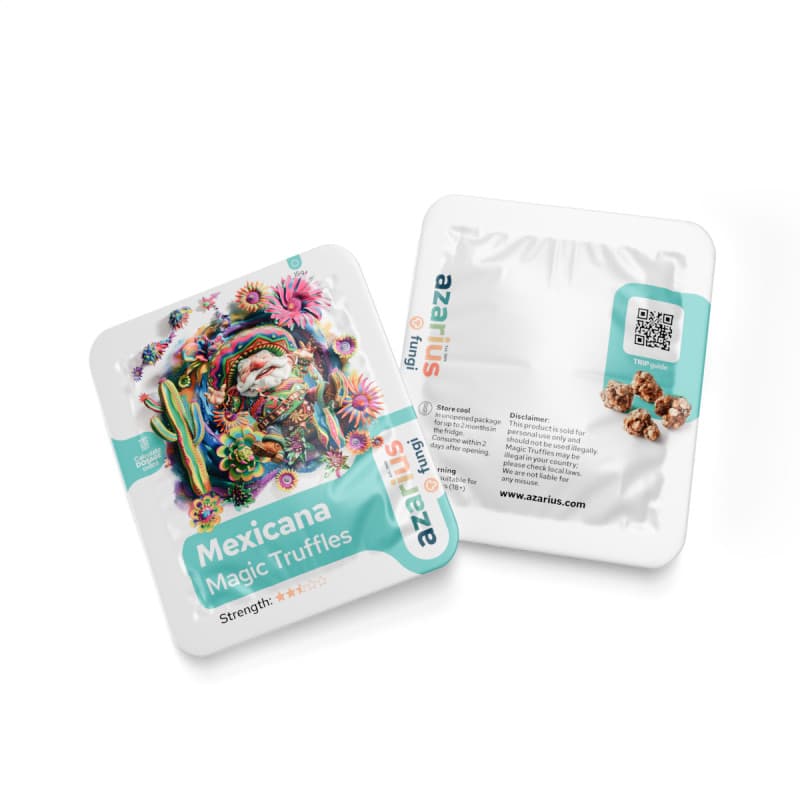
The original magic truffle — Psilocybe mexicana was the first sclerotia species studied by Albert Hofmann. Mexicana offers warm euphoria, creative thinking, and light visuals, and remains one of the most popular beginner strains in the world.
- • The original Hofmann strain — a true classic
- • Warm euphoria, creativity boost, and mild visuals
- • 15g pack — legally sold in Dutch smartshops
Disclosure: We may earn a commission if you purchase via these links.
Magic Truffles Pajaritos
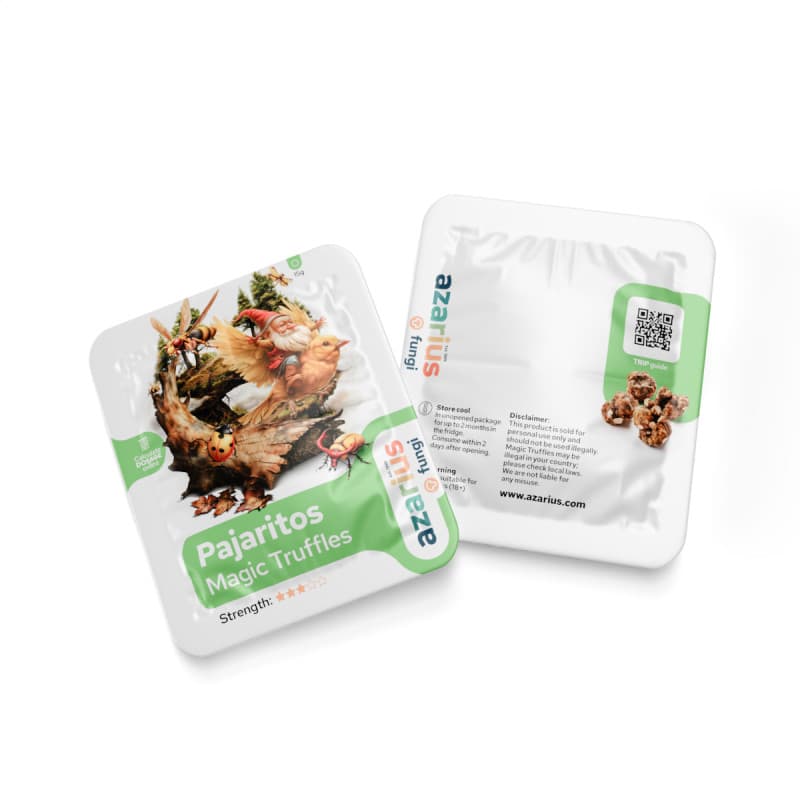
One of the gentlest truffle experiences available. Pajaritos (Spanish for "little birds") offer a light, playful trip with heightened senses, mild visuals, and a warm, uplifting mood — perfect for first-timers or a relaxed daytime adventure.
- • Mildest in the Azarius range — ideal for beginners
- • Uplifting mood with light visuals and social energy
- • 15g pack — legally sold in Dutch smartshops
Disclosure: We may earn a commission if you purchase via these links.
A truffle grinder helps ensure consistent particle size, which means more even absorption and a smoother, more predictable onset. This is a small investment that meaningfully reduces the risk of unexpected intensity spikes.
Magic Truffle Grinder
Compact grinder designed specifically for magic truffles — makes them easier to chew and digest, and can help with more even dosing. A simple but useful accessory for truffle users.
- • Designed specifically for magic truffle preparation
- • Finer grind = easier digestion and more even dosing
- • Compact and easy to clean
Disclosure: We may earn a commission if you purchase via these links.
Body Weight and Sensitivity
Psilocybin sensitivity varies significantly between individuals and does not correlate neatly with body weight, though larger individuals may need slightly higher doses. Factors that influence sensitivity include:
- Genetics — enzyme variations affect how quickly you metabolise psilocin
- Stomach contents — an empty stomach produces faster, more intense onset; eating 2-3 hours before provides a gentler experience
- Previous psychedelic experience — complete novices are often more sensitive
- Current medications — SSRIs can blunt effects; MAOIs can intensify them dangerously
The golden rule: you can always take more, but you can never take less. If your first experience with a mild dose is underwhelming, you have lost nothing. If your first experience with a heroic dose is overwhelming, you may have a genuinely traumatic time that puts you off psychedelics permanently.
Gentle Strains for Growing
If you prefer to grow your own mushrooms rather than purchasing truffles, the Golden Teacher variety is widely regarded as one of the most forgiving strains for beginners. It offers a moderate, well-balanced experience with a gradual onset that gives you time to adjust.
Golden Teacher Grow Kit
The Golden Teacher is the most iconic and widely loved magic mushroom strain — deep introspective effects, philosophical insight, and a gentle onset. Perfect for first full-dose experiences.
- • Golden Teacher — most iconic and trusted strain
- • Introspective, philosophical experience
- • Gentle onset — forgiving for beginners
Disclosure: We may earn a commission if you purchase via these links.
The Trip Sitter: Your Most Important Safety Measure
A trip sitter is a sober, trusted person who remains present during your psychedelic experience to provide support if needed. If you take one piece of advice from this entire article, let it be this: never take a moderate or high dose of psilocybin alone for the first time.
What Makes a Good Trip Sitter
Not everyone is suited to this role. A good trip sitter:
- Is someone you trust deeply — this is not the time for acquaintances
- Remains completely sober throughout the experience
- Has some knowledge of psychedelics — ideally personal experience, but at minimum an understanding of effects, timeline, and what to expect
- Is patient and non-judgemental — capable of sitting quietly for hours without getting bored or anxious
- Knows your medical history and any medications you are taking
- Has emergency numbers saved and knows your address
- Has read this article (or similar harm reduction resources)
The Trip Sitter's Role
| Do | Do Not |
|---|---|
| Stay calm and present | Panic or show fear |
| Speak in a soft, reassuring voice | Raise your voice or argue |
| Remind them they took a substance and it will pass | Try to "snap them out of it" |
| Offer water, blankets, a change of music | Force food or drink |
| Maintain gentle eye contact | Stare intensely |
| Ask "what do you need?" | Assume you know what they need |
| Move them to a different room if the environment feels wrong | Physically restrain them (unless safety demands it) |
| Have the trip stopper ready to offer | Pressure them to take anything |
| Call for help if genuinely concerned | Try to be a hero — know your limits |
What Else Helps During a Difficult Trip
A trip stopper is one tool in a larger toolkit. If you or someone you are with is having a hard time, try these approaches — ideally in combination:
Change the Environment
Sometimes a difficult trip is being driven by something in the immediate surroundings — a song that is too intense, a room that feels claustrophobic, lighting that is too bright. Simple changes can have outsized effects:
- Switch rooms — move from bedroom to living room, or step into a garden
- Change the music — switch to something calm and familiar, or turn it off entirely
- Adjust lighting — dimmer, warmer light often helps
- Go outside if the weather is mild and you have a private outdoor space — nature is remarkably soothing during a psychedelic experience
The 5-4-3-2-1 Grounding Technique
This is a simple sensory grounding exercise used by therapists worldwide for anxiety and dissociation. Walk the person through it slowly:
- Name 5 things you can see — "I can see the lamp, the curtain, my hands..."
- Name 4 things you can touch — "I can feel the sofa cushion, my jumper, the carpet..."
- Name 3 things you can hear — "I can hear the music, the rain outside, your voice..."
- Name 2 things you can smell — "I can smell the candle, the fresh air..."
- Name 1 thing you can taste — "I can taste the water I just drank..."
This exercise works by pulling attention back into the body and the immediate physical environment, countering the tendency of a difficult trip to spiral into abstract, frightening territory.
Breathing Exercises
Slow, controlled breathing activates the parasympathetic nervous system — the body's "rest and digest" mode. Try:
- Box breathing: Inhale for 4 counts, hold for 4 counts, exhale for 4 counts, hold for 4 counts. Repeat.
- Extended exhale: Inhale for 4 counts, exhale for 6-8 counts. The longer exhale stimulates the vagus nerve, promoting calm.
Physical Comfort
- Cold water on the wrists or face — triggers the mammalian dive reflex, slowing heart rate
- A weighted blanket or being wrapped in a duvet — provides deep pressure stimulation, which is genuinely calming at a neurological level
- Gentle movement — walking slowly, stretching, or rocking can help discharge physical tension
Sugar and Vitamin C
As discussed in the trip stopper mechanism section, blood sugar plays a real role. If you do not have a trip stopper to hand:
- Orange juice is the classic recommendation — it provides sugar, vitamin C, and hydration in one
- A banana or a few sweets can also help
- Avoid caffeine — it is a stimulant and is likely to increase anxiety
What to Avoid During a Psychedelic Crisis
Equally important as knowing what to do is knowing what not to do. Some well-meaning responses can make things significantly worse.
Do Not Fight the Experience
Resistance is one of the primary drivers of psychedelic distress. The instinct when things become frightening is to clench, resist, and try to force your way back to normal. This almost always escalates the fear. The most effective attitude — difficult as it is — is surrender. "I notice I am frightened. That is okay. This will pass."
Do Not Drive or Leave the House Unsupervised
This should go without saying, but it needs saying. Psilocybin profoundly impairs judgement, coordination, and perception. Do not drive. Do not operate machinery. Do not wander into traffic. If someone in distress wants to leave the house, accompany them to a safe outdoor space — do not let them leave alone.
Do Not Take More Substances
Taking more psilocybin ("maybe I did not take enough and that is why it feels weird") is a genuinely dangerous response. Taking cannabis to "calm down" frequently has the opposite effect, intensifying the trip dramatically. Alcohol impairs your ability to process the experience and increases physical side effects.
The only substances that are appropriate to add during a difficult trip are: water, sugar (food or drink), and a trip stopper containing valerian/maltodextrin.
Do Not Leave Someone Alone
If you are sitting for someone who is in distress, do not leave them unattended. Even to go to the bathroom, let them know: "I am going to the bathroom. I will be back in two minutes. You are safe." Feeling abandoned during a psychedelic crisis can be deeply traumatic.
Do Not Threaten to Call an Ambulance (Unless You Mean It)
Saying "I'm going to call an ambulance if you don't calm down" is coercive and will almost certainly escalate panic. If you genuinely believe someone needs medical attention, call for help quietly and calmly. If you do not believe they need medical attention, do not use it as a threat.
The Day After: Integration and Recovery
The psychedelic experience does not end when the visuals fade. The 24-48 hours following a psilocybin session — and arguably the weeks that follow — are an important part of the process.
The Afterglow
Many people experience a positive afterglow in the day or two following a psilocybin experience: elevated mood, enhanced appreciation for nature and relationships, a sense of peace and clarity. This is normal and generally pleasant. Enjoy it. Do not try to force it to last.
When You Feel Rough
Not everyone has a smooth landing. Some common post-trip experiences include:
- Fatigue — your brain has been working overtime; rest is essential
- Emotional sensitivity — you may feel more tearful, open, or vulnerable than usual
- Mild headache — hydration and paracetamol (not ibuprofen on an empty stomach) can help
- Residual anxiety — if the trip was difficult, some anxiety may linger for a day or two
- Difficulty sleeping the first night — this is common and usually resolves within 24 hours
Integration Practices
Integration is the process of making sense of your experience and incorporating any insights into your daily life. Simple practices include:
- Journaling — write down what you experienced, felt, and learned while it is still fresh
- Talk to someone — a trusted friend, your trip sitter, or a therapist familiar with psychedelic experiences
- Gentle exercise — walking, yoga, or swimming can help process residual emotions held in the body
- Good nutrition — your brain needs fuel to recover; eat well, hydrate, and consider supplementing with vitamins and omega-3 fatty acids
- Rest — take the day off if you can; do not schedule demanding work or social obligations
When to Seek Professional Support
Most post-trip difficulties resolve naturally within a few days. However, contact a mental health professional if:
- Anxiety or depression persists for more than a week after the experience
- You are having flashbacks or intrusive thoughts related to the trip
- You feel disconnected from reality (depersonalisation/derealisation)
- You had a pre-existing mental health condition that seems to have worsened
- You feel the urge to use psilocybin again immediately to "fix" the bad experience
Organisations like the Fireside Project (US) and PsychedelicSupport.io offer directories of therapists experienced with psychedelic integration.
Frequently Asked Questions
Can a trip stopper completely end a trip?
No. A trip stopper does not "switch off" a psilocybin experience. Once psilocybin has been metabolised into psilocin and is active at serotonin receptors, no over-the-counter supplement can completely reverse that process. What a trip stopper does is reduce the intensity — calming anxiety through valerian's GABAergic action and stabilising blood sugar through maltodextrin. Most people find this is enough to transform a frightening experience into a manageable one.
Should I always have a trip stopper when using psychedelics?
Yes, absolutely. At €2.95, a trip stopper costs less than a coffee. Even if you never use it, simply knowing it is there provides psychological reassurance — and that reassurance alone can prevent difficult moments from escalating. Think of it like a first aid kit: you hope you never need it, but you would be foolish not to have one.
Can I take a trip stopper preventively, before the trip starts?
This is not generally recommended. Taking valerian before ingesting truffles may slightly dull the experience, and the maltodextrin will have been metabolised long before you need it. The trip stopper is designed to be used during the experience, when symptoms of distress arise. However, some people do take a valerian capsule 30 minutes before their session to "take the edge off" the come-up, which is the most anxiety-prone phase. There is no safety concern with this approach, but it may reduce the overall depth of the experience.
What if the trip stopper does not work?
If you have taken a trip stopper and are still in significant distress after 20-30 minutes, employ all the other strategies discussed in this article: change your environment, use grounding techniques, practise slow breathing, and lean on your trip sitter. If distress continues to escalate despite these interventions, and especially if there are signs of a medical emergency, do not hesitate to call emergency services. Being honest about what has been consumed will help medical professionals provide appropriate care.
Is it safe to take valerian with psilocybin?
There are no known dangerous interactions between valerian and psilocybin. Valerian has been used safely alongside a wide range of substances and is classified as Generally Recognised as Safe (GRAS) in most jurisdictions. Its GABAergic effects are mild compared to pharmaceutical alternatives and do not pose the respiratory depression risk associated with benzodiazepines. That said, individual reactions can vary, and this article does not constitute medical advice.
How long do the effects of a trip stopper last?
Valerian's calming effects typically onset within 20-30 minutes and last for 2-4 hours. Maltodextrin's blood sugar effects are faster (10-15 minutes) but shorter-lived (1-2 hours). This timing aligns well with the typical arc of a difficult psychedelic moment, which usually passes within 1-2 hours even without intervention.
Can I use a trip stopper with substances other than psilocybin?
Trip stoppers are primarily marketed for use with psilocybin (truffles and mushrooms), but the underlying mechanism — blood sugar support and mild GABAergic calming — is not specific to psilocybin. Some people use them with other psychedelics. However, this article focuses specifically on psilocybin, and we cannot speak to the safety or efficacy of trip stoppers with other substances. If you are using other psychedelics, research the specific interactions and safety profiles relevant to that substance.
Trip Stopper
The Azarius Trip Stopper — an essential harm reduction product for any psychedelic experience. Contains maltodextrin and valerian to help calm an overwhelming trip. Keep one accessible any time you use psychedelics.
- • Essential harm reduction product for psychedelic use
- • Contains maltodextrin and valerian to calm overwhelming trips
- • Affordable — always keep one on hand
Disclosure: We may earn a commission if you purchase via these links.
Disclaimer
This article is for educational and harm reduction purposes only. It does not constitute medical advice, and Smart Supplements does not endorse or encourage the use of any controlled substance.
Psilocybin is a controlled substance in most countries worldwide. In the Netherlands, psilocybin-containing magic truffles (sclerotia) are legal to purchase and consume, but psilocybin mushrooms are not. Laws vary dramatically between jurisdictions, and it is your responsibility to understand and comply with the laws in your location.
This article is written from a harm reduction perspective — acknowledging that people do use psychedelics and providing evidence-based information to help them do so more safely. Harm reduction does not imply endorsement.
If you or someone you are with is in physical danger or experiencing a medical emergency, call emergency services immediately (112 in Europe, 999 in the UK, 911 in the US). No supplement, technique, or article is a substitute for professional medical care.
Individuals with a personal or family history of psychosis, schizophrenia, bipolar disorder, or other serious psychiatric conditions should avoid psilocybin entirely unless under direct clinical supervision.
Related Articles
- What Are Nootropics? A Beginner's Guide to Cognitive Enhancers
- Microdosing vs Nootropics: Which Approach to Cognitive Enhancement Is Right for You?
This article is for informational purposes only and is not intended as medical advice. Always consult a healthcare professional before starting any new supplement, especially if you take prescription medication.
Related topics
Related articles
How to Trip Sit: The Complete Guide to Psychedelic Support
A trip sitter can make or break a psychedelic experience. Learn exactly what to do (and what not to do) when someone trusts you to guide them through a tru
How to Navigate a Bad Trip: Prevention, Rescue, and Recovery
Bad trips happen — but they do not have to be traumatic. Learn what causes challenging psychedelic experiences, how to help yourself or someone else throug
Magic Mushrooms & Truffles: The Complete Guide to Psilocybin in the Netherlands
The definitive guide to psilocybin in the Netherlands — covering magic truffles, mushroom grow kits, strains, dosage, effects, safety, and everything you n