
Microdosing for Focus and Productivity: What the Science Says
Written by Smart Supplements Editorial Team
Key takeaways
- Self-report data consistently lists focus as a top microdosing benefit
- Placebo-controlled evidence shows modest benefits — expectation effects are significant
- Microdosing suits creative and open-ended work better than precision analytical tasks
- The Fadiman protocol provides the clearest structure for scheduling cognitive work
- Day 2 (first off-day) is often reported as peak performance day
- Daily dosing does not work — tolerance develops within 2–3 consecutive days
Table of contents
- The Productivity Claim
- What the Research Actually Shows
- The Neuroplasticity Window
- Best Protocols for Cognitive Performance
- Microdosing vs Other Cognitive Enhancers
- Who Benefits Most?
- Designing a Focus-Optimised Practice
- The Tolerance and Diminishing Returns Problem
- Frequently Asked Questions
- Further Reading
Silicon Valley popularised microdosing for productivity. But does the science support what the tech industry claims? Here's an honest look at the evidence — what works, what doesn't, and how to structure a practice around cognitive performance.
The Productivity Claim
The microdosing-for-productivity narrative emerged from Silicon Valley around 2015. Engineers at major tech firms, designers at creative agencies, and founders running startups began reporting that sub-perceptual doses of psilocybin or LSD gave them an edge: sharper focus, enhanced problem-solving, reduced procrastination, and a state of "effortless concentration" that felt different from caffeine or Adderall.
James Fadiman's early collection of self-reports — compiled from hundreds of microdosers who emailed him their experiences — consistently placed cognitive enhancement alongside mood improvement as the two most commonly cited benefits.
The question is whether this edge is measurable, reproducible, and attributable to the substance — or whether it's a story told by high-performing people who were already optimising everything else in their lives.
What the Research Actually Shows
Self-report evidence
Polito & Stevenson (2019) tracked 98 microdosers over six weeks. Participants reported increased absorption — the psychological trait of becoming fully immersed in a task. This maps well onto the "flow state" reports from the productivity community. However, the changes were smaller than participants expected.
The Quantitative Mind survey — with thousands of respondents — consistently ranks focus and concentration among the top three perceived benefits, alongside mood improvement and creativity. The sheer consistency across large samples is noteworthy, even with the limitations of self-report.
Placebo-controlled evidence
Szigeti et al. (2021) — the Imperial College self-blinding RCT — found that microdosers reported improved focus and concentration. However, the placebo group also showed improvements. The drug effect above placebo was positive but modest, and did not reach statistical significance for the concentration measures specifically.
Ramaekers et al. (2021) — a placebo-controlled study at Maastricht University — found that a low dose of psilocybin improved divergent thinking (creative idea generation) compared to placebo, but showed no improvement in convergent thinking (analytical problem-solving). This distinction matters enormously for the productivity question.
What this means in practice
| Cognitive Task | Evidence for Microdosing Benefit | Strength |
|---|---|---|
| Brainstorming / ideation | Positive (Prochazkova 2018, Ramaekers 2021) | Moderate |
| Creative writing / design | Positive (self-report, consistent) | Weak-moderate |
| Deep focus on open-ended work | Positive (self-report, absorption data) | Weak-moderate |
| Analytical problem-solving | Neutral to mildly negative | Moderate |
| Precision debugging / coding | No benefit found; possible impairment | Moderate |
| Routine administrative tasks | No benefit found | Weak |
The honest summary: microdosing may genuinely support certain types of cognitive work — particularly open-ended, creative, and exploratory tasks. For precision analytical work, the evidence is at best neutral. This is not a universal cognitive enhancer.
For the creativity angle specifically, our Microdosing and Creativity deep-dive covers the Prochazkova and Szigeti studies in more detail.
The Neuroplasticity Window
One of the more compelling hypotheses for how microdosing affects cognition is the neuroplasticity window.
Psilocybin promotes the release of BDNF (brain-derived neurotrophic factor) — a protein that supports neuronal growth and synaptic plasticity. Research in animal models has shown that psilocybin promotes structural changes in cortical neurons, with effects lasting beyond the acute dosing period.
The hypothesis: each microdose opens a temporary window of increased neural plasticity — a period where the brain is more receptive to forming new connections, learning new patterns, and breaking out of established cognitive ruts.
How to use this window:
The neuroplasticity window, if it exists at the microdose level, peaks in the hours following dosing and may extend into the following day. This has practical implications:
- Dose mornings (9–11am): Schedule your most cognitively demanding, creative, or novel work here. This is when the theoretical plasticity window aligns with the subtle pharmacological effects.
- Dose afternoons: The acute effect is fading; good for reflection, review, and lighter tasks.
- Off-day 1 (day after): Many microdosers report this as their most productive day. The plasticity window may still be open, but without the mild stimulation of the dose day itself. This is the "integration day."
- Off-day 2: Baseline returns. Good for routine work, administration, and analytical tasks.
The Stamets Stack adds Lion's Mane mushroom — which promotes nerve growth factor (NGF) — to amplify this neuroplasticity effect over the long term. The combination is hypothesised to produce cumulative cognitive benefits that build across weeks and months, rather than acute dose-day effects.

Microdosing Truffles Mental
Azarius Mental microdosing truffles — formulated for cognitive enhancement, focus and mental clarity. Sub-perceptual psilocybin dose (approx. 1g) designed for use in a Fadiman or similar protocol.
- • Target: focus, mental clarity and cognitive performance
- • Sub-perceptual psilocybin dose — no trip
- • Pre-packaged for Fadiman-style protocols
Disclosure: We may earn a commission if you purchase via these links.
Best Protocols for Cognitive Performance
Fadiman Protocol — best for acute focus enhancement
| Day | Action | Cognitive Priority |
|---|---|---|
| Day 1 | Dose (6–8am) | Creative/open-ended work, 9–11am |
| Day 2 | Off (transition) | Deep focus work, review, editing |
| Day 3 | Off (baseline) | Analytical work, routine tasks |
| Day 4 | Dose | Repeat |
The Fadiman protocol's strength for productivity is its clarity. You know exactly which days are dose days and can schedule your work type accordingly. The two off-days provide a clean comparison and prevent tolerance.
Pro tip: Many microdosers who optimise for productivity report that Day 2 (the first off-day) is actually their peak performance day. If this matches your experience, schedule your most important deliverables for Day 2, and use Day 1 for brainstorming and creative exploration.
Stamets Protocol — best for long-term cognitive investment
| Days | Action | Cognitive Priority |
|---|---|---|
| Days 1–4 | Dose + Lion's Mane + Niacin | Creative and exploratory work |
| Days 5–7 | Off | Analytical, precision, and routine work |
The Stamets approach is less about acute dose-day enhancement and more about sustained neuroplasticity support. The four consecutive dose days can feel slightly overstimulating for some people (tolerance reduces the effect by day 3–4), but the cumulative BDNF + NGF support from psilocybin + Lion's Mane is the theoretical payoff.
See our Fadiman vs Stamets comparison for a full protocol breakdown.
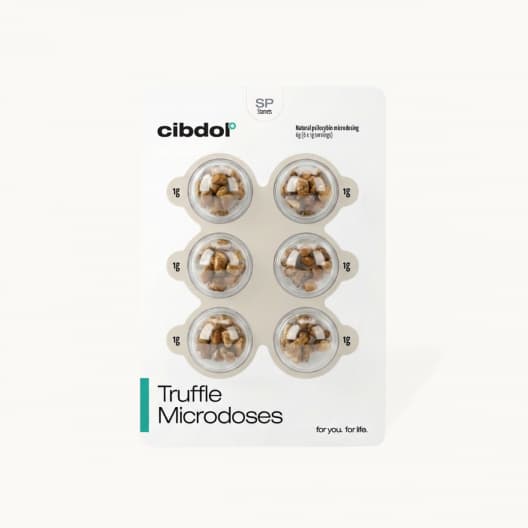

Truffle Microdoses (SP)
Cibdol Truffle Microdoses (SP), carefully prepared microdosing truffles suited for the Stamets Protocol. Made with Psilocybe galindoi truffles, each pack contains 6 × 1g portions to support clarity, cognitive growth, and mental flexibility. Designed for those following a more active, neuroplasticity-focused microdosing routine.
- • For mental flexibility and cognitive freedom
- • Up to 1.3 mg psilocybin per dose (6×)
- • Up to 2.6 mg active tryptamines per dose
Disclosure: We may earn a commission if you purchase via these links.
Microdosing vs Other Cognitive Enhancers
How does microdosing compare to the more established focus tools?
| Enhancer | Onset | Duration | Best For | Legal Status |
|---|---|---|---|---|
| Microdosing psilocybin | 30–60 min | 4–6 hours | Creative/divergent work | Legal (NL truffles) |
| Caffeine | 15–30 min | 3–5 hours | Alertness, routine tasks | Legal everywhere |
| L-Theanine + Caffeine | 20–40 min | 4–6 hours | Calm focus, analytical work | Legal everywhere |
| Modafinil | 30–60 min | 8–12 hours | Sustained wakefulness, analytical | Prescription (most EU) |
| Lion's Mane (standalone) | 2–4 weeks | Ongoing | Long-term cognitive support | Legal everywhere |
Key distinction: Microdosing is not a stimulant. It doesn't produce the immediate alertness of caffeine or the sustained wakefulness of modafinil. Its potential value lies in a different dimension — cognitive flexibility, creative connection-making, and openness to novel approaches. If your bottleneck is raw alertness and you're sleep-deprived, caffeine is a better tool. If your bottleneck is creative stagnation or rigid thinking, microdosing may address something stimulants cannot.
For a broader view of cognitive enhancement tools, see our What Are Nootropics? guide.
Who Benefits Most?
Based on the available evidence and consistent self-report patterns:
Likely better candidates for microdosing for focus:
- Writers, designers, and creative professionals in the generative phase
- Strategists, consultants, and anyone doing open-ended problem-solving
- Entrepreneurs in the ideation and planning stages
- Researchers in early exploratory phases
- People stuck in cognitive ruts who need fresh perspective
Less likely to benefit:
- Software engineers doing precision debugging
- Accountants and financial analysts
- Anyone requiring sustained analytical precision
- People whose focus issues stem from sleep deprivation (fix sleep first)
- People with ADHD (the evidence for microdosing for ADHD is weak — a 2025 LSD microdosing RCT found no benefit above placebo)
The honest bottom line: If your work requires creative thinking, lateral connections, and openness to new ideas, microdosing has a plausible — if not yet definitively proven — role. If your work requires precision, routine execution, and analytical rigour, other tools are better suited.
Designing a Focus-Optimised Practice
If you're approaching microdosing specifically for cognitive performance, here's a structured framework:
Weekly template (Fadiman protocol)
| Day | Dose? | Work Priority | Notes |
|---|---|---|---|
| Monday | ✅ Dose AM | Brainstorming, writing, strategy | Peak creative window 9–11am |
| Tuesday | Off | Deep work, editing, key deliverables | Integration day — often peak performance |
| Wednesday | Off | Analytical, admin, meetings | Baseline day |
| Thursday | ✅ Dose AM | Creative work, client-facing | Second dose-day cycle |
| Friday | Off | Review, planning, reflection | Integration |
| Weekend | Off | Rest, exercise, social | Full reset |
Tracking cognitive performance
To genuinely assess whether microdosing improves your focus, track these metrics daily:
- Focus score (1–10): How well could you sustain attention on your primary task?
- Productive hours: How many hours of real output (not just desk time)?
- Task type: Categorise as creative, analytical, administrative, or social
- Procrastination level (1–10): How much did you avoid your key task?
- Ideas captured: Count of novel ideas or connections recorded
After 4–6 weeks, compare dose days vs. off-days across these metrics. Without this data, you're relying on impression — which is heavily biased by expectation.
The Tolerance and Diminishing Returns Problem
Daily microdosing for focus doesn't work. Here's why:
Psilocybin tolerance develops within 2–3 consecutive doses. The 5-HT2A receptors that psilocybin acts on downregulate rapidly with repeated exposure. By day three of daily dosing, you're essentially taking a pharmacological placebo.
This is not a flaw in the substance — it's a feature of the receptor system. The off-days in every legitimate protocol exist specifically to allow receptor resensitisation.
The practical lesson: If you're tempted to dose every day because you want the focus benefit daily, resist. The pharmacology doesn't support it. Structure your work around the protocol, not the other way around. Off-days are not lost days — they're often the best days.
Frequently Asked Questions
Does microdosing improve focus?
Self-report data consistently says yes. Placebo-controlled evidence is more nuanced — the Szigeti 2021 study found improved self-reported concentration, but placebo effects were also significant. The benefit appears real but modest, and is better suited to creative/open-ended tasks than precision analytical work.
Is microdosing good for productivity?
It depends on the type of productivity. For creative output, brainstorming, and open-ended problem-solving, there's a plausible benefit. For routine tasks, data entry, or precise analytical work, other tools (caffeine, L-Theanine, adequate sleep) are likely more effective.
How does microdosing affect the brain?
Psilocybin acts on 5-HT2A serotonin receptors and promotes BDNF release, which supports neuroplasticity — the brain's ability to form new connections. This may create a temporary window of enhanced cognitive flexibility on dose days and the day after.
What's the best protocol for work performance?
The Fadiman protocol (1 day on, 2 off) gives the clearest structure for scheduling work around dose effects. Plan creative work on dose mornings and analytical work on off-days. Many users find Day 2 (first off-day) is actually their peak performance day.
Can I microdose instead of taking Adderall or modafinil?
Microdosing is fundamentally different from stimulant medication. It doesn't produce alertness or sustained wakefulness. If you have diagnosed ADHD, a 2025 clinical trial found LSD microdosing no more effective than placebo for ADHD symptoms. Discuss any changes to your treatment with your doctor.
Does the effect wear off over time?
Tolerance develops within 2–3 consecutive doses, which is why protocols include off-days. For long-term use, take 2–4 weeks completely off after each 4–8 week cycle. Some users report that the cognitive flexibility benefits persist during breaks, suggesting lasting neuroplastic changes.
Further Reading
- Microdosing Psilocybin: The Complete Guide — full overview
- Microdosing and Creativity — the divergent thinking evidence
- The Stamets Stack Explained — long-term neuroplasticity protocol
- Fadiman vs Stamets Protocol — compare schedules
- How to Start Microdosing — beginner setup guide
- What Are Nootropics? — the broader cognitive enhancement landscape
This article is for informational purposes only and is not intended as medical advice. Always consult a healthcare professional before starting any new supplement or protocol, especially if you take prescription medication.
Last updated: March 2026
Written by the Smart Supplements editorial team
Related topics
Where to buy
Affiliate linksMicrodosing Truffles
Cibdol microdosing truffle kits: FP (Fadiman), SP (Stamets), and OP (One-day-on/off). Lab-tested, 6×1g servings per pack. Choose by protocol and goal — inner calm, mental flexibility, or daily sharpness.
Microdosing XP Truffles
Pre-portioned psilocybin truffle strips designed specifically for microdosing — consistent dosing without a scale.
- • Pre-portioned for accurate microdosing
- • No scale needed — ready to use
- • Consistent psilocybin content per portion
Magic Truffles
Legal psilocybin truffles (sclerotia) available over the counter in the Netherlands. Multiple strains from mild to strong.
Mushroom Grow Kits
All-in-one psilocybin mushroom grow kits — just add water. Multiple strains available for home cultivation in the Netherlands.
Disclosure: We may earn a commission if you purchase via these links.
Related articles
Microdosing vs Nootropics: Two Paths to Cognitive Enhancement
A head-to-head comparison of microdosing psilocybin and nootropic supplements for cognitive enhancement — covering mechanisms, evidence, safety, and which
Microdosing and Creativity: Myth or Real Cognitive Boost?
Does microdosing boost creativity? We look at the actual research — from Prochazkova 2018 to the Imperial College self-blinding study — to separate the cul
Microdosing Journal: How to Track Your Experience
Microdosing journal: what to track, how to track it, and a structured template to measure your microdosing results objectively over 30 days.