Microdosing for Anxiety and Depression: What the Research Says
Written by Smart Supplements Editorial Team
Key takeaways
- Observational studies show consistent mood benefits from microdosing
- Placebo-controlled evidence is mixed — expectation effects are significant
- Microdosing is NOT the same as full-dose psilocybin therapy
- SSRIs may blunt microdosing effects — never stop medication without medical supervision
- Best results reported when combined with therapy, journaling, or mindfulness
- The Netherlands is the primary legal access point for psilocybin truffles in Europe
Table of contents
- Why People Turn to Microdosing for Mental Health
- What the Research Actually Shows
- Proposed Mechanisms
- Microdosing vs Full-Dose Psilocybin Therapy
- Who Reports the Most Benefit?
- The SSRI Interaction Problem
- Harm Reduction for Mental Health Users
- Legal Access in Europe
- Frequently Asked Questions
- Further Reading
Microdosing for mental health is one of the fastest-growing areas of psychedelic research — but the evidence is far more nuanced than the headlines suggest. Here's what the science actually supports, who it may help, and the critical safety considerations you need to know.
Why People Turn to Microdosing for Mental Health
The interest isn't hard to understand. Across Europe, rates of anxiety and depression have climbed steadily since 2020. Conventional treatment with SSRIs works for many people — but not for everyone. Common complaints include delayed onset (4–6 weeks before effects), sexual side effects, emotional blunting, weight gain, and difficult withdrawal (discontinuation syndrome).
Against this backdrop, the idea of a natural, sub-perceptual intervention that works within days rather than weeks is deeply appealing. Survey data from Polito & Stevenson (2019) — an observational study of 98 microdosers over six weeks — found that participants reported decreased depression, decreased stress, and increased emotional wellbeing.
But appealing and proven are two different things. Let's look at what the research actually shows.
What the Research Actually Shows
Observational and self-report studies
Polito & Stevenson (2019) — an observational study published in PLOS ONE — tracked 98 participants through six weeks of self-directed microdosing. Results showed reduced depression and stress scores alongside increased absorption (the tendency to become fully engaged in experiences). Notably, the psychological changes were smaller than participants expected, suggesting that the reality is more modest than the hype.
The Quantitative Mind survey (2019–2021) — one of the largest self-report datasets on microdosing — found that mental health benefits (mood improvement, reduced anxiety) were among the top three reasons people microdose, and among the top three reported outcomes. But self-report data is inherently limited by selection bias: people who choose to microdose are often already seeking improvement and primed to notice positive changes.
Rootman et al. (2021) — published in Scientific Reports — surveyed 8,703 adults and found that microdosers reported lower levels of depression and anxiety compared to non-microdosing controls. The effect was small-to-moderate and held up after controlling for demographics. Still observational, still subject to confounders — but the scale is noteworthy.
Placebo-controlled evidence
Szigeti et al. (2021) — the Imperial College London self-blinding study, published in eLife — is the most methodologically rigorous microdosing study to date. Participants prepared their own blinded capsules (active microdose or placebo) and tracked psychological outcomes over four weeks. The results were mixed: microdosers reported genuine improvements in wellbeing, including depression and anxiety scores — but the placebo group also improved significantly. The drug effect above placebo was smaller than many expected.
This study doesn't mean microdosing doesn't work. It means that expectation itself produces measurable psychological benefits, and disentangling the drug effect from the expectation effect is exceptionally difficult.
The 2025 LSD microdosing ADHD trial — while focused on ADHD rather than depression — is the first completed double-blind RCT of psychedelic microdosing. LSD microdoses were no more effective than placebo for ADHD symptoms. This doesn't directly apply to psilocybin or to depression, but it signals that the bar for placebo-controlled evidence in microdosing is high.
The honest summary
| Evidence Type | Finding | Strength |
|---|---|---|
| Self-report surveys (thousands) | Consistent mood benefits reported | Weak (no control) |
| Observational studies | Reduced depression/anxiety scores | Moderate (no randomisation) |
| Self-blinding RCT (Szigeti 2021) | Real benefits, but strong placebo | Moderate-strong |
| Double-blind RCT (LSD/ADHD 2025) | No benefit above placebo | Strong (different substance/condition) |
Something real is probably happening — but the effect size may be smaller than the cultural narrative suggests, and a significant portion of the benefit may be driven by expectation, ritual, and the intentional structure of a microdosing practice.
Proposed Mechanisms
How might sub-perceptual doses of psilocybin affect mood? Several pathways are proposed:
5-HT2A receptor agonism. Psilocybin (converted to psilocin in the body) acts on serotonin 5-HT2A receptors — the same receptors targeted at full dose. At microdose levels, the activation is thought to be modest but sufficient to increase neural flexibility and emotional responsiveness.
BDNF release. Brain-derived neurotrophic factor — a protein that supports neuronal growth and synaptic plasticity — appears to increase following psilocybin administration. Higher BDNF is associated with improved mood and cognitive flexibility. This has been demonstrated in animal models; human microdose data is still limited.
Default mode network modulation. The DMN — active during rumination, self-referential thinking, and the "inner critic" loop that characterises depression — appears to become less rigidly active under psilocybin's influence. At full doses, this manifests as ego dissolution. At microdose levels, it may manifest as a subtle reduction in negative self-talk.
Neuroplasticity window. The combination of 5-HT2A activation and BDNF release may create a temporary window of increased neural plasticity — a period where the brain is more receptive to forming new patterns of thought and emotion. This is the theoretical basis for why microdosing might help people "unstick" from depressive thought patterns.
For the full science behind how psilocybin works in the brain, see our Complete Beginner's Guide to Microdosing Psilocybin.
Microdosing vs Full-Dose Psilocybin Therapy
This distinction is critical and often confused. They are not the same intervention.
Full-dose psilocybin therapy — typically 25mg synthetic psilocybin in a clinical setting — has strong evidence from multiple Phase 2 trials. The COMPASS Pathways trial found that a single 25mg dose produced rapid and sustained reductions in treatment-resistant depression. The Imperial College London PSILODEP trials showed similar results. These are supervised sessions with trained therapists, lasting 6–8 hours.
Microdosing — 0.5–1.5g truffle or 0.1–0.3g dried mushroom — is a self-directed practice taken repeatedly over weeks. The evidence is weaker, the effect size appears smaller, and no Phase 2 or Phase 3 trial has tested it specifically for depression.
| Factor | Microdosing | Full-Dose Therapy |
|---|---|---|
| Dose | Sub-perceptual | Full psychedelic experience |
| Setting | Self-directed, at home | Clinical, therapist-guided |
| Evidence for depression | Observational + 1 RCT | Multiple Phase 2 RCTs |
| Effect size | Small-to-moderate (uncertain) | Large (well-established) |
| Legal access | NL truffles (legal) | Czechia medical (2026), clinical trials |
| Risk profile | Lower | Higher (requires professional support) |
Microdosing is not a replacement for clinical psilocybin therapy. It may be a useful complement to other approaches — therapy, lifestyle changes, community — but it should not be positioned as a treatment for clinical depression.
Who Reports the Most Benefit?
Based on available survey data and observational studies, the people who report the most positive outcomes from microdosing for mental health tend to share certain characteristics:
More likely to benefit:
- People with mild-to-moderate mood issues (subclinical or managed depression/anxiety)
- People experiencing burnout, creative stagnation, or emotional flatness
- People who combine microdosing with intentional practice (journaling, therapy, meditation)
- People who are not currently on SSRIs (clearer pharmacological effect)
Less likely to benefit:
- People with severe clinical depression (microdosing is too subtle for this)
- People in acute crisis (this is not an emergency intervention)
- People on SSRIs (receptor competition may blunt effects)
- People with bipolar I or psychosis history (risk of destabilisation)
The SSRI Interaction Problem
This section is essential reading for anyone considering microdosing while on antidepressants.
SSRIs (selective serotonin reuptake inhibitors) and psilocybin both act on the serotonin system, but through different mechanisms. SSRIs increase serotonin availability in the synapse by blocking reuptake. Over time, this causes the 5-HT2A receptors — the exact receptors psilocybin needs to produce its effects — to downregulate.
The practical consequence: if you're on an SSRI, psilocybin microdoses may produce little to no effect. Many people on SSRIs report that microdosing simply "doesn't work" for them.
The safety concern: at higher doses, combining serotonergic substances carries a theoretical risk of serotonin syndrome — a potentially dangerous condition of excessive serotonin activity. At true microdose levels, this risk is very low. But it is not zero, and individual variation in metabolism matters.
The critical warning: never stop SSRIs to microdose. SSRI discontinuation syndrome can be severe and medically dangerous. Withdrawal must always be managed by your prescribing doctor over weeks or months. If you are interested in exploring microdosing while on SSRIs, discuss it with your doctor first.

Microdosing Truffles Emotional
Azarius Emotional microdosing truffles — designed for emotional openness, empathy and mood support. Sub-perceptual psilocybin dose ideal for days requiring social connection or emotional processing.
- • Target: emotional openness, empathy and mood support
- • Sub-perceptual psilocybin — functional daily dose
- • Ideal for social or emotionally demanding days
Disclosure: We may earn a commission if you purchase via these links.
Harm Reduction for Mental Health Users
If you're approaching microdosing specifically for mood support, these guidelines are important:
Microdosing is not a replacement for therapy. It may create a window of increased emotional openness and plasticity — but you need something to do with that window. Combining microdosing with talk therapy, journalling, or structured self-reflection is where the most consistent positive reports come from.
Journal your experience rigorously. Track mood, anxiety, energy, and sleep daily. Without data, you cannot determine whether the practice is genuinely helping or whether you're experiencing placebo-fuelled optimism.
Watch for anxiety amplification. Psilocybin can amplify whatever emotional state is already present. Some people — particularly those with generalised anxiety — find that the first 1–2 weeks of microdosing slightly increase anxiety before any improvement occurs. If anxiety escalates consistently across three or more dose days, this may not be the right approach for you.
Take breaks. After 4–8 weeks of a protocol, take at least 2 weeks completely off. This prevents tolerance, provides a clean comparison baseline, and reduces any theoretical long-term risks.
Do not self-diagnose. If you're experiencing symptoms of clinical depression — persistent low mood, loss of interest, changes in appetite/sleep, difficulty functioning — seek professional help first. Microdosing is an adjunct, not a front-line intervention.
Legal Access in Europe
Access to psilocybin for microdosing depends entirely on where you are.
The Netherlands — psilocybin truffles (sclerotia) are legal to buy and consume. Available in smartshops and online from Dutch retailers. No prescription required. Age restriction: 18+. This is the primary legal access point for most European microdosers.
Czechia — as of January 1, 2026, Czechia became the first EU country to legalise medical psilocybin. This is a therapeutic framework — not recreational. Access requires a prescription and medical supervision. But it signals a major policy shift in Europe.
Portugal — personal use of all drugs is decriminalised (not legalised). You won't be prosecuted for small amounts, but you can't buy psilocybin legally.
Rest of EU — psilocybin is a controlled substance in Germany, France, Italy, Belgium, Sweden, the UK, and most other European countries. Research is accelerating — the EU recently allocated €6.5 million to a psilocybin clinical trial consortium across Denmark, the Netherlands, Portugal, and Czechia — but legal access remains limited.
For a full country-by-country breakdown, see our complete microdosing guide.
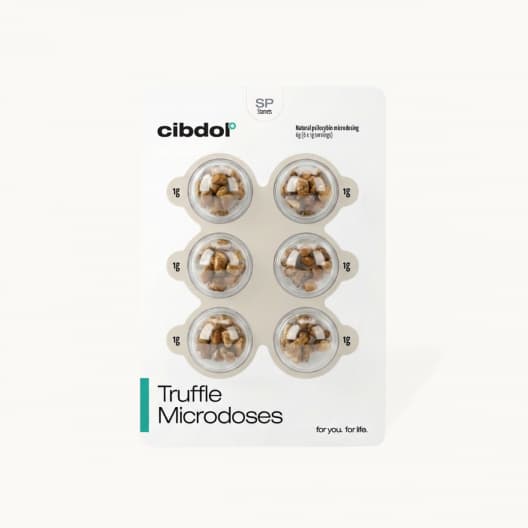

Truffle Microdoses (SP)
Cibdol Truffle Microdoses (SP), carefully prepared microdosing truffles suited for the Stamets Protocol. Made with Psilocybe galindoi truffles, each pack contains 6 × 1g portions to support clarity, cognitive growth, and mental flexibility. Designed for those following a more active, neuroplasticity-focused microdosing routine.
- • For mental flexibility and cognitive freedom
- • Up to 1.3 mg psilocybin per dose (6×)
- • Up to 2.6 mg active tryptamines per dose
Disclosure: We may earn a commission if you purchase via these links.
Frequently Asked Questions
Does microdosing help with depression?
Self-report data and observational studies consistently show that microdosers report improvements in mood and reduced depressive symptoms. However, the only rigorous placebo-controlled study (Szigeti 2021) found that placebo accounted for a significant portion of the benefit. Something real is likely happening, but the evidence is not yet strong enough to call microdosing a treatment for clinical depression.
Can microdosing replace antidepressants?
No. Microdosing has not been clinically validated as a treatment for major depressive disorder. It should not be used as a replacement for prescribed medication. If you're considering changes to your treatment, discuss this with your doctor first. Never stop SSRIs to microdose.
Is microdosing good for anxiety?
The picture is mixed. Many microdosers report reduced anxiety over time. However, some people — particularly those with generalised anxiety disorder — experience increased anxiety in the first 1–2 weeks. Psilocybin can amplify existing emotional states, and this cuts both ways.
How long does it take for microdosing to affect mood?
Some people report subtle mood improvements within the first week. For a reliable assessment, commit to at least 4–6 weeks of consistent dosing with daily tracking. The effects are cumulative and subtle — not a single dramatic shift.
What's the difference between microdosing and psilocybin therapy?
Microdosing (0.5–1.5g truffle) is sub-perceptual and self-directed. Psilocybin therapy (25mg, clinical setting) is a full psychedelic experience supervised by trained therapists. The therapy model has much stronger evidence for depression. They are fundamentally different interventions.
Should I microdose or try CBD for anxiety?
They address anxiety through entirely different mechanisms. CBD modulates the endocannabinoid system and has some evidence for generalised anxiety. Psilocybin microdosing works on serotonin receptors. Some people use both at different times. See our CBD for Anxiety guide for the cannabinoid perspective.
Further Reading
- Microdosing Psilocybin: The Complete Beginner's Guide — full overview
- The Fadiman Protocol vs Stamets Protocol — compare schedules
- Microdosing and Creativity — evidence for cognitive enhancement
- Microdosing LSD vs Psilocybin — substance comparison
- CBD for Anxiety: What Does the Research Say? — cross-cluster link
- Magic Truffles Explained — understand the legal psilocybin product
This article is for informational purposes only and is not intended as medical advice. Microdosing is not a substitute for professional mental health treatment. Always consult a healthcare professional before starting any new protocol, especially if you take prescription medication.
Last updated: March 2026
Written by the Smart Supplements editorial team
Related topics
Where to buy
Affiliate linksMicrodosing Truffles
Cibdol microdosing truffle kits: FP (Fadiman), SP (Stamets), and OP (One-day-on/off). Lab-tested, 6×1g servings per pack. Choose by protocol and goal — inner calm, mental flexibility, or daily sharpness.
Microdosing XP Truffles
Pre-portioned psilocybin truffle strips designed specifically for microdosing — consistent dosing without a scale.
- • Pre-portioned for accurate microdosing
- • No scale needed — ready to use
- • Consistent psilocybin content per portion
Magic Truffles
Legal psilocybin truffles (sclerotia) available over the counter in the Netherlands. Multiple strains from mild to strong.
Mushroom Grow Kits
All-in-one psilocybin mushroom grow kits — just add water. Multiple strains available for home cultivation in the Netherlands.
Disclosure: We may earn a commission if you purchase via these links.
Related articles
Microdosing for ADHD: What the Research Actually Shows
Microdosing for ADHD: what the 2025 clinical trial found, why anecdotal reports differ from evidence, and a responsible framework if you want to try it alo
Microdosing Side Effects: What to Watch Out For
Microdosing side effects: what to watch for, why they happen, and how to manage or avoid them. Honest guide covering anxiety, tolerance, the integration da
Microdosing Journal: How to Track Your Experience
Microdosing journal: what to track, how to track it, and a structured template to measure your microdosing results objectively over 30 days.